


Some energy relief by 2027, end to crisis by 2030
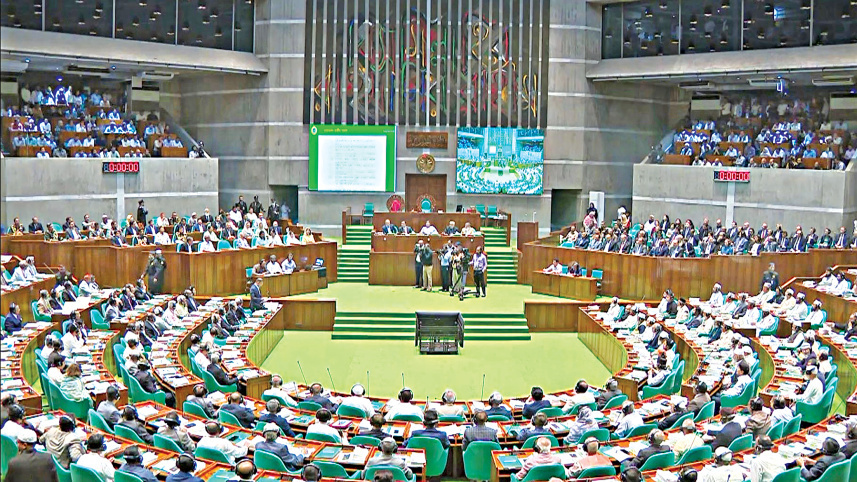
State Minister for Energy Aninda Islam Amit yesterday told parliament that the government has adopted short-, medium- and long-term plans to address the energy and electricity crisis.
“Since assuming office, the government has been taking realistic measures to overcome the situation. The government’s target is to achieve some relief by 2027, greater relief by 2028, and to create a situation free from energy crisis by 2030,” he said.

He attributed the current crisis to policy mistakes, corruption and mismanagement under the previous Awami League government.
Treasury bench members also blamed the previous government for what they described as the “short-sightedness, corruption and protection of partisan business interests” behind the crisis.
Opposition lawmakers agreed that the previous government had created the roots of the problem but said the incumbent had compounded it through “mismanagement, indecision, and above all, the government’s incompetent leadership”.
They made the remarks during a Jatiya Sangsad debate on a motion brought by Leader of the Opposition Shafiqur Rahman, who proposed forming a taskforce or cell to tackle the crisis.
“Such a body should not be a short-term measure but a permanent mechanism to ensure coordinated action. If both the government and the opposition could move forward together through this platform, public confidence would be restored,” Shafiqur said.
Acknowledging that the government had inherited the problem, he said the current crisis was far more severe than previous energy shortages and had created widespread anxiety.
Aninda urged the opposition to formally submit their proposals to his ministry.
Jamaat MP Muhammad Nazibur Rahman said those responsible for tackling the crisis had failed to offer hope, instead suggesting that “counting the days” was the only option while shifting blame onto the opposition.
“The root causes of the crisis are corruption, mismanagement, indecision, and above all, incompetent leadership of the government,” he said.
He proposed increasing domestic gas production, ensuring regular fuel supplies, providing financial guarantees for coal-fired power plants, maintaining a three-month fuel reserve, fully utilising existing infrastructure and implementing medium- and long-term plans.
He also called for an expert taskforce to explore using domestic coal instead of importing it, and prioritising gas supplies to power plants, fertiliser production, export-oriented industries and other essential sectors.
In the long term, he proposed a balanced mix of domestic gas, coal, renewables and nuclear power, backed by a smart, disaster-resilient and cyber-secure grid. He also suggested an “open access” system allowing factories to buy electricity directly from producers.
Home Minister Salahuddin Ahmed blamed the previous government’s energy policy and the fallout from the Middle East conflict for the crisis.
“No sooner as the new government took charge, the US-Israel war on Iran broke out, and immediately afterward this fuel crisis emerged,” he said.
“During the previous government, many power plants were built. The Awami miscreants nurtured foreign dependence by establishing single source gas-based power plants. This was done to benefit their party tycoons.”
He said no exploration had been carried out in onshore or offshore fields under the previous government and that the present government had initiated drilling under Prime Minister Tarique Rahman’s directive.
On capacity charges, Salahuddin said, “This fascist legacy was left behind by Sheikh Hasina, and we inherited it. But now, for electricity needs, the prime minister has approved three rental power companies. On what basis? No capacity charge! No power, no money! That is our patriotism.”
State Minister for Planning Zonayed Abdur Rahim Saki said the previous government’s “energy policy was adopted for the benefit of a few favoured individuals”, resulting in an import-dependent energy policy and special benefits for certain individuals in LNG imports.
 For all latest news, follow The Daily Star's Google News channel.
 Aninda said Barapukuria has surplus coal, but transporting it elsewhere is currently too costly. If environmentally sustainable coal production in the north increases, the government plans to build rail infrastructure to transport it to other regions.
Offshore gas exploration has begun through a bidding round, while 150 gas wells are planned, with work underway on 30. The wells are expected to add 2,320 million cubic feet of gas to the national grid by 2031, he said.
The Middle East crisis forced the government to buy LNG from the spot market at high prices, resulting in additional expenditure of about Tk 15,350 crore, Aninda said.
On meter rent, he said, “If we could waive meter rent, we would have been glad. But after extensive review, we found that waiving meter rent would require Tk 29,000 crore. Therefore, we are analysing how meter rent can gradually be reduced over time.”
Comments