Bihar wants Delhi to not renew Ganges treaty. What does it mean for Dhaka?

As the 1996 Ganges Water Sharing Treaty counts down to its 12 December expiry, perhaps the most consequential new voice in its renegotiation has come not from Dhaka or New Delhi but from Bihar.
Sanjay Kumar Jha — the Janata Dal (United)’s national working president, a Rajya Sabha MP, and Bihar’s water resources minister between 2021 and 2024 — has long been arguing that the treaty should not be renewed but simply be allowed to lapse.
What has changed lately is that the argument no longer lives only in newspaper columns or parliamentary interventions.
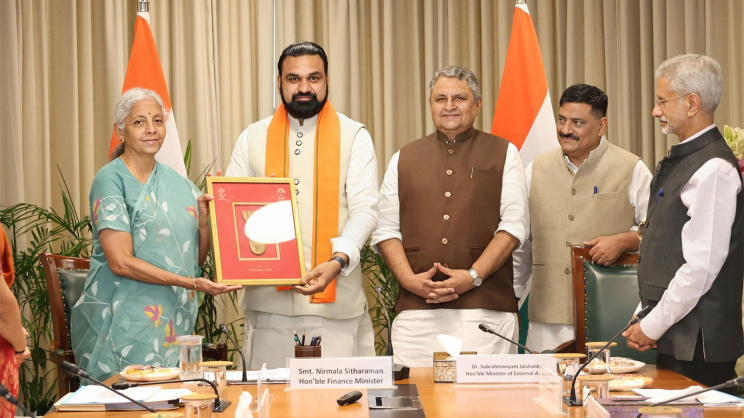
On August 21, Jha sat across from Union Finance Minister Nirmala Sitharaman and External Affairs Minister S Jaishankar in New Delhi, alongside Bihar Chief Minister Samrat Choudhary and Deputy Chief Minister Vijay Kumar Choudhary, pressing Bihar’s case directly into the Centre’s negotiating calculus.
The Centre has now gone further than a private meeting. In a recent letter to Jha, Jaishankar formally assured him that Bihar’s water requirements will be considered before any decision is taken on renewing the treaty.
The letter states that the Union government fully understands the concerns raised and will take an appropriate decision after examining all relevant factors.
It follows Jha’s special mention in the Rajya Sabha on 6 August, when he sought protection of Bihar’s water interests in any future arrangement with Bangladesh.
Jaishankar noted that inter-ministerial consultations under the Ministry of Jal Shakti had already included an authorised representative of the Bihar government on August 22, 2023, October 30, 2023, March 15, 2024 and May 31, 2024, and that Bihar’s drinking-water and industrial requirements would be duly considered.
Whatever India ultimately decides about Farakka, the sequence of the meeting and the subsequent written assurance confirms something the looser framing of this dispute has understated: Bihar has moved from complaint to counterparty whose concerns the Centre now publicly acknowledges it must weigh.
It is worth being precise about what Bihar is objecting to, because the crudest version of its argument — that Bangladesh is simply taking water that belongs to Bihar — does not survive contact with the treaty’s text.
The 1996 agreement binds India and Bangladesh; Bihar was never a signatory and has no allocation under it, positive or negative.
What Jha and Bihar’s government are actually arguing is narrower, and in its way more serious: that a river flowing through Bihar is being managed to satisfy an international commitment fixed at Farakka, well downstream, without the state that absorbs much of the river’s variability having any binding say in how that commitment is met.
Jha’s most-repeated figure illustrates the point. He has said the treaty’s operation requires close to 1,500 cusecs of assured flow at Farakka during the lean season, while barely 400 cusecs actually enters Bihar from Uttar Pradesh at Buxar — a gap he has rounded into a claim that roughly 73 percent of the water Bihar needs ends up crossing into Bangladesh.
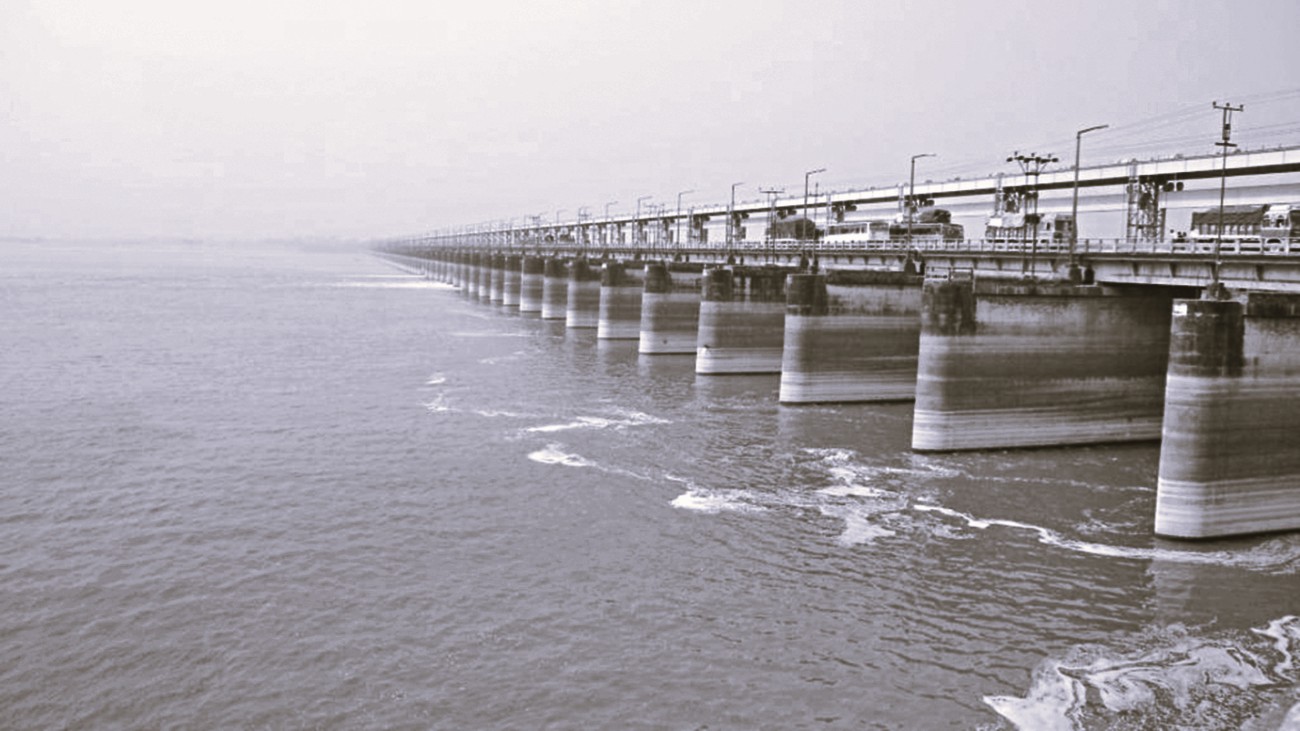
That comparison is not new. Nitish Kumar made an almost identical case as far back as 2016, noting that Bihar’s own rivers supply around three-quarters of the Ganga’s lean-season flow even though barely 400 cusecs reaches the state at its western border, and calling on the Centre to guarantee uninterrupted flow from the upper co-basin states.
What has changed since then is not the arithmetic but its vehicle: a technical grievance about interstate river management has been picked up by a national party office-bearer and pointed, for the first time, at an actual international treaty on the eve of its expiry.
Jha has paired the figure with concrete asks — protection of Bihar’s needs for industry, irrigation, agriculture and drinking water, and consideration of the state’s projected population in 2050 — rather than only a complaint.
He has also pressed for swift implementation of the National Silt Policy to address desilting, though whether dredging can meaningfully reverse three decades of sediment accumulation remains an open technical question.
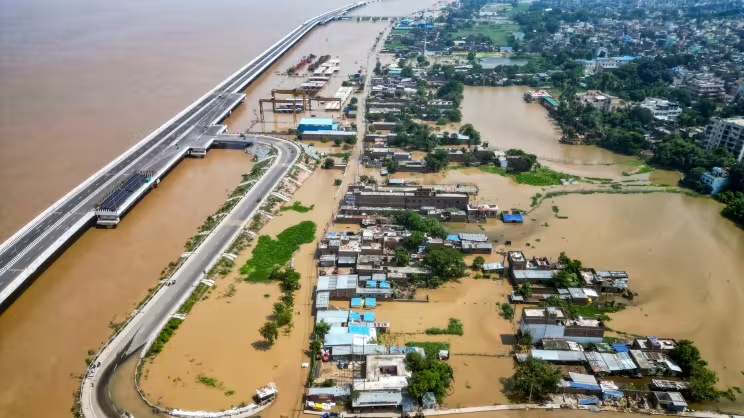
The siltation-and-flooding half of Bihar’s case deserves the same care.
State leaders, Jha included, argue that maintaining assured flow at Farakka has raised the riverbed upstream and worsened monsoon flooding around Bhagalpur and Munger, producing the paradox of a state inundated in July and short of water by April.
Uttam Kumar Sinha of the Manohar Parrikar Institute for Defence Studies and Analyses said the concern merits a scientific assessment, adding that this holds for Jharkhand and other Ganga basin states too — a reminder that Bihar, though the loudest, is not the only claimant.
But the causal chain from Farakka to Bihar’s floods is genuinely contested: sediment load, river morphology, embankments, land-use change and extreme rainfall all shape flooding along an alluvial river as dynamic as the Ganga, and treating Farakka as the primary explanation risks overstating a case that is, in its more defensible form, really about the absence of any mechanism to examine Bihar’s claim rather than proof that the claim is correct.
Notably, the demand also draws rare cross-party agreement inside the state: RJD’s Buxar MP Sudhakar Singh, from the principal opposition, has separately cited Bihar Water Resources Department figures showing lean-season shortfalls against planning benchmarks of 330, 487 and 191 cusecs for February, March and April, and has pressed for the same broader basket — flood control, anti-erosion work, and year-round navigability of National Waterway-1.
That absence of a mechanism is the structural story beneath the political noise.
Water is a state subject under India’s constitution; foreign affairs is a Union one. Bihar’s inputs have travelled only through inter-ministerial consultations under the Ministry of Jal Shakti — the rounds Jaishankar has now publicly listed — that remain advisory and leave no binding record of what the state asked for.
India’s own Parliamentary Standing Committee on External Affairs has recommended that any successor arrangement draw on updated hydrological data and consult Bihar and West Bengal directly, itself an acknowledgment that the existing channel is inadequate.
There is a pointed irony that Bihar’s campaign inadvertently exposes: New Delhi has for decades cited this very federal division — water as a state matter beyond the Centre’s unilateral reach — to help justify staying outside the 1997 UN Watercourses Convention, which India abstained on rather than supported.
Bangladesh, by contrast, acceded to that convention last year, becoming the first South Asian state to do so and gaining a fresh, if largely symbolic, legal register of “equitable and reasonable utilisation” to invoke in future disputes.
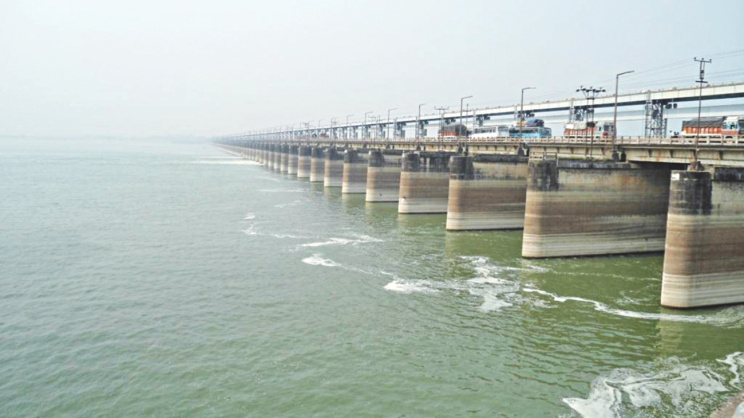
The reasoning New Delhi has long used internationally to resist multilateral water obligations is now the reasoning a state government is using domestically to demand a seat the Centre has never institutionalised — and which Jaishankar’s letter now at least formally recognises must be weighed.
What sharpens all of this considerably is a shift in the domestic map that most commentary on Bihar’s intervention has not registered.
Bihar’s own government changed hands mid-year: Nitish Kumar, having led the National Democratic Alliance to a near-total majority in the November assembly election — the NDA topped 200 of the state’s 243 seats, with the JD(U) alone winning around 85 — resigned as chief minister in April and moved to the Rajya Sabha, handing the post to the BJP’s Samrat Choudhary, the state’s first-ever BJP chief minister.
A month later, West Bengal underwent a larger rupture still: the BJP swept to power in the May assembly election with 207 of 294 seats, ending fifteen years of Trinamool Congress rule, and Suvendu Adhikari — once one of Mamata Banerjee’s closest lieutenants — was sworn in as the state’s first BJP chief minister after defeating her personally in Bhabanipur.
West Bengal’s own list of demands for the renewed treaty — protecting dry-season flow through Farakka into the Hooghly for the navigability of Kolkata’s port, addressing erosion in Malda, Murshidabad and Nadia, and flagging groundwater and arsenic risk — long predates this transition.
It was pressed just as insistently, with just as little visible result, when Alapan Bandyopadhyay spoke for Mamata Banerjee’s government in 2024 and complained that the state’s own technical representative had not been given a real hearing.
What is new is that the state carrying Jha’s argument and the state carrying West Bengal’s are, for the first time in the 50-year history of the Farakka Barrage, both governed by the party that also runs the Union government.
Whether that produces a more coordinated Indian position at the table, or simply relocates what used to be open Centre-state friction into the BJP’s own internal channels, may be the single most consequential and least remarked-upon fact about this renegotiation.
Jaishankar’s written assurance to a JD(U) leader sits squarely inside that newly aligned landscape.
Bangladesh’s side of the table carries an almost identical structure of domestic pressure, running the other way.
The ruling Bangladesh Nationalist Party, marking what it calls Historic Farakka Day in May, had its then secretary-general and cabinet minister, Mirza Fakhrul Islam Alamgir, now the country’s president, tell an audience in Dhaka that the future of relations with India depends substantially on how the treaty is renewed.
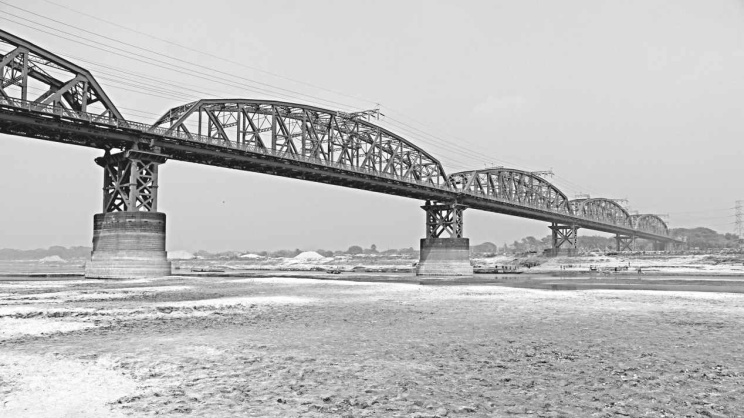
He added that Bangladesh wants an agreement of indefinite duration rather than another fixed term. That position stands in direct contrast to Jha’s call for the current treaty to be allowed to lapse.
Bangladesh’s foreign minister, Khalilur Rahman, told NDTV in April that a revised, fairness- and climate-based Ganges agreement would be “the first test” of rebuilding ties strained since Sheikh Hasina’s ouster in 2024.
Also, he recently said that Bangladesh has formed a team to review issues related to the treaty and has informed Indian authorities accordingly. Bangladesh now awaits India’s response.
Dhaka has hedged with infrastructure of its own: the Tarique Rahman government’s approval of the $2.8 billion Padma Barrage at Rajbari, some 180 kilometres downstream of Farakka, intended to impound close to 2.9 billion cubic metres of monsoon water for release during the dry season across roughly 2.88 million hectares of the drought-prone southwest.
But there is a strategic paradox here. By investing heavily in a downstream mechanism to store and redistribute water, Bangladesh gains some protection against seasonal scarcity but also risks signalling that it can adapt to inadequate upstream flows rather than secure greater releases from India.
It also ties years of fiscal and political capital to infrastructure whose effectiveness ultimately remains partly dependent on a variable Dhaka cannot control: how much water India releases at Farakka.
This produces an irony sharper than the one usually described.
Bangladesh has argued for half a century that Farakka deprives it of water. Bihar now argues that the same barrage leaves it flooded in the monsoon and short of water in the dry season.
And Indian technical commentaries on the Padma Barrage have begun warning of upstream backwater and sediment‑trapping effects, urging joint hydrological and sediment modelling before the structure proceeds unchecked — echoing the same siltation‑and‑flooding logic Bihar has long directed at Farakka, now turned by analysts onto Bangladesh’s downstream project.
Every party in this basin, in other words, distrusts the barrage immediately below it while demanding assured, unencumbered flow from whoever sits immediately above.
That is a more accurate description of the basin’s politics than any simple upstream-versus-downstream binary, and it is one reason a purely bilateral renegotiation between Delhi and Dhaka was probably never going to be adequate to the problem either side actually faces.
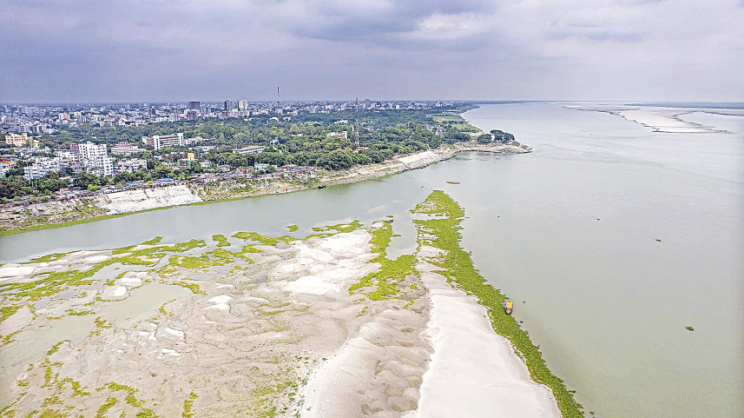
The timing of all this coincides, almost too neatly, with a live demonstration of how India is prepared to treat an older water treaty under strain.
On August 31, the Permanent Court of Arbitration in The Hague ruled that India’s April 2025 suspension of the Indus Waters Treaty with Pakistan has no legal effect and that the six-decade-old agreement remains fully binding, ordering India to limit construction at the Ratle hydroelectric project.
India rejected the ruling outright, its Ministry of External Affairs calling the tribunal “illegally constituted” and insisting the treaty remains in abeyance regardless of what The Hague decides.
The analogy should be drawn carefully rather than assumed: there is no security trigger with Bangladesh remotely comparable to the Pahalgam attack that preceded India’s suspension of the Indus treaty, and the Ganga treaty, unlike the Indus system, has no third-party arbitration mechanism that Bangladesh could invoke even if it wished to.
What the parallel more plausibly signals is a general shift in New Delhi’s disposition — a growing willingness, at least rhetorically, to treat legacy river treaties as instruments open to revision rather than settled inheritances — and it is precisely that register Jha and Bihar’s government have been borrowing when they argue the treaty should not simply continue by default.
None of this guarantees any particular outcome by December. India could renew the 1996 formula largely intact, negotiate a revised one that folds in updated flow data and a sediment protocol, or allow it to lapse and start again from consultations that have already run for three years without resolution.
Jaishankar’s letter makes clear that Bihar’s requirements form part of the “relevant factors” the Centre says it will examine; it does not commit to any specific outcome.
What Bihar’s intervention has done, regardless of which path is chosen, is turn what looked like a bilateral renegotiation between two capitals into a three-cornered one.
One corner is an upstream Indian state that has now extracted a formal written assurance it was never given in 1996; a second is an upstream state now aligned for the first time with both Bihar and the Centre under a single ruling party; and the third is a downstream country that has staked its own government’s credibility, and a multi-billion-dollar barrage, on guarantees it has no means of compelling New Delhi to provide.
The decision India reaches by December 12 will be read in Dhaka as a verdict on the relationship.
It should be read, with equal seriousness, as a verdict on whether an international river commitment can survive intact when the domestic politics on one side of the border have become as contested, and as newly aligned, as the diplomacy across it.
The same tension, in a different form, has long defined the stalled Teesta agreement.
Jannatul Naym Pieal is a Dhaka-based writer, researcher and journalist. He can be reached at jn.pieal@gmail.com.
Send your articles for Slow Reads to slowreads@thedailystar.net. Check out our submission guidelines for details.
Bangladesh and the United States: Beyond the tariff bargain

From the Carter Doctrine to the Mecca Pact: A changing Gulf security order

More capability, less autonomy? Bangladesh’s emerging security dilemma

An anti-West network is emerging: How should Bangladesh respond?

The Mecca Pact: Deterrence, Israel, and the new Gulf security equation
What Nepal’s flood devastation means for Bangladesh, India and China
Five reasons why Bangladesh shouldn’t join the Mecca Pact
Why Gaza peace deals keep falling apart
Rohingya genocide: Will the ICJ verdict bring justice?