


What does success mean if it cannot care for a mother?

On Eid morning, my father is usually the first voice I hear. That has been our ritual for years. I tend to wake up late, so he starts calling.
This year, I woke up before anyone called me. But there was a knock on my door.

My nephew stood outside, worried.
"Uncle, please come fast. Your mother is sick."
I ran to my mother. She had been vomiting. She looked weak and drained. She said she had been suffering from severe diarrhoea since midnight.
I held her, helped her lie down, gave her oral saline and tried to sound more certain than I felt.
A little later, she asked me to take her to the washroom again. I helped her stand.
She looked at me and said, "Babu" -- that is what she calls me -- "I am dying. Everything is going dark. Let me sit."
That kind of sentence empties a room.
I helped her sit on a chair. Moments later, she vomited on herself and on me. Severely dehydrated and exhausted, she lost consciousness in my arms.
I called her name. She did not respond.
Panicked, I shouted for everyone to come. The household rushed in. We put her back on the bed. She regained consciousness. We gave her more saline, called a doctor and slowly she recovered.
I do not tell this story because it is unusual. I tell it because it is painfully ordinary.
When an elderly mother becomes weak, someone should hear. Someone should run. Someone should hold her. Someone should mix the saline. A household must wake up before silence becomes irreversible.
That is why the death of Nurjahan Begum is so difficult to read.
According to Prothom Alo, police recovered the decomposed body of 75-year-old Nurjahan from a house in Mirpur-11 after neighbours called 999 because of a foul smell. Her body had become infested with insects.
Agamir Somoy, quoting police, reported that she may have died seven to eight days before she was found. It said her daughter called a nurse after receiving no response from her mother. The nurse entered the room and found her dead.
We still do not know how Nurjahan died. The investigation and post-mortem must answer that. No one should be judged before the facts are established.
But do we need a post-mortem to ask this: who opened her door while she was alive?
That question is not about whether children must always live with their parents. Many do not. Many cannot.
 For all latest news, follow The Daily Star's Google News channel.
 I do not live at home because of my profession. My siblings do not either. We had gone home for Eid.
Modern life has scattered families across cities and countries.
But distance is not absence.
We call. We check. We return when we can.
Care is not measured by who shares a roof. It is measured by whether someone is paying enough attention to notice danger before tragedy.
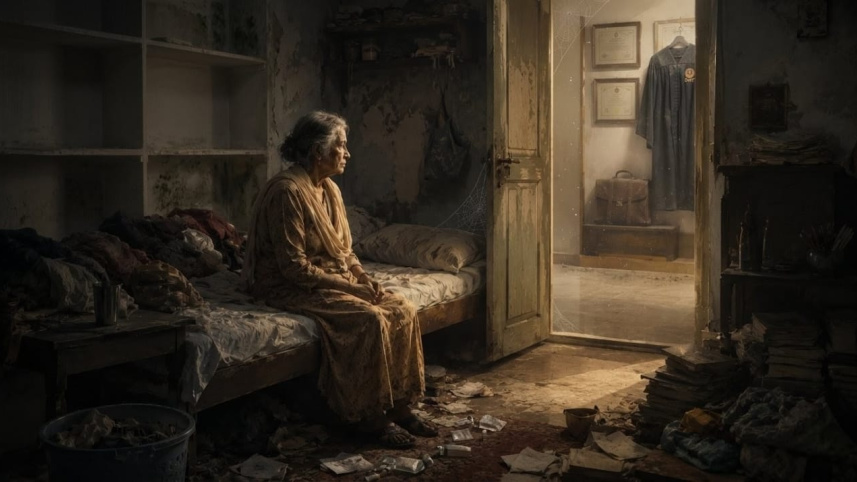
Police said Nurjahan lived alone in her daughter's house, in a room filled with dirt and fungus. Reports said one of her sons is a joint secretary, another teaches at Buet, and her son-in-law is a university teacher.
These details hurt, not because children with power or education carry a greater moral duty.
They hurt because we worship a narrow idea of success: rank, titles, prestige and the polished furniture of respectability.
Yet behind that surface, a mother's room sits dirty, silent and unseen.
Suddenly, our idea of success feels hollow.
We speak about mothers with great sentiment in Bangladesh. We praise them, quote them, post about them and invoke heaven beneath their feet.
But old age is not sustained by reverence.
It is sustained by clean sheets, food, medicine, water, patience and the discipline of checking whether the person in the next room is all right.
On Eid morning, my mother survived because someone was there when her world darkened.
Nurjahan Begum was found only after death crossed a door that care apparently did not.
A title, a degree or a government post means little if it cannot reach the room where an elderly mother is waiting.
The investigation may tell us how Nurjahan died.
But her story asks a deeper question: how was she living before death arrived?
We must look at our elderly today.
We cannot claim heaven lies beneath a mother's feet if we cannot step into the next room to see whether she is still breathing.
That is where all our titles, degrees and public respectability face their real test:
What does success mean if it cannot care for a mother?
Arafat Rahaman is a journalist at The Daily Star. He can be reached at arafat.mcj@yahoo.com
Comments