


Giving Grace Foundation begins formal journey in institutional zakat management
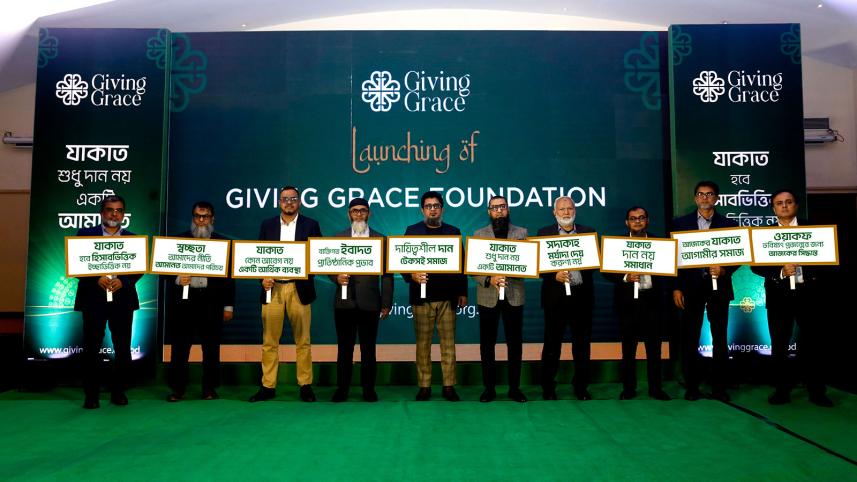
Giving Grace Foundation (GGF) has formally begun its journey with the aim of transforming Islamic social finance into an effective and sustainable development tool through an institutional management framework.
The foundation seeks to reduce poverty through the structured use of zakat, sadaqah, waqf and qard hasanah. Its inauguration ceremony was held in Dhaka on January 10 and was attended by Islamic scholars, economists, development practitioners, corporate leaders, professionals and representatives of civil society.

Members of the Trustee Board and Advisory Board of Giving Grace Foundation present at the ceremony included Sheikh Md Shafiqul Islam, Muhammad Rashid Al Majid Khan Siddiqui Mamun, Murtoza Zaman, Muhammad Junayadul Munir, Arif Bin Idrish, Kamruz Zaman, Md Zulfiker Ali Siddique, Asif Saad Bin Shams, Syed Sadique Reza, Reza Ahmed and Arifur Rahman.
At the event, the foundation’s vision, mission and operational framework were presented. A panel discussion titled How to Advance the Zakat Movement in Bangladesh focused on the need for transparent, structured and impactful zakat management. The discussion featured Dr Omar Faruq, Dr Abul Kalam Azad and Shah Mohammad Wali Ullah.
Speakers said the estimated annual potential of zakat in Bangladesh is around Tk 1 lakh crore, but only a small portion is currently managed through institutional channels. They noted that planned and accountable zakat management could play a key role in poverty alleviation, healthcare, education, livelihood development and social protection.
The keynote address was delivered by Dr Mohammad Ayub Miah, chairman of Sammilito Islami Bank. He said institutional zakat could create a sustainable and dignified pathway for poverty reduction.
The event also marked the official launch of the Giving Grace Foundation website, www.givinggrace.org.bd
. The foundation outlined its key programmes, including healthcare, education, livelihood development, humanitarian assistance and income-generating initiatives. Its data-driven and Shariah-compliant beneficiary selection process was also explained.
It was shared that Giving Grace Foundation has already supported 3,059 families, reaching 11,426 individuals. Its activities include 1,426 eye surgeries, primary healthcare services for 25,119 patients through four health centres, and support for 72 critically ill patients through partner hospitals. In addition, 112 families are receiving monthly food assistance and 411 students are being supported through education programmes.
Speaking at the event, Sheikh Md Shafiqul Islam, chairman of Giving Grace Foundation, said:
“Zakat is not merely charity; it is a powerful instrument for establishing justice and dignity in society. Our goal is to institutionalize this trust through transparency and accountability.”
A presentation on the foundation’s Shariah Supervisory Framework was delivered by Shariah Board chairman Dr Mohammad Manzur E Elahi, a faculty member at the National University. Other board members include Dr Zubair Mohammad Ehsanul Haque, professor and chairman of the Department of Arabic at the University of Dhaka, and Mufti Maulana Saiful Islam, khatib of Taqwa Mosque in Dhanmondi. The board independently oversees all activities and financial operations to ensure Shariah compliance. Remarks on corporate zakat were delivered by Dr Mufti Yusuf Sultan, director of IFA Consultancy.
In the concluding session, the foundation outlined its future plans and reaffirmed its commitment to creating sustainable social impact based on Islamic financial principles.
Giving Grace Foundation currently operates in five districts — Lalmonirhat, Dinajpur, Sirajganj, Barishal and Patuakhali — and plans to expand its faith-based social development initiatives nationwide.
 For all latest news, follow The Daily Star's Google News channel.
Comments