


‘Arrests alone won’t stop it’: Police say as election violence flares


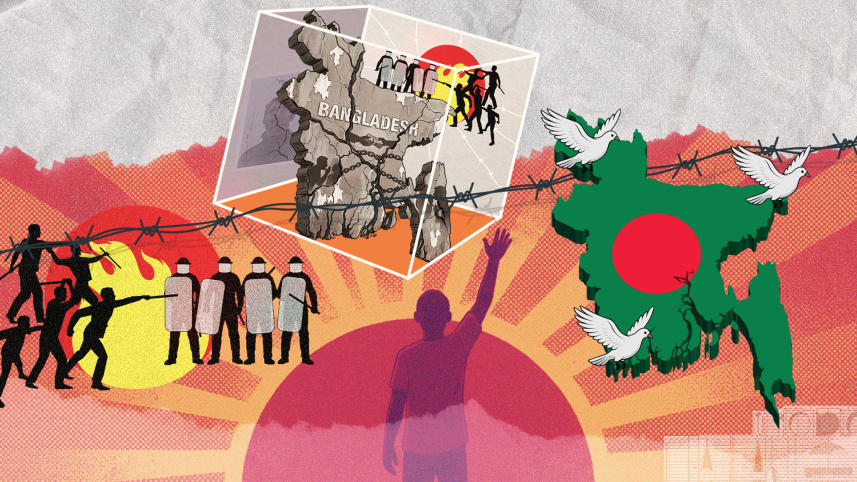
Violence has flared since campaigning began for the 13th national parliamentary election, and police say arrests and cases alone will not be enough unless rival groups show restraint.
In the eight days from the start of official campaigning until today, at least 19 incidents of clashes were reported across the country, according to media reports and data received from police.

A Jamaat upazila unit secretary was killed in clashes in Sherpur on Wednesday.

The incidents were triggered by local disputes, “offensive” comments on social media, and even arguments over seating arrangement, according to the information.
Human Rights Support Society (HRSS) in a statement said, based on information it collected from October until today (January 29, 2026), at least 981 people have been injured and five killed in 113 incidents of violence across the country linked to the upcoming 13th national parliamentary election.
HRSS believes that during the campaign period, candidates’ aggressive attitude, spreading hatred against opposition parties and other candidates, threats and intimidation, smear campaigns, falsehoods, and hostile remarks are fuelling hostility and violence among party leaders, activists, and supporters.
When asked about the ongoing violence, Khondoker Rafiqul Islam, additional inspector general (crime and operations) at Police Headquarters, told The Daily Star that election-time violence is not new and urged people not to treat it as something unusual.
“It is unfortunate,” he said, adding that Bangladesh has often failed to move beyond a culture of confrontation during elections.
Rafiqul said police, other law enforcement agencies, and returning officers are trying to bring rival sides to the table and ensure the electoral code of conduct is followed.
But he said many people do not listen to advice and act with “other agenda”.
Referring to the death of a Jamaat leader in Sherpur after a BNP-Jamaat clash, he said a manifesto-reading that should have been orderly turned into chair-throwing, clashes, and, later, a death.
Rafiqul said police tried to move the groups out in different directions, but tension continued for hours as the sides stayed close to each other.
He said cases have been filed against those responsible.
“We will keep trying so that nothing like this happens again,” he said, adding that police alone cannot stop such violence if the parties do not show restraint.
Tawohidul Haque, an associate professor at Dhaka University's Institute of Social Welfare and Research, however, said the measures taken by law enforcement agencies on the ground were “very weak”, which is why violence cannot be prevented.
He said the Election Commission is only issuing verbal warnings, with no visible steps on the ground.
Tawohidul added that political parties also bear responsibility, as public expectations of political leaders and activists after the 2024 movement have not been reflected.
“They are behaving violently as before,” he said, adding that political violence will not come down unless law enforcement agencies act firmly.
An analysis of reported incidents since January 22 shows that most clashes have taken place between the BNP-led alliance and the Jamaat-led alliance.
 For all latest news, follow The Daily Star's Google News channel.
 In recent days, election-related clashes were reported in at least seven places, including in Dhaka, Faridpur, Cumilla, Shariatpur, Sherpur, Pabna, Chattogram, and Bhola.
HRSS said several women activists faced attacks, beatings, and humiliation while campaigning in different districts, as political vendetta spilled onto the streets.
The rights group said they were also harassed and obstructed during canvassing, pressured to remove their hijab, and subjected to physical and mental abuse, and cyberbullying. Such acts undermine women’s political participation and interfere with civic and voting rights, personal freedom, and freedom of expression, it said.
A high official at Police Headquarters told The Daily Star that their analysis of recent violence found clashes were fuelled by rumours, offensive posts, and provocative information on Facebook, alongside local disputes.
“We reviewed such information and took necessary measures,” the official said.
The incidents started on December 12 last year, when Sharif Osman Bin Hadi, an independent MP aspirant from Dhaka-8 and spokesperson for Inqilab Moncho, was shot. He died while undergoing treatment in Singapore on December 18, sparking outrage and protests across the country.
Chief Adviser’s Press Secretary Shafiqul Alam, however, expressed hope that the security situation would improve.
“We hope the coming days will be much better. With the gradual deployment of security forces, the situation will further improve,” he said, responding to a question while briefing journalists at the Foreign Service Academy today.
Shafiqul said that political parties have so far shown restraint and tolerance while carrying out election campaigns.
Noting that according to police data, so far four people have been killed until today since the formal election campaign started on January 22, he said, “If you compare this with previous elections, though it is tough to reach a conclusion as two weeks are still left to the polls, you will see that 115 people were killed before elections on January 5 in 2014.”
“In that reality, we believe that there is still a sufficient level of tolerance among the political parties. They are campaigning in a good manner, and they are abiding by electoral laws and following the code of conduct,” the press secretary said.
He, however, acknowledged that “a few isolated incidents” have taken place.
Comments