


BNP’s average win margins dwarf Jamaat’s

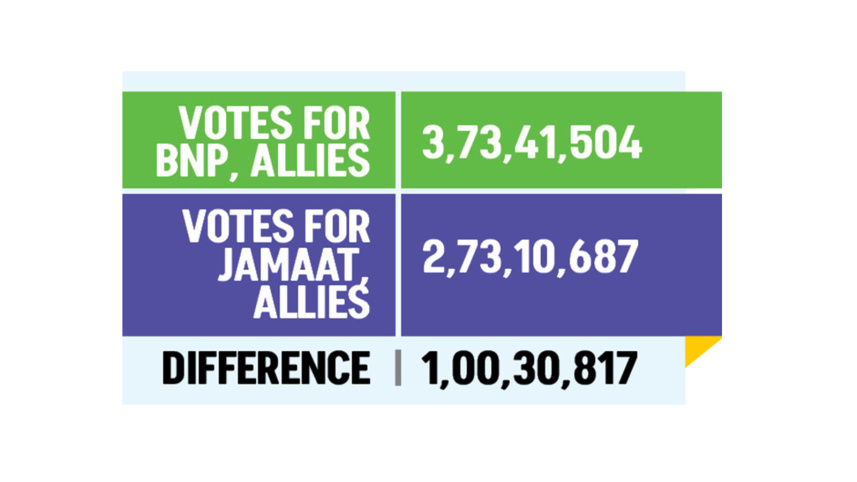
In the 13th National Parliamentary Election, the two main political alliances produced sharply different patterns in their winning margins, revealing a clear imbalance in electoral dominance.
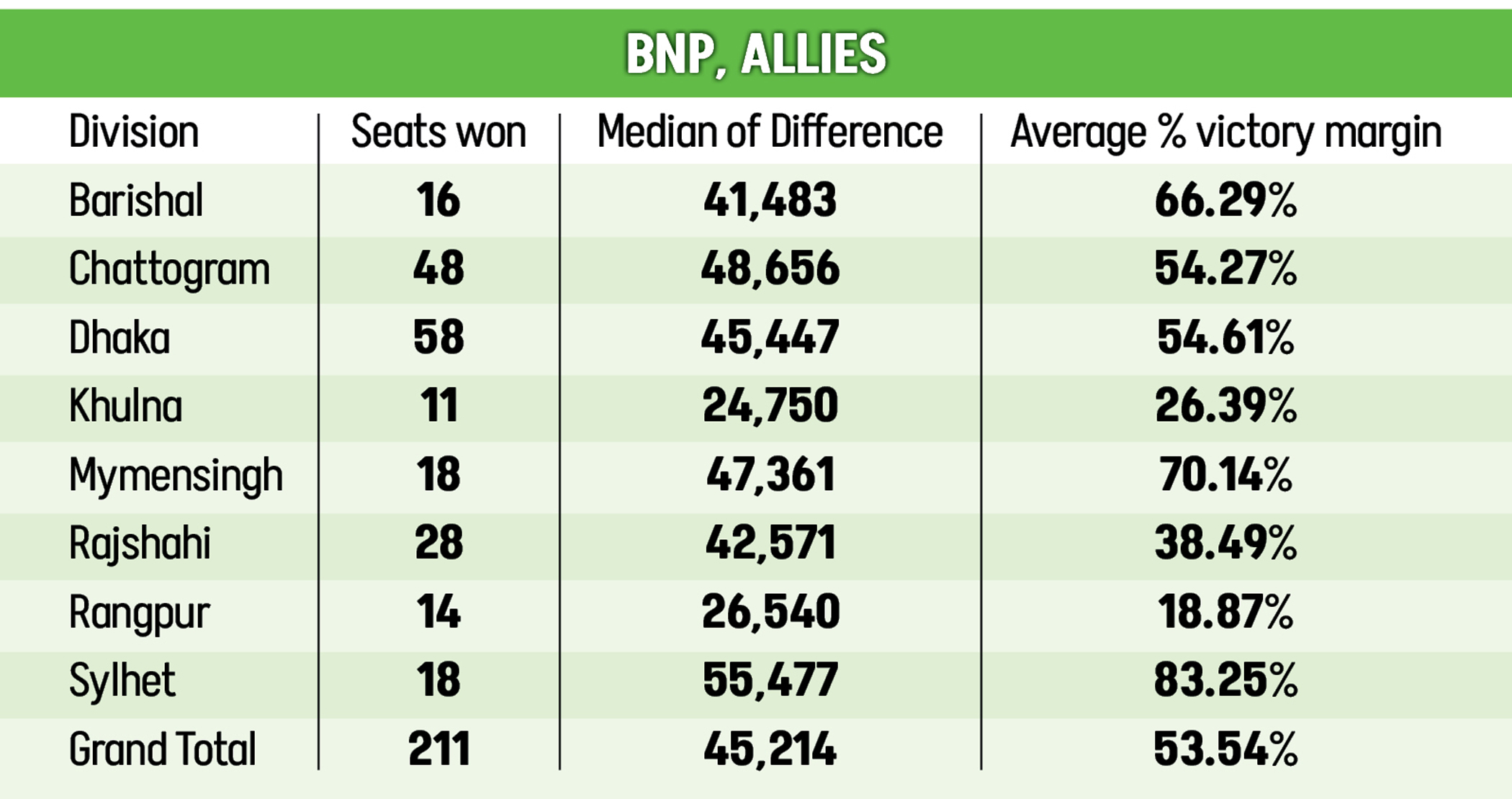
The BNP-led alliance swept to power with a commanding landslide, recording a median winning margin of 45,214 votes across the 212 seats it secured.
 For all latest news, follow The Daily Star's Google News channel.
 On average, BNP candidates won with 53.54 percent more votes than their nearest rivals, underlining the scale of its nationwide victory.
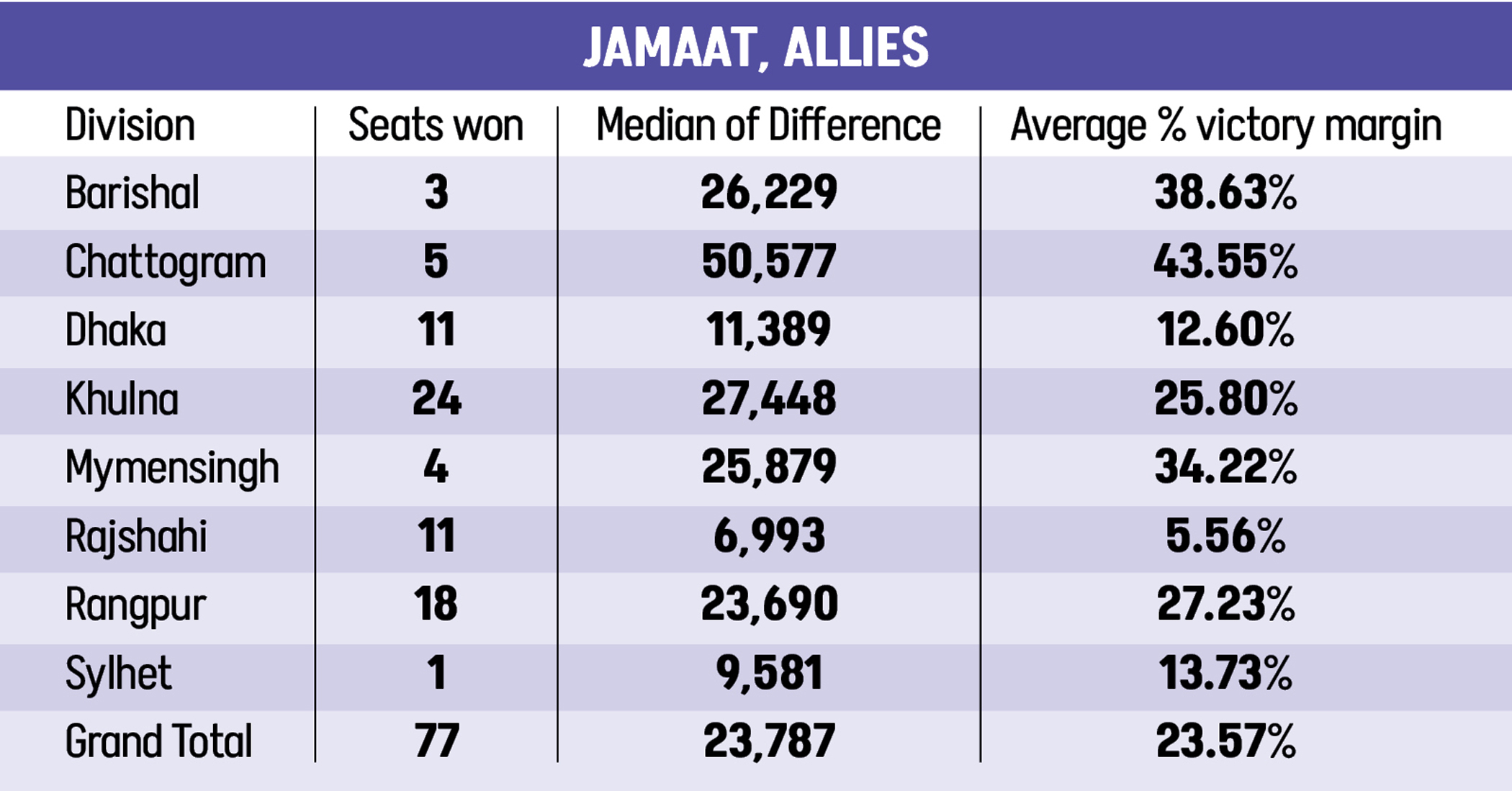
By contrast, the Jamaat-e-Islami-led 11-Party Alliance posted more modest margins. Across its 77 seats, the alliance achieved a median winning margin of 23,787 votes, with an average vote advantage of 23.57 percent over runners-up.

Several of Jamaat’s victories were narrow. The alliance won by fewer than 1,000 votes in two constituencies -- Madaripur-1 and Sirajganj-4, with margins of 384 and 594 votes respectively.
In four seats -- Rajshahi-1, Rangpur-6, Dhaka-11, Dhaka-4 and Netrokona-5 -- the winning margin for Jamaat alliance candidates ranged between 1,000 and 3,000 votes.
They won another four seats -- Bagerhat-1, Pabna-3, Dhaka-16 and Pabna-4 -- by margins between 3,000 and 5,000 votes.
Taken together, these seats recorded percentage margins of victory below 5 percent.
In nine seats, Jamaat won by margins between 5,000 and 10,000 votes, translating into percentage margins of 5 to 13 percent.
At the other end of the spectrum, the alliance won by over 50,000 votes in 14 constituencies. In four seats -- Gaibandha-1, Cumilla-4, Rangpur-3 and Satkhira-2 -- the margin exceeded 100,000 votes.
The largest gap was in Satkhira-2, where Jamaat triumphed by 150,666 votes. In these landslide seats, the average margin of victory stood at 252.15 percent.
The BNP-led alliance, despite its sweeping success, also faced close contests in several constituencies.
Its narrowest victory margin was just over 1,000 votes. It won by between 1,000 and 2,000 votes in three seats -- Chattogram-14, Brahmanbaria-5 and Cox’s Bazar-4.
In another six seats -- Dhaka-13, Khulna-5, Gaibandha-4, Dhaka-10, Dhaka-17 and Dinajpur-3 -- the margin ranged from 2,000 to 5,000 votes. Dhaka-17 was won by BNP chairperson Tarique Rahman.
The average percentage margin of victory in these close BNP wins was just 2.17 percent.
The BNP alliance won by margins of 5,000 to 10,000 votes in 18 seats.
In total, it recorded landslide victories -- margins exceeding 100,000 votes -- in 27 constituencies.
The largest margin was in Rangamati, where BNP won by 170,322 votes, followed closely by Rajbari-2 with a margin of 169,955 votes.
On average, in these big wins, BNP candidates secured over 200 percent more votes than their closest rivals.

Overall, 24 constituencies across the country saw percentage winning margins below 5 percent.
These were almost evenly split between the two camps -- 11 seats went to the BNP and 13 to the Jamaat-led alliance.
As the margin brackets widen, the gap between the two alliances becomes more pronounced.
A total of 25 seats had winning margins between 5 and 10 percent, with BNP winning 15 and Jamaat eight.
Similarly, 35 seats recorded margins between 10 and 20 percent; BNP and its allies captured 22 of these, while Jamaat and its partners secured 13.
Regionally, Jamaat faced its toughest competition in the Rajshahi division, where it won 11 seats with an average margin of just 5.56 percent.
The BNP, meanwhile, encountered its strongest resistance in Rangpur division, winning 14 seats there with an average margin of 18.87 percent.
Jamaat’s most comfortable victories came in the Chattogram division. Although it won only five seats in the region, the alliance posted an average margin of 43.55 percent -- its highest regional performance.
The BNP, on the other hand, dominated Sylhet division, achieving an overwhelming average winning margin of 83.25 percent across 18 seats, marking it as the party’s strongest regional bastion.
Comments