


Political control, market pressures hindering academic freedom in universities: Speakers
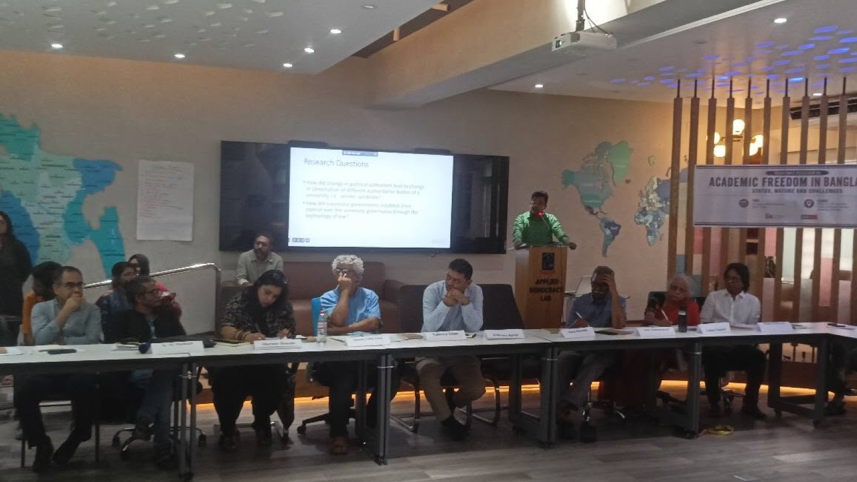
Political control and a lack of institutional autonomy have prevented Bangladesh’s universities from becoming spaces for genuine academic freedom, while market-driven reforms have shaped what they teach, research and value, speakers said at a roundtable today.
The discussion, titled “Academic Freedom in Bangladesh: Status, Nature & Challenges”, was held at the Applied Democracy Lab at Dhaka University’s Faculty of Social Sciences and organised by steering committee members of the SSA-IIE Project on Academic Freedom in South Asia.

Economist Prof Anu Muhammad said universities are being forced to become “training institutions” rather than centres of critical knowledge.
“Privatisation has been entrenched so deeply that we often see calls for dissoliving departments like Philosophy, History and Sanskrit as they do not directly serve the market,” he said.
“In the neoliberal era, the new addition is commercialisation of universities,” he said, adding that linking university activities with money and commerce contaminates their true objectives.
Anu Muhammad said the 1973 University Ordinances, which established autonomous governance for four major public universities, have gradually been eroded by state intervention.
“It seems that faculty members, students and researchers do not feel that it is our right; rather, it seems like a special facility that could be availed through special means,” said Gitiara Nasreen, professor of Mass Communication and Journalism at Dhaka University and former member of the Media Reform Commission.
Gitiara also highlighted the impact of regressive structures in student politics on academic freedom.
“When a university student has to bow down and wait on the streets just to meet political leaders, what could be more subjugating than that?” she said.
Presenting a research paper co-authored with Prof Mohammad Tanzimuddin Khan, Prof Samina Luthfa said university administrations tended to turn teachers into compliant followers during 2014–2025.
“To maintain the culture of compliance, pressure is placed on junior teachers, and those who refuse to comply may have their permanent appointments or promotions withheld,” she noted.
The roundtable also featured Fahmidul Haq of Bard College, Barrister Jyotirmoy Barua, RU professor Abdullah Al Mamun, and Barrister Sara Hossain, honorary executive director of BLAST, among others.
 For all latest news, follow The Daily Star's Google News channel.
Comments