


Economy shows signs of gradual stabilisation
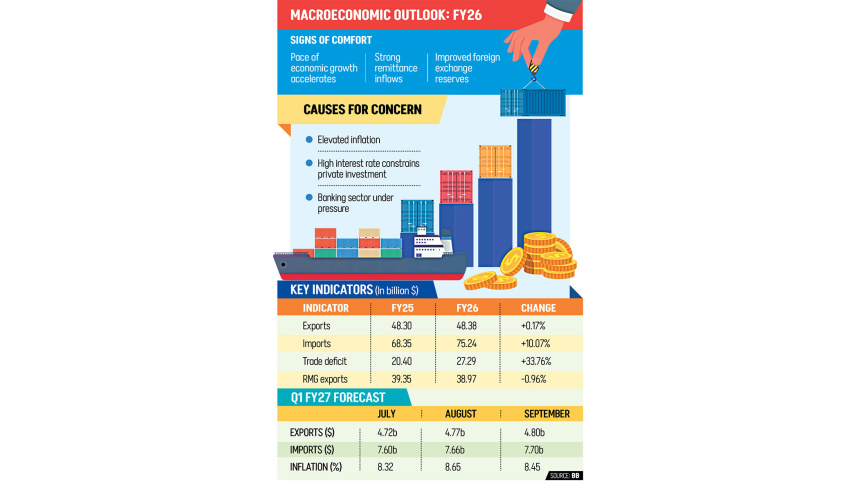
Bangladesh’s economy showed signs of gradual stabilisation during the April-June quarter of FY26, although overall economic activity remained subdued, said the Metropolitan Chamber of Commerce and Industry (MCCI) in its review.
“Inflation remained the major concern,” the MCCI said in the review released yesterday.

The leading trade body said the country’s economic growth for FY26 was provisionally estimated at 4.14 percent, up from 3.49 percent in FY25. Inflation, however, remained elevated, continuing to put pressure on household purchasing power and the cost of living.
The external sector performed relatively well, supported by strong remittance inflows and improved foreign exchange reserves.
Remittances remained robust during the quarter, while reserves strengthened significantly by the end of June, providing greater stability for the balance of payments and the foreign exchange market, the MCCI said.
Yet, there were some challenges.
“Export growth remained weak despite a rebound in June, while private investment, credit growth and domestic demand were constrained by high interest rates and economic uncertainty. The banking sector also remained under pressure, alongside fiscal constraints and elevated inflation,” it said.
“Overall, the quarter reflected a transition from macroeconomic adjustment towards gradual recovery, with improved external sector resilience being a key positive development,” said the MCCI.
The trade body said data on the sectoral performance of the economy was yet to be available.
Third-quarter (January-March) data for FY26 released by the Bangladesh Bureau of Statistics (BBS) showed that the industrial sector suffered a 0.28 percent contraction during the period as businesses remained cautious about fresh investment amid tight liquidity, elevated borrowing costs and persistent macroeconomic uncertainties.
Within the sector, the manufacturing sub-sector registered negative growth of 0.34 percent in the same period, against 1.13 percent in the previous quarter, according to the BBS.
The MCCI said merchandise export earnings rebounded strongly in June 2026, the last month of the fiscal year, rising by 25 percent year-on-year to $4.19 billion from $3.35 billion.
However, total export earnings for FY26 stood at $48.38 billion, a marginal increase of 0.17 percent from $48.30 billion in FY25, falling short of the government’s target of $55 billion by 12 percent, largely due to weak global demand, high energy costs and inflationary pressures.
The inflow of remittances in FY26 reached a record $35.59 billion, a 17 percent rise over the previous fiscal year.
The trade body, citing experts, said Bangladeshi expatriate workers sent increased amounts of money home through official channels, while the banking regulator’s steps to ease money transfers and monitor informal channels also helped.
On the investment climate, the MCCI, citing Balance of Payments data from Bangladesh Bank, said net inflows of foreign direct investment (FDI) in FY26 decreased by 15 percent year-on-year to $1.46 billion from $1.72 billion a year ago.
It said FDI inflows in Bangladesh is low compared with that in many other countries at a similar level of development, even though the low labour costs available here are generally believed to be attractive to foreign investors.
The MCCI said foreign investors hesitate to make fresh investments in the country because of underdeveloped infrastructure, a shortage of energy and weak transmission infrastructure, a lack of consistency in policy and regulatory frameworks, a scarcity of industrial land, corruption, and non-transparent and uneven application of rules and regulations.
“The government needs to address these impediments to attract more FDI to the country to ensure the country’s economic development.”
Outlook
 For all latest news, follow The Daily Star's Google News channel.
 For the current quarter, the chamber, representing large companies, said exports, imports and remittances may increase. Foreign exchange reserves may decrease between July and September due to import payments to Asian Clearing Union (ACU) member countries.
Inflation, however, is likely to go down in September of FY27 after a spike in August, it said, projecting an 8.65 percent increase in consumer prices on a point-to-point basis this month and an 8.45 percent increase in September.
“After the general election, the economy is trying to overcome the difficulties due to the present political uncertainty and conflicting world scenario. Therefore, the performance of the selected economic indicators is mixed,” it said.
Going forward, the MCCI said sustaining price stability, strengthening the financial sector, promoting private investment and exports, and maintaining external-sector stability will be critical for achieving stronger and more inclusive economic growth.
“The policy priority going forward is therefore to consolidate external sector stability while bringing inflation down and creating conditions for stronger private investment and sustainable growth.”
Comments