


Without accountability, democracy will fail, speakers tell discussion
Democracy in Bangladesh cannot survive without accountability, said speakers at a dialogue yesterday, warning that promises lose meaning when governments are not answerable to the people.
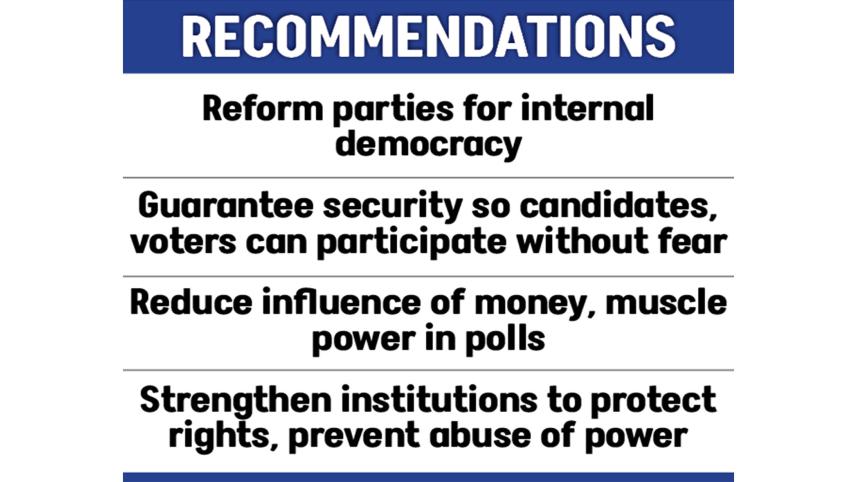
They stressed the need for internal reforms within political parties, greater transparency, and stronger engagement with civil society to improve governance.
 For all latest news, follow The Daily Star's Google News channel.
 Speakers also highlighted the importance of social protection for women and marginalised groups, addressing economic inequality, and incorporating citizens’ voices into policymaking.
The dialogue, titled “Citizen Manifesto 2026: Expectations for National Election and Democratic Transition,” was held at the Bangladesh-China Friendship Conference Centre in Agargaon. It was organised by Citizen's Platform with support from the Centre for Policy Dialogue (CPD).
BNP Standing Committee member Amir Khosru Mahmud Chowdhury stated that accountability must function both within and outside parliament.
“Without accountability, promises disappear again and again,” he said, adding that civil society is a key partner in governance and that restricting its role signals the rise of authoritarianism.
He also said parliamentary committees must function effectively to ensure oversight.
On the economy, Khosru said it should be democratised so that all citizens benefit, not just a small group.
He noted that while governments enjoy an initial “honeymoon period,” many fail because they cannot accept criticism despite rising public expectations.
Saiful Alam Khan Milan, a central executive committee member of Jamaat-e-Islami, said security during elections is a major concern.
Candidates and voters must be able to participate without fear, and political parties should ensure fair and peaceful polls, he said.
He urged political parties not to nominate individuals involved in corruption, extortion or land grabbing, and said Jamaat’s manifesto prioritises women’s rights, education, employment, housing and safety.
“All citizens, regardless of religion or minority status, should have equal access to opportunities,” he also said.
Gonoforum Acting President Subrata Chowdhury said political parties must reform internally before expecting national-level good governance. “Without internal democracy, participatory governance is impossible,” he said.
Independent candidate for Dhaka-9 Tasnim Jara highlighted the lack of social security for informal workers such as rickshaw pullers.
She also said, “Even elected representatives cannot act against their party, and institutions meant to check corruption or human rights violations are often controlled by the very people they should monitor.”
“Citizens’ rights and democratic accountability are weak. Without real mechanisms, people have no choice but to protest on the streets to demand their rights,” she added.
Nusrat Tabbasum, joint convener of the NCP, stressed youth leadership and civic responsibility, saying votes should not be treated as commodities and social protection requires collective effort.
She said meaningful reform needs patience, education and civic engagement.
AB Party Chairman Mojibur Rahman Manzu apologised for failing to deliver a new political order, saying the party had been forced to operate within the old system.
“If a political party can ensure good governance, many other problems will be solved automatically,” he said.
CPB General Secretary Abdullah Al Kafee Ratan said MPs should not hold business interests to prevent conflicts of interest.
He also said elections in Bangladesh are heavily influenced by money, limiting fair competition for smaller parties.
Manisha Chakraborty, Barishal district coordinator of Bangladesh Samajtantrik Dal, urged greater focus on social welfare and budget allocation, noting that Bangladesh has one of the lowest minimum wages and education budgets in South Asia.
“Our manifesto will push for education to receive at least 6% of GDP and health around 15% of the total budget,” she said.
Political scientist Rounaq Jahan said citizens’ opinions should guide political decisions, stressing that security must respect human rights.
Security should not mean controlling people with force, she said, adding that many parties still rely on money and muscle power, ignoring real grassroots opinions and democratic principles.
CPD distinguished fellow Devepriya Bhattacharya said national unity, citizen rights and institutional reform are essential to build an inclusive, accountable, and just Bangladesh.
“Governance must reflect the voices and needs of marginalised groups, ensure human rights, and strengthen the rule of law through independent and professional institutions,” he also said.
Comments