


Trump-Xi summit: Win, lose or draw?
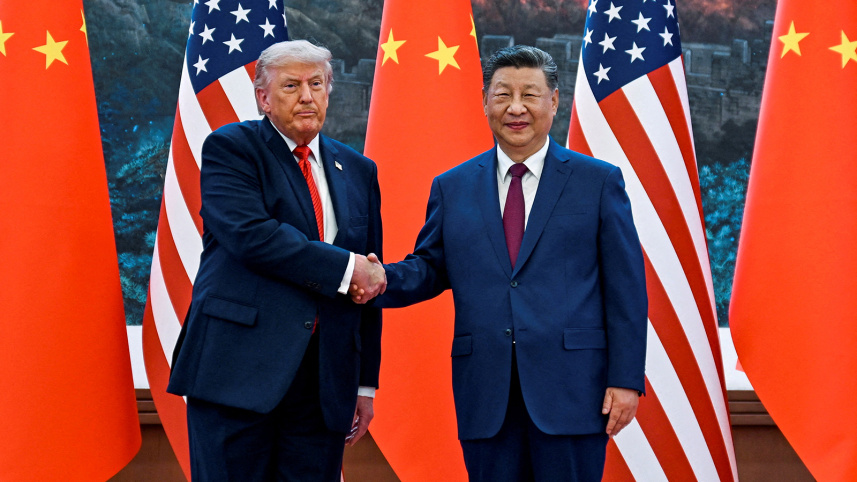
In the old imperial garden of Zhongnanhai, Chinese President Xi Jinping tried to impress US President Donald Trump with trees older than America itself.
“That thicker one over there is 400 years old," Xi told Trump on May 15 as he pointed to a tree while the two were strolling through the compound that serves as the headquarters for the Communist Party with only their interpreters.

“Look at the vitality and history on display!" Xi exclaimed, gesturing with both hands.
This exchange underscored a key message Xi had been keen to telegraph throughout Trump's visit: the two leaders stand at a moment in history and have a duty to steer their countries away from confrontation.
At the Temple of Heaven a day earlier, Xi had expressed hope that China and the US could escape the Thucydides Trap, the notion that conflict often arises between an emerging power and the incumbent.
Back among the trees in Zhongnanhai, Trump humoured his host.
“Wow, they can live that long,” he said. He then asked how often Xi had brought other foreign dignitaries to the garden—apparently keen to know how privileged the treatment was.
“Very rarely,” the Chinese leader said.
Xi may not have been briefed that Trump, though, is not especially sentimental about trees. Last year, decades-old magnolias commemorating presidents Warren Harding and Franklin D. Roosevelt were removed from the grounds of the White House to make way for his planned grand ballroom.
The episode captured the disconnect between the two leaders. While Xi thought in terms of history and the burden of great-power responsibility, Trump measured the moment by what was in it for him in the now.
Measuring victory
So who won the latest diplomatic arm wrestle between the two most powerful men on earth?
By some measures, both did.
Xi claimed to have persuaded Trump to agree on a new framework for China-US ties that aims for a “constructive and strategically stable” relationship.
As Professor Zhu Feng of Nanjing University explained to The Straits Times, strategic stability originated as a Cold War concept, when the US and the Soviet Union kept each other in check through the threat of mutually assured nuclear destruction.
By comparison, Xi's post-Cold War version of strategic stability is meant to be constructive, not destructive. It calls for cooperation as the mainstay and competition within bounds.
It also signals how Beijing wants Washington to see China: not as a junior partner, but a peer competitor, or frenemy, on par with the US.
Trump could also claim he “won” something, too. He secured what he described as Beijing’s offer to help with the Iran crisis, though what China is prepared to do remains unclear.
From another perspective though, neither “won” anything.
There was no visible shift in Washington’s position on Taiwan, despite Xi making clear that this remains Beijing’s top concern.
Trump also did not walk away with the blockbuster trade deals he might have liked.
 For all latest news, follow The Daily Star's Google News channel.
 While he said China had agreed to buy 200 Boeing planes, that number was lower than expected. No exact figures for agriculture or energy purchases have been released so far.
World peace
Seen in this light, such a win-lose binary may be too limiting a frame in understanding broader gains from the first American presidential visit to the Chinese capital in nearly a decade.
Stability itself is a gain. “The world wins,” Professor Yang Dali of the University of Chicago told ST, because any meeting that lowers the temperature between Washington and Beijing would give the rest of the world some breathing space.
Moreover, this was only the first round in what could become a year of repeated Xi-Trump encounters. Why hurry to declare a winner now when the game is still being played?
If Xi accepts Trump's invitation to visit the US in September, if Trump returns to China for Apec in November, and if Xi goes to Florida for the Group of 20 summit in December, the two men could end up having four meetings in 2026.
That may explain why there were few concrete deliverables from this summit, which looked thin. Both sides may be “rationing” the diplomatic candy so there is enough to last till Christmas.
It was always going to be unrealistic to expect a grand bargain. One hastily arranged visit was never going to resolve a structural rivalry that cuts across technology, trade and security.
Instead, it was more important to ensure the optics were right. Both sides needed to assure the world that they could get along, and that both leaders had something to take home to their domestic audiences.
Feeling exceptional
Above all, there was flattery on both sides. Trump called Xi a great leader and brought with him a bevy of chief executives, including Tesla’s Elon Musk and Nvidia’s Jensen Huang, giving Beijing the high-profile show of confidence from global businesses it wanted.
Xi, for his part, pulled out the stops, such as a welcome ceremony with goose-stepping honour guards and military pageantry of the sort Trump is known to admire.
There were more personal touches too. At the welcome ceremony, Xi appeared to linger over his handshake with Eric Trump, the president’s second son and an executive vice-president of the Trump Organisation. Beijing understands that with Trump, flattery works best when it feels personal and recognises the family orbit around him.
In another nod to the visiting president, the final song played at the state banquet was “YMCA”, a staple at Trump's rallies and the unofficial soundtrack to his campaign-trail dance.
Back in the former imperial garden in Zhongnanhai, Trump, famously alert to flattery, seemed pleased to learn from Xi that few foreign leaders had been shown the grounds of the exclusive compound where China’s leaders work and where Mao Zedong lived for 27 years.
What he may not know is that Xi had also hosted Vladimir Putin for tea in the same compound in May 2024. At the end of that visit, state television footage showed Xi opening his arms to embrace the Russian leader – the sort of “big, fat hug” Trump had said before the trip that he expected from Xi but never ended up receiving this time.
Putin is now reportedly due in Beijing within days of Trump's departure. The choreography is telling. Beijing wants to court Washington without loosening its embrace of Moscow. It wants to present itself as the indispensable power that can speak to all sides on its own terms.
In great-power diplomacy, everyone wants to believe he is exceptional, but the old trees in Zhongnanhai have seen enough to know better.
Comments