


Scientists witness supernova’s early stages for the first time
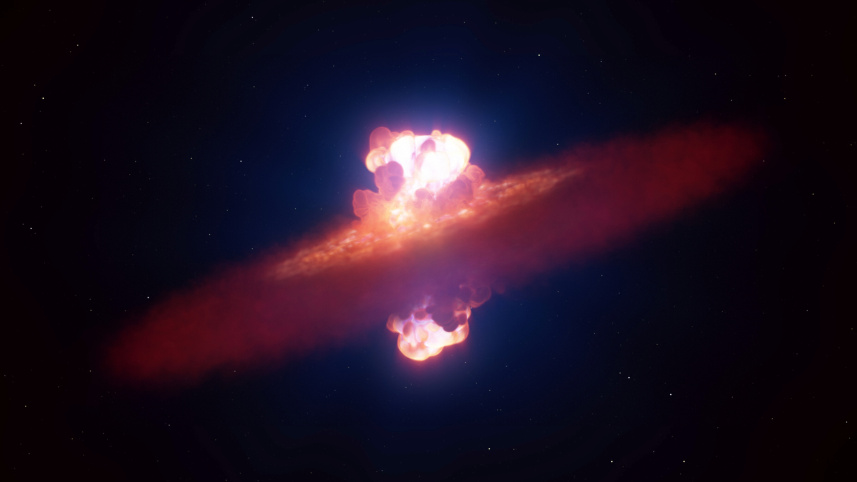
Scientists have observed for the first time the very early stages of a supernova, with a massive star exploding in a distinctive olive-like shape.
The researchers used the European Southern Observatory's Chile-based Very Large Telescope, or VLT, to observe the supernova, which involved a star roughly 15 times the mass of our sun residing in a galaxy called NGC 3621 about 22 million light-years from Earth in the direction of the constellation Hydra.

A light-year is the distance light travels in a year, 5.9 trillion miles (9.5 trillion km).
The shape of such explosions has been hard to nail down until now because of how rapidly they take place, so it took quick action with this supernova. The explosion was detected on April 10, 2024, around the time astrophysicist Yi Yang of Tsinghua University in China had landed on a long flight to San Francisco. Yang's formal request just hours later to aim the VLT at the supernova was granted.
The researchers thus were able to observe the explosion just 26 hours after the initial detection and 29 hours after material from inside the star first broke through the stellar surface.
What they saw was the doomed star surrounded at its equator by a preexisting disk of gas and dust, with the explosion pushing material outward from the stellar core to distort the star's shape into one resembling a vertical-standing olive.
 For all latest news, follow The Daily Star's Google News channel.


Comments