


Trump has immunity for official acts
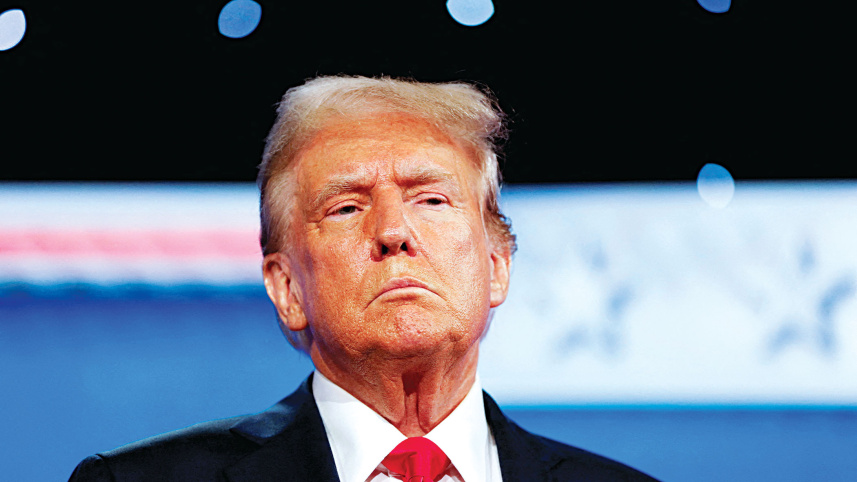
The US Supreme Court yesterday found that Donald Trump cannot be prosecuted for official actions taken as president, but can for private acts, in a landmark ruling recognising for the first time any form of presidential immunity from prosecution.
The justices, in a 6-3 ruling written by Chief Justice John Roberts, threw out a lower court's decision rejecting Trump's claim of immunity from criminal charges involving his efforts to undo his 2020 election loss to Joe Biden.

The court's six conservative justices were in the majority and its three liberal justices dissented.
"We conclude that under our constitutional structure of separated powers, the nature of presidential power requires that former president have some immunity from criminal prosecution for official acts during his tenure in office," Roberts wrote.
"At least with respect to the president's exercise of his core constitutional powers, this immunity must be absolute. As for his remaining official actions, he is also entitled to immunity," Roberts added.
Roberts said Trump's case will be sent back to the lower courts for further review.
The court analysed four categories of conduct contained in Trump's indictment: his discussions with Justice Department officials following the 2020 election, his alleged pressure on then-Vice President Mike Pence to block certification of Biden's election win, his alleged role in assembling fake pro-Trump electors and his conduct related to the January 6, 2021, attack on the US Capitol.
The court found Trump was absolutely immune for conversations with Justice Department officials but returned the case to lower courts to determine whether Trump has immunity for the other three categories.
The ruling marked the first time since the nation's 18th century founding that the Supreme Court has declared that former presidents may be shielded from criminal charges in any instance.
The decision came in Trump's appeal of a lower court ruling rejecting his immunity claim. The court decided the case on the last day of its term.
Trump is the Republican candidate challenging Democratic President Joe Biden in the November 5 US election in a rematch from four years ago.
The court's slow handling of the blockbuster case already had helped Trump by making it unlikely that any trial on these charges brought by Special Counsel Jack Smith could be completed before the election.
Liberal Justice Sonia Sotomayor delivered a sharply worded dissent, saying the majority's ruling "makes a mockery of the principle, foundational to our Constitution and system of government, that no man is above the law."
She added: Relying on little more than its own misguided wisdom about the need for bold and unhesitating action' by the president, the court gives former President Trump all the immunity he asked for and more."
Trump had argued that he is immune from prosecution because he was serving as president when he took the actions that led to the charges. Smith had opposed presidential immunity from prosecution based on the principle that no one is above the law.
 For all latest news, follow The Daily Star's Google News channel.
Comments