


Don’t let another waterway project fail
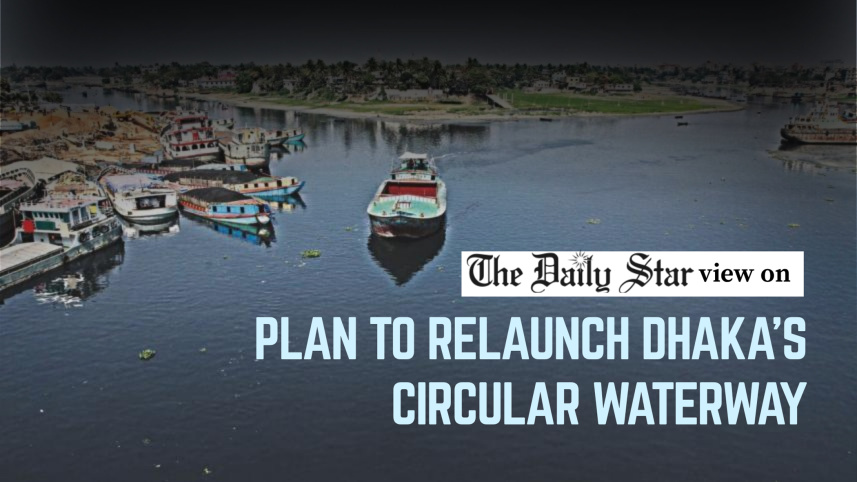
Historically, the country’s government, irrespective of whether they were political or non-political, has usually ended up wasting resources—both natural and tax-funded. This is quite evident in the case of introducing and operating waterway transport surrounding the capital. A recent report by Prothom Alo illustrates how, since the beginning of the millennium, there have been several failed attempts and at least Tk 122 crore lost in establishing waterways and passenger waterbuses on the rivers and canals in and around Dhaka. More than two decades later, the incumbent BNP government is reportedly considering the revival of the capital’s waterways to curb pollution, improve drainage, increase navigability, and introduce waterbuses. But before these plans materialise, will the authorities stop to really learn from past failures?
Reportedly, between 2000 and 2005, Tk 36 crore was spent to build 10 landing stations, seven terminals, and other infrastructure along 29 km on the Ashulia-Sadarghat route. Two launches, dubbed “waterbuses,” were also introduced in 2004, but their service ended shortly after. Between 2007 and 2010, the 40-km water route from Ashulia to Kanchpur Bridge via Tongi was developed with three landing stations and using Tk 47 crore, while an additional Tk 38 crore went towards purchasing waterbuses. Although the Bangladesh Inland Water Transport Corporation (BIWTC) claims that the services of these several waterbuses along multiple key routes failed due to a shortage of passengers, commuters cite the service’s lack of punctuality as what drove them away.

Efficient public transport is perhaps one of the most needed services in and around the capital. Therefore, it is obvious that the circular waterway project has largely failed due to a combination of poor planning and inadequate service quality. For instance, Bangladesh Inland Water Transport Authority data shows that of the 25 road bridges and three railway bridges across the circular waterway, at least 20 are too low to facilitate the passage of waterbuses. Besides, in 2017, a BIWTC committee made several recommendations to rectify issues such as the Buriganga’s pollution, terminal inaccessibility, and lack of walkways on banks, which were unheeded. The same issues still plague the system today.
As the government considers reviving these waterways and incorporating them into the capital’s transportation network, it must plan for decades ahead instead of hastily implementing projects to tout as achievements in the next election. The people of this country are painfully familiar with grand plans and wastage of crores of taka, with nothing to show but dilapidated components. This must not be the case for the next Dhaka circular waterway plan.
 For all latest news, follow The Daily Star's Google News channel.
Comments