


Early closure will hurt business
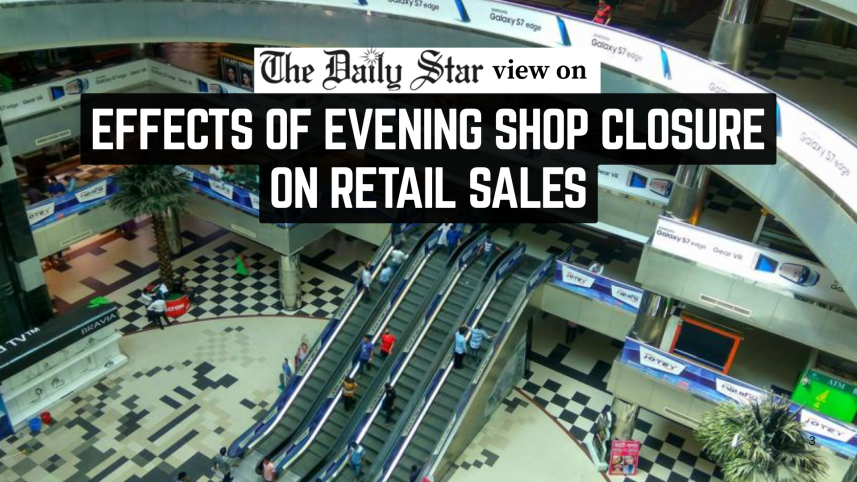
Any government facing an energy crunch reaches instinctively for the most visible lever available. If the lights are on, switch them off. If shops are open, shut them early. The logic is simple. However, the economics of the early closure, more often than not, are far less convincing. The new administration first ordered shops and malls nationwide to close at 6pm, citing fuel shortages triggered by the Middle East conflict. After pushback from the business community, the deadline was extended by one hour. Retailers remain unimpressed, and with reason. An extra 60 minutes feels less like a solution and more like a token adjustment.
The problem lies in how retail actually works in Bangladesh. This is, fundamentally, an evening economy. After long workdays, oppressive heat, and relentless traffic, consumers arrive at markets and malls only after dusk. Per industry estimates, nearly 60 percent of daily retail sales take place during these evening hours. This is not a matter of preference but constraint. Cutting off that window does not shift demand into the daytime but simply erases it.

The cost of that decision is not trivial. Retail supports as many as 1.20 crore jobs across the country. A large portion of these are part-time workers—students, secondary earners, and young people from lower-income households—whose livelihoods depend precisely on evening shifts. When the hours shrink, so do their incomes. However, retail accounts for roughly three percent of national electricity consumption. Even the broader commercial sector consumes only 8-10 percent.
There is also a fiscal dimension. Retail is a steady source of value-added tax revenue. Industry estimates suggest that early closure could cut these receipts by up to 20 percent. At a time when public finances are already under strain, this amounts to an odd form of self-inflicted pressure—a policy that weakens the state’s own revenue stream for limited gains on the energy front.
Consumer sentiment, already fragile, is another casualty. Fuel shortages and transport disruptions began to dampen spending even before the directive. Retailers experienced a subdued Eid-ul-Fitr season. Now, with restricted hours and ongoing uncertainty, the run-up to Eid-ul-Azha, typically a peak retail period, looks increasingly uncertain. When sales slow at the storefront, the effects ripple backwards through distributors, manufacturers, and the informal networks that sustain them.
There is, however, a more workable path, one that balances energy savings with economic reality. Several industry groups have already outlined practical alternatives. Trading hours could shift later into the day, from around 1pm to 9pm, avoiding the peak midday electricity load. Air-conditioning could be capped at 25 degrees Celsius or higher. Non-essential decorative lighting should be curtailed. And there should be a concerted move towards energy-efficient equipment. The current closure order offers modest relief to the grid, but the economic cost it imposes is far heavier. Crises demand hard choices, but they also demand that those choices be the right ones.
 For all latest news, follow The Daily Star's Google News channel.
Comments