


Who profits from Bangladesh’s heritage?

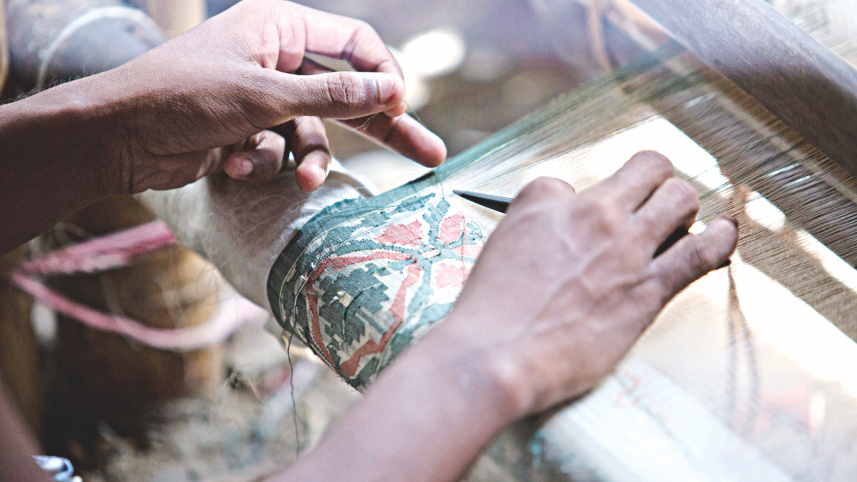
A weaver in Narayanganj spends months creating a single Jamdani saree. Each motif is placed by hand, each thread carrying generations of knowledge. Thousands of kilometres away, a luxury fashion house releases a collection with strikingly similar patterns and sells them at prices the original artisan could never have imagined. The value travels, while the credit and profit don’t. This is no longer just a story of cultural injustice. As Bangladesh awaits graduation from the Least Developed Country (LDC) status, the pertinent economic question is: who owns this country’s creative heritage, and who benefits from it?
Jamdani is not an ordinary textile. Recognised by Unesco as part of humanity’s intangible cultural heritage, it is one of the most intricate weaving traditions in the world. For centuries, it has been produced—primarily in Rupganj upazila of Narayanganj—by communities whose skills are globally admired but economically undervalued. Variations of these designs circulate in international markets today with little acknowledgment of their origins. Patterns are adapted, renamed, and resold. A local tradition has become a global commodity, but the artisans remain at the margins of that value chain.

Bangladesh has taken some steps. The Geographical Indication Goods (Registration and Protection) Act, 2013, enacted in line with obligations under the World Trade Organization Agreement on Trade-Related Aspects of Intellectual Property Rights (TRIPS), granted Jamdani the GI status in 2016. But this protection is largely domestic. A GI certificate issued in Dhaka carries little weight in Paris, Milan, or Amsterdam. In the global market, protection that stops at the border is protection in name only. That is precisely why the current moment matters.
A significant shift has taken place in Europe. Under Regulation (EU) 2023/2411, the European Union has introduced a new system to protect craft and industrial products through geographical indications. For the first time, non-EU countries can apply for protection of textiles, ceramics, and other crafts across all EU member-states through a single registration. Jamdani, Muslin, Nakshi Kantha, and Shital Pati—they all qualify. This is far bigger than an administrative reform; it is a structural opening. A single successful application can secure protection across 27 markets, but Bangladesh has yet to file one.
At the global level, an even more consequential development has emerged. In May 2024, member-states of the World Intellectual Property Organization (WIPO) adopted a treaty on intellectual property, genetic resources, and associated traditional knowledge. For the first time, the international intellectual property system requires patent applicants to disclose the origin of genetic resources and, where applicable, associated traditional knowledge used in their inventions. This introduces a principle long demanded by countries of the Global South: that traditional knowledge is not free for the taking. Disclosure requirements create a legal foothold to challenge misappropriation, whether in patents, designs, or derivative products.
The urgency is sharpened by Bangladesh’s upcoming LDC graduation. For decades, the country’s export model has relied heavily on preferential market access, particularly in ready-made garment exports under schemes linked to the WTO framework and unilateral preferences such as the EU’s “Everything But Arms” initiative. When these preferences phase out, Bangladesh must reposition itself in a more competitive landscape. Its cultural heritage—crafts, designs, and traditional knowledge—is one of the few assets that cannot be easily replicated unless it is protected, recognised, and monetised on its own terms.
The issue extends far beyond Jamdani. Nakshi Kantha embroidery, Shital Pati weaving, terracotta, brass, and bell metal work—these are not just cultural artefacts but repositories of knowledge and identity. In today’s global market, where authenticity is a premium, they should command value. Instead, they are often treated as an open-access resource. Reversing this trend requires prompt action.
First, Bangladesh needs a national digital archive of traditional designs. It can be an authoritative repository of motifs, techniques, and patterns. Without documented proof of origin, claims of ownership are difficult to defend internationally. Countries like India have demonstrated how such databases can be used to successfully challenge wrongful patents and claims.
Second, Bangladesh must internationalise its GI strategy. Filing applications under the EU’s new CIGI system should be an immediate priority. Protection is not just about preventing misuse but also about establishing market identity and securing long-term value.
Third, and most importantly, Bangladesh must rethink how it values its craft sector. Artisans are not merely producers of goods; they are creators of intellectual property. The motifs embedded in Jamdani or Nakshi Kantha are design assets. If properly protected, they can be licensed, not just sold.
This is the shift Bangladesh needs to turn from an exporter of labour-intensive goods into the owner of high-value creative assets. In such a model, a Jamdani weaver is no longer at the bottom of a supply chain but part of a creative economy, one where ideas, heritage, and design generate sustained income.
However, none of this will happen without political will. It requires coordination across ministries, investment in institutions, and a clear strategy that links culture with trade. Too often, intellectual property is treated as a technical legal matter. In reality, it is about power. It determines who benefits from creativity, whose knowledge is recognised, and whose labour is rewarded.
Bangladesh faces a choice: it can either remain a supplier of low-cost production, or it can assert ownership over what is uniquely its own. The answer may lie in something as simple, and as complex, as a piece of cloth. A Jamdani saree is not just a product but a history woven into fabric, a form of knowledge passed down through generations. Properly protected, it is also a source of economic resilience. The loom is in Narayanganj, the luxury houses are all over the world. The question is whether Bangladesh can finally claim its share of the value in between.
Namia Akhtar is an anthropologist and has previously worked at the Embassy of the Netherlands in Dhaka, the United Nations Development Programme (UNDP), and the European External Action Service (EEAS). She can be reached at namiaakhtar11@gmail.com.
Views expressed in this article are the author's own.
Follow The Daily Star Opinion on Facebook for the latest opinions, commentaries, and analyses by experts and professionals. To contribute your article or letter to The Daily Star Opinion, see our guidelines for submission.
 For all latest news, follow The Daily Star's Google News channel.
Comments