


Govt must heed Fitch's warning
When Fitch Ratings revised its outlook on Bangladesh to “negative,” it attributed the downgrade to the Middle East conflict, external financing pressures, and existing economic vulnerabilities. However, behind these reasons lies an urgent human story, one that can be heard in the lives of migrant workers. One of them was Kawser Ahmed, who borrowed Tk 5 lakh in 2021 to migrate to Tehran, found work at a car factory, and had nearly repaid his debt when the US-Israel war on Iran began. By April, he was home, unemployed, and, in his own words, with no idea what to do next.
Kawser’s story, presented at a press conference by the Refugee and Migratory Movements Research Unit (RMMRU) on Wednesday, reflects precisely the risk that Fitch has flagged. Nearly half of Bangladesh’s remittances originate in the Middle East, where around 70 lakh Bangladeshis work. Crude oil and petroleum products, much of which is sourced from the same region, account for roughly 15 percent of import costs, worth about $10 billion in 2025. Remittances held up strongly in the 2025-2026 fiscal year, but aggregate flows can remain resilient even as conditions for individual workers deteriorate in the face of risks.


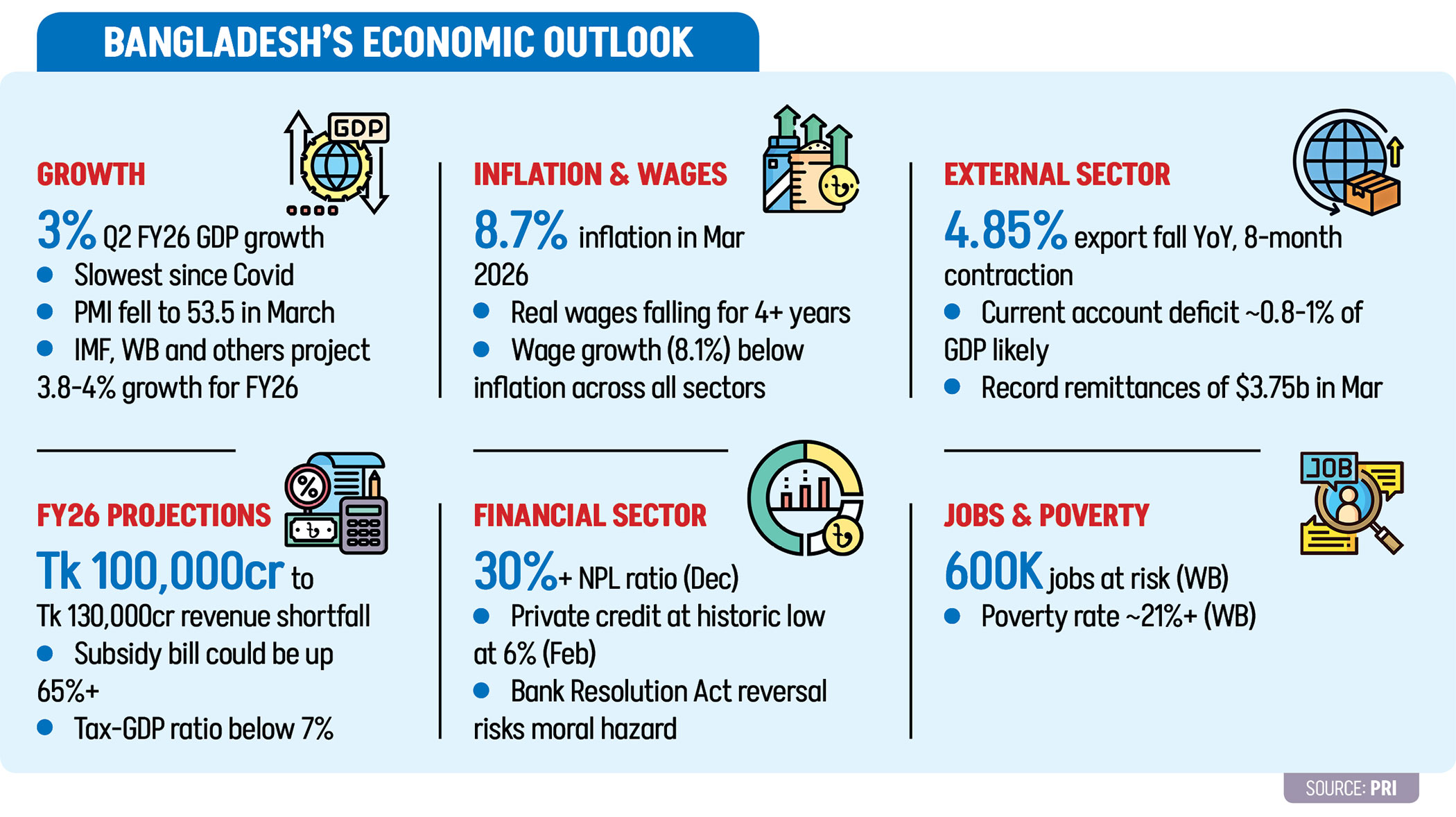
RMMRU’s field research documents what the macro data has yet to fully capture: an online company in Saudi Arabia that employed 400 workers before the war now retains just 65; a Bangladeshi migrant in Dubai reports that monthly living costs have risen from 450 to 600 dirhams as the ongoing conflict drives up prices. At least 11 Bangladeshis have been killed in the war; many more have been left underemployed. This is what Fitch calls “significant downside risks,” and it comes at a moment when Bangladesh’s foreign exchange reserves are already thin. Inflation is hovering around 9 percent. Growth forecasts have been trimmed. The garment sector is losing orders as reciprocal tariffs bite. Bangladesh is not facing a single shock. It is facing several at once.
So economic stability is vital, yes, but the government must urgently build what is presently glaringly absent—a safety net for returning migrants. There is no emergency support mechanism for those still in the Gulf, and no insurance coverage for workers whose employers go bankrupt mid-conflict. Dhaka should negotiate bilateral protections with Gulf governments to ensure that migrants unable to renew work permits due to war-related disruptions are not deported. A formal reintegration programme—combining skills development with financial assistance—must also be built for workers returning involuntarily.
 For all latest news, follow The Daily Star's Google News channel.
Comments