


Primary teachers’ strike is a mirror held up to Bangladesh


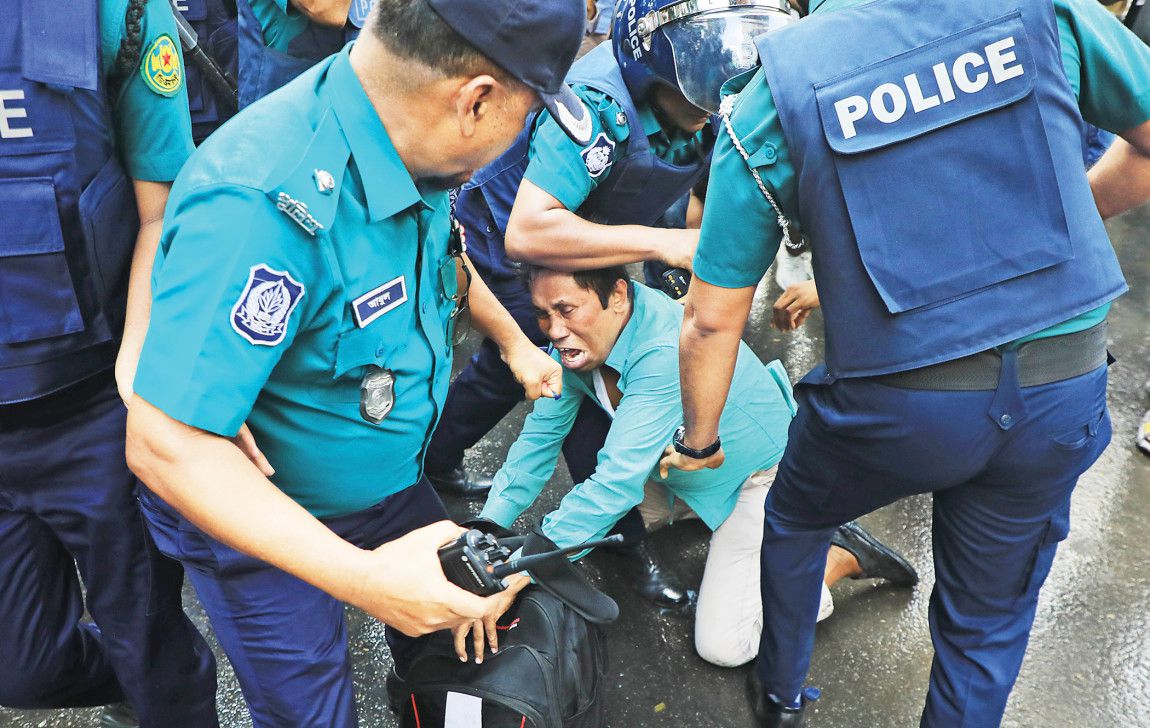
A primary school teacher on strike was seen bleeding profusely from the wounds inflicted by the agitated guardians who blamed him and his colleagues for turning their wards into hostages to push for better pay and benefit. There was a lot to unpack from the image. As I scrolled down to the comment section, there was no sympathy for the striking teacher or protest against the violence. "Good, he deserves it!" reads one comment. What does such a reaction say about where our sympathies lie as well as how our institutions fail? This crisis over primary school exams operates across four interlocking axes: ethical, financial, moral, and political. And none, it seems, can be solved in isolation.
The teachers have the legal right to indulge in civic protest. But is it ethical to do so by compromising their primary duty towards their students? Additionally, what about the children's rights to education enshrined in the Unesco mandate? Adults' financial concerns should not infringe on the basic rights of children, who are right-bearing entities. The cry for a raise is not unique to the teachers: inflation and household costs have hit every sector. Then again, is it moral to use exams as bargaining chips with children as the currency? Is it ethical to betray the guardians who have entrusted their children, hoping the teachers will ensure their education? The guardians feel the added pressure that the disruption caused by the teachers will create a session lag costing more both in terms of time and money. Conversely, the striking teachers can well argue that their demands are far from sudden. They have voiced their resentment over pay grade anomalies, promotion bottlenecks, and perceived humiliation relative to other cadres in different forums and formats. Regular political dialogues have failed, and the failure of preventive governance has now pushed the teachers towards last-minute brinkmanship around exams. So, it is necessary to reflect on the issues that gave rise to the current situation.

The assistant teachers of 65,000-plus government primary schools have been pressing for a three-point demand. They want to upgrade their pay scale (from grade 13 to grade 10/11), resolve higher-grade benefits after 10 and 16 years of service, and ensure 100 percent departmental promotion from assistant to head teacher. The protest intensified in November with a call for the complete shutdown and boycott of the annual exams starting December 1.
As a result, many schools failed to hold exams. In some cases, the headmaster, with assistance from guardians, held or invigilated the exams. The authorities served legal notices to absent teachers, issued transfer orders, and even threatened to take actions under criminal law. Social media is rife with images of heated arguments, scuffles, or symbolic acts (tearing up question papers, locking school gates, shouting matches with head teachers or local officials).
I wish the conflict was a mere sectoral wage dispute. It is a confrontation staged on the bodies and futures of children. The guardians and teachers are only addressing a small portion of the problem, while the teachers' councils continue to battle the financial issue with the overburdened interim government. In this tussle, parents blame teachers, educators blame the ministry, and children remain voiceless.
The same ethical scripts were seen earlier, where the bargaining chips were patients during the health sector strike, passengers during transport blockades, or ordinary citizens as collateral damage in struggles between organised groups and the state. Can we call this yet "another government-versus-everyone standoff" a "labour dispute"?
The deeper political truth is uncomfortable. All the promises of reform were doomed because everyone wants a slice of the pie. Nobody wants to bake it. They believe that the only way to achieve something is by making disruption unbearable. The formula is simple. Negotiation requires disruption. Unless you block a road or boycott an exam, no one listens. Primary teachers have attempted to follow the national strategy. But by the time they have come to the scene, the patience of the government has withered away. And they responded, not with carrots, but with sticks. And some teachers lost their last vestige of prestige by grasping the feet of marauding police constables. The irony lies in the expectation of low-paid teachers to uphold the moral standards of those unaffected by pay rigidity.
Head teachers and local government officials intervened to provide a lifeline. Caught between ministry orders and teacher resentment, they allowed exams to continue, creating friction with both groups. The crisis also showed the urban/rural rift where the city-based guardians tend to react more assertively than the rural ones. Since most of the primary teachers are women, the lack of sympathy also hints at gendered devaluation of care work.
The crisis, therefore, is not a teachers' strike. It's a mirror held up to Bangladesh. Ours is a governance system that waits for explosions instead of preventing fires. We have never been able to find a balance between the welfare state and neoliberal corporatisation. Our essential workers, and by extension all public- and semi-public sector officials, survive on words rather than salaries. We have adopted a culture of protest that aims to inconvenience others, believing it to be the most persuasive form of communication. The practice of buying off the leaders and diluting the protests is so common that our moral climate is made up of fragile trust and negotiable respect. The country reminds us of the arithmetic problem we had as children, involving a water reservoir with more pipes leaking water than ones filling it. Meanwhile, we act like plumbers busy arguing about whose wrench is more prestigious.
The announcement of the strike's suspension serves as a rehearsal for a mediated agreement. In a few weeks, we will go back to an uneasy calm, and our teachers will return to their classes pretending nothing had happened. The cracks, however, will remain unhealed and unattended.
A more honest approach would require endorsing a teacher pay scale that maintains transparency and parity; developing a contingency plan for dispute resolution so that classrooms aren't used as bargaining arenas; and creating exam alternatives to protect children from the adult's power struggles. After all, schools exist for children. They shouldn't be used as pawns in our political game. The other stakeholders of the school are our teachers, who must be respected as essential workers building the nation's foundational blocks. Treating them like vocational workers cannot be beneficial for the country's future.
The image of a bleeding teacher, cursed by the public with no moral support to hold him, is a national crisis. We can consider it an outburst of the guardians' anger or frustration over their fear for their children's future or a self-reflective concern about paying more for coaching or an extra year caused by the teacher's work absence. Regardless, the hostility mirrors how there is a structural faultline that causes occasional tremors in our social life—an issue not unique to the primary teachers' protest but a cross-sectoral phenomenon affecting our country.
Dr Shamsad Mortuza is professor of English at Dhaka University.
Views expressed in this article are the author's own.
Follow The Daily Star Opinion on Facebook for the latest opinions, commentaries, and analyses by experts and professionals. To contribute your article or letter to The Daily Star Opinion, see our guidelines for submission.
 For all latest news, follow The Daily Star's Google News channel.
Comments