


From boycotts to balance: Rethinking the opposition’s role in parliament

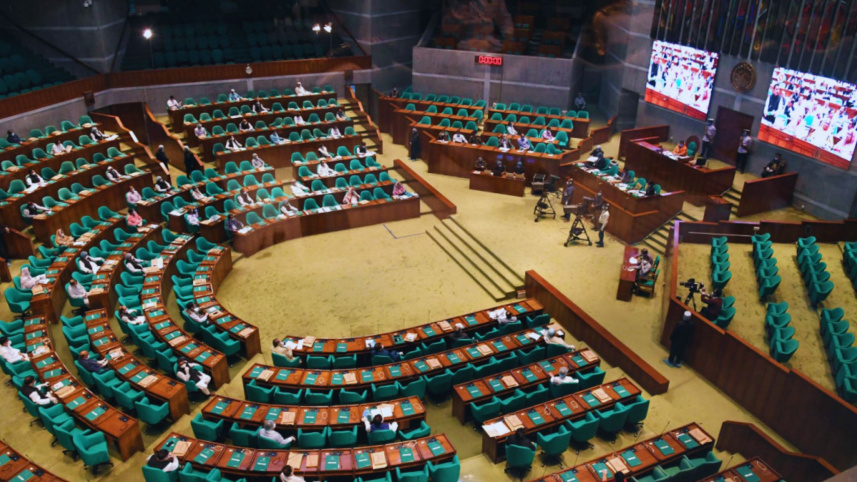
On Thursday, Bangladeshis got another chance to practise parliamentary democracy through a national election that appeared more participatory and competitive than those in 2014, 2018, and 2024. While the opportunity has been precious, it has also forced us to ask ourselves an awkward question: not just what kind of government, but what kind of opposition are we prepared to accept this time?
Since the 1990 mass uprising, Bangladesh has formally followed a British-style parliamentary model. On paper, this system assumes two pillars: a government that governs, and an opposition that questions, scrutinises, and holds power to account. Parliamentary democracy is simply unimaginable without both.

In theory, the country has always had an opposition. In practice, that opposition has rarely behaved as if parliament is its main arena. We invest a great deal of energy in criticising whoever is in power, often because of very real abuses of authority and corruption. But the record of opposition politics since the 1990s has also been quite problematic. The story is not only about authoritarian governments, but also about opposition sides that repeatedly walked away from the one institution designed to restrain those governments—sometimes of its own volition, sometimes because of pressures coming from the side in power.
Since 1991, both the major parties have treated parliament as almost optional. The Awami League, in opposition during the BNP governments, boycotted around 30 percent of the sitting days during the fifth parliament (1991-1995) and 60 percent of the sitting days during the seventh parliament (2001-2006). Later, when BNP became the main opposition in the ninth parliament (2009-2014), its MPs were absent on 83.38 percent of the sitting days. Overall, studies show that over roughly two decades, opposition parties in the country skipped about half of all parliamentary sittings, regardless of who was in power.
So when we talk about a “culture of boycott,” it is not a metaphor. It is a measurable pattern. Both the Awami League and BNP have treated parliament like a stage that can be deserted whenever negotiations stall, criminal cases are filed, or street pressure seems more useful than parliamentary debate. This is the first layer of the problem. The second layer is how these boycotts interact with elections themselves.
Bangladesh has already experienced “elections without voters” more than once. In February 1996, disputes over a by-election and demands for a caretaker government led all major opposition parties to boycott, turnout fell to about 21 percent, and the BNP government that emerged survived only 12 days before a caretaker administration was installed. In January 2014, the roles reversed: the Awami League stayed in office without a caretaker system, while BNP and most other opposition parties stayed out of the race. That election saw 153 of 300 seats go uncontested and effectively decided before polling day, with the Awami League winning 127 by default. International observers largely stayed away, and serious research now treats the 2014 polls as neither free nor genuinely competitive.
In 1996 (February), 2014, 2018, and 2024, the pattern was similar: an incumbent party used constitutional formalities to stage an election with minimal competition, while opposition parties responded with total boycott. Each side played both roles at different moments: sometimes as the overbearing government, sometimes as the sulking boycotter.
The aftermath of the 2014 election created a new distortion. With BNP and Jamaat out of the race, Jatiya Party stepped into the vacuum as the “main opposition” in parliament. At the same time, its leaders also joined the Awami League-led cabinet and took ministerial portfolios. Analysts and even party documents have described this as a “domesticated opposition”—formally in the opposition benches but functionally a part of the ruling arrangement.
So the country moved from one extreme to another: from boycotting opposition to ornamental opposition.
If we look at the period between 1990 and 2014, excluding the military-backed caretaker interludes, one pattern runs through every parliament. Opposition parties were far more active in press conferences, hartals, road marches, and talk shows than in committees and floor debates. Hartals became the real “sessions,” and Jatiya Sangsad became a symbolic backdrop.
This habit has several consequences. First, it leaves legislative power almost entirely in the hands of the ruling party. With supermajorities generated by the first-past-the-post system, governments already enjoy the mathematical ability to pass any law they like. Second, it helps ruling parties shift political argument from policy to security. Once politics moves to the street, governments can frame every confrontation as a law and order problem, rather than a democratic disagreement. Third, boycott politics normalises the idea that parliament is optional. MPs are elected on taxpayers’ money, supported by public allowances, yet they feel no shame in skipping hundreds of sittings.
Now the political script is changing again. Sheikh Hasina was forced out of power following the uprising in 2024. The Awami League was barred from the just-held 13th parliamentary election. A transitional government oversaw a vote that many describe as the most open in a decade and a half. Whoever wins will form the government; whoever loses will sit in opposition.
The temptation will be strong to dust off the old playbook. Already, we hear hints of zero-sum thinking. Tarique Rahman has signalled that if his party wins, it will prefer to form a government alone. Jamaat, in contrast, has floated the ideas of a national government or broader power sharing. These are tactical disagreements about cabinet formation and coalition management, but beneath them lies a deeper reluctance to accept opposition as a legitimate, long-term role.
The debate will become even sharper if the proposed package of constitutional reforms goes ahead. If the referendum, held on the same day as the election, approves the creation of an upper house, the opposition will no longer be confined to just one chamber; it will have institutional footholds in both. On paper, this could create stronger checks and balances. In reality, if the boycott culture continues, the country will simply end up with two half-empty houses instead of one. New architecture without new behaviour will not rescue parliamentary democracy.
At the minimum, a democratic opposition in Bangladesh needs three shifts.
First, an opposition that shows up. That sounds banal, yet the statistics say it would be a radical change. Turning up to sessions, serving on committees, engaging in budget debates and Q&A sessions is not charity. It is the job. Walkouts and boycotts might still have a place, but as rare, targeted tools with clear demands and time limits, not as a default operating system.
Second, an opposition that does its homework. Criticising “corruption” or “misrule” is easy. Drafting an alternative budget, dissecting the fine print of a bill, or proposing concrete amendments to a policy requires staff, research, and discipline. A serious opposition should behave like a government in waiting, not a permanent protest group. That includes presenting alternative policies inside parliament, not just in talk shows and rallies.
Third, an opposition that defends rules even when it hurts. Real commitment to democracy is tested when your rivals are under threat. That means speaking up against extrajudicial killings, media intimidation, or attacks on minorities even when the victims are seen as “enemy voters.” If opposition parties only care about rights when their own activists are targeted, they simply rehearse the same selective morality that they condemn in governments.
Without these changes, any new parliament will slowly reproduce the old pathologies. Governments, no matter how popular at birth, will drift towards arrogance once they realise that there is no institutional cost to ignoring parliament. Opposition parties will again discover that they gain more attention from street violence than from committee hearings. The cycle of boycott, crackdown and sham election will reassert itself.
Asif Bin Ali is an Atlanta-based geopolitical analyst and a doctoral fellow at Georgia State University. He can be reached at abinali2@gsu.edu.
 For all latest news, follow The Daily Star's Google News channel.
 Views expressed in this article are the author's own.
Follow The Daily Star Opinion on Facebook for the latest opinions, commentaries, and analyses by experts and professionals. To contribute your article or letter to The Daily Star Opinion, see our guidelines for submission.
Comments