


Credit isn’t enough – farmers need assets to build income

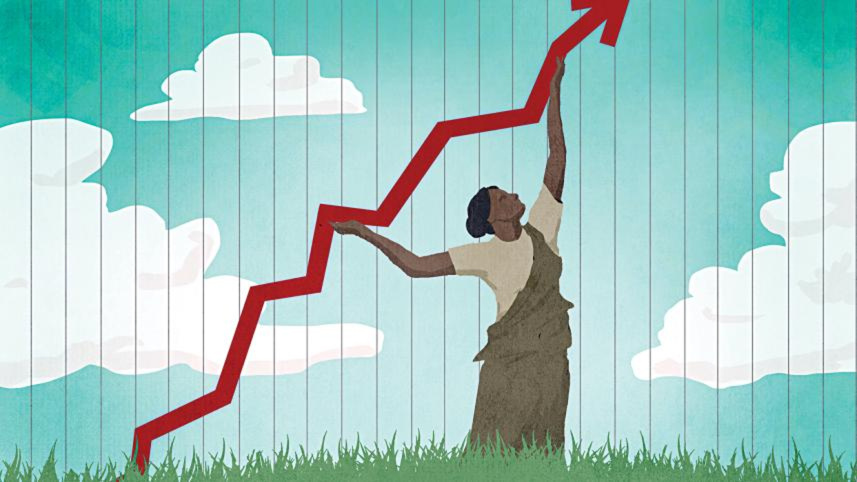
Bangladesh has built a considerable rural credit system. Each year, tens of thousands of crores are supplied to the countryside. But too little of this money becomes machinery, storage, irrigation, livestock, processing capacity, or producer-owned assets. The result is a rural economy that borrows repeatedly without accumulating enough to grow. On paper, the stagnation makes little sense. Disbursement targets are routinely met and national financial inclusion metrics appear strong. Agricultural credit targets continue to expand. New policy instruments are being introduced to deepen farmers’ access to finance and machinery. The system moves more capital into the rural economy than it has at any point before. But the question remains as to whether this credit builds anything that lasts.
Agriculture still contributes some 11 percent to our GDP and supports a large share of livelihoods. Its weakness affects through employment, consumption, food prices, rural demand, and banking sector exposure. Its upside will also travel through the same channels. Better rural finance can turn agriculture into a stronger source of income, demand, and resilience.

Decades ago, microloans were a necessary innovation. They proved that the rural poor were bankable. As opposed to formal banking, these loans provided liquidity. But the rural economy still hasn’t moved far from that model. In 2024, Microcredit Regulatory Authority-licensed microfinance institutions (MFIs) disbursed more than Tk 263,000 crore across all loan categories. Scheduled banks disbursed Tk 37,154 crore under targeted agricultural and rural credit. The figures are not identical categories, yet they show where rural financial delivery capacity now sits. Commercial banks often lack the infrastructure to underwrite rural risk directly. Many meet central bank-mandated agricultural targets by channelling bulk capital through MFIs.
By the time outsourced capital reaches the farmer, it carries additional intermediation costs, meaning that subsidised credit reaches the final borrower at a much higher price than the headline policy rate suggests. The subsidy is priced out before it reaches the farm. Bangladesh Bank has recognised this cost-shifting and recently mandated that banks disburse at least half of their agricultural targets through their own networks, which should force the development of genuine last-mile infrastructure. But the conventional banking behemoth will likely move slowly.
The dominant microfinance model is better at stabilising consumption than financing capital formation. Small, high-frequency loans do not suit the purchase of machinery, storage, irrigation, and processing capacity. These assets still depend on subsidy, informal capital, or external ownership. Microcredit once promised a bridge to commercial banking. However, it now keeps rural borrowers inside a narrow loop of liquidity and repayment.
Formal banks also misread the rural economy when they lend directly. Finance runs on monthly calendars, while agriculture runs on cycles of planting, growth, harvest, storage, and sale. Rural lending needs to be backed by knowledge about crops, seasons, markets, and communities. It cannot rely only on conventional customer files.
In Panjor Bhanga, a flood-prone community in northern Bangladesh, a woman named Renu Bala helped build a women’s milk cooperative around a simple ambition: buy better cattle, produce more milk, and earn a more stable income. But they did not have the collateral. At a training programme, she learned about a credit policy for small dairy businesses offering lower interest rates and longer repayment periods. She still had to go from bank to bank before one agreed to lend to her. With that loan, the cooperative bought Friesian cows. Production rose, the loan was repaid, and the group expanded.
The lesson is not that credit solved everything, but that the right kind of credit allowed income to form around an asset.
Nearly half of our national agricultural lending is absorbed by seasonal crop loans used for seeds, fertiliser, and diesel. These loans keep production moving but they rarely build the asset base that can help raise productivity over time. Instead, the harvest comes in, the debt is cleared, and the farmer starts again from zero. The problem does not end at credit. Farmers work through the season to keep crops alive, then often lose pricing power after harvest. Without local storage, many sell immediately when prices are at their weakest. Intermediaries capture margins that should remain with producers. After all, a farmer who cannot hold produce cannot negotiate value.
The financing inequity is also geographic. Rural Bangladesh operates as a net exporter of capital. The banking system moves savings out of the countryside more easily than it supports local asset formation. Rural deposits move towards the city while rural proposals for harvesters, storage, irrigation, and processing face rejection. Therefore, our core metric of success must shift from credit volume to the creation of productive rural assets.
Ownership matters as much as access. Too often, financed agricultural assets belong to absentee landlords or urban investors. Meanwhile, credit follows land titles and production remains under-credited. The farmer operates the economy without owning the asset base that allows the economy to grow. To correct this, we need finance that creates assets and allows producers to own them.
The tools already exist. Digital transaction histories can support credit assessment where land records are weak. Warehouse receipts can turn stored produce into collateral and help farmers wait for better prices. Equipment leasing and shared ownership models can make machinery accessible without unsuitable debt burdens. District-level lending discipline can ensure that rural deposits return as meaningful local commercial credit.
Renu Bala’s case shows the difference between credit that passes through a village and credit that stays there as capital. The cooperative did not need another short loan to manage scarcity. It needed finance that was patient enough to buy an income-generating asset and wait for that asset to generate earning.
The first phase of financial inclusion gave rural Bangladesh access to the system. The next phase must help rural producers build and own assets that generate income. Without this shift, rural growth will remain visible in credit data but absent from lived realities.
Saba El Kabir is a sustainability practitioner. He can be reached at saba@cultivera.net.
Views expressed in this article are the author's own.
Follow The Daily Star Opinion on Facebook for the latest opinions, commentaries, and analyses by experts and professionals. To contribute your article or letter to The Daily Star Opinion, see our guidelines for submission.
 For all latest news, follow The Daily Star's Google News channel.
Comments