


Deferment or not, Bangladesh must prepare for LDC graduation

During my decades of studying and working abroad, I had the privilege of watching this country surprise the world repeatedly. It delivered infrastructure projects rising from barren lands, mobile connectivity reaching remote river-bound villages, and a garment industry rising from zero into a global force. Bangladesh has always found a way. But engineering a system at its early growth phase and sustaining it through maturity requires fundamentally different strategies. What got us here may not get us there.
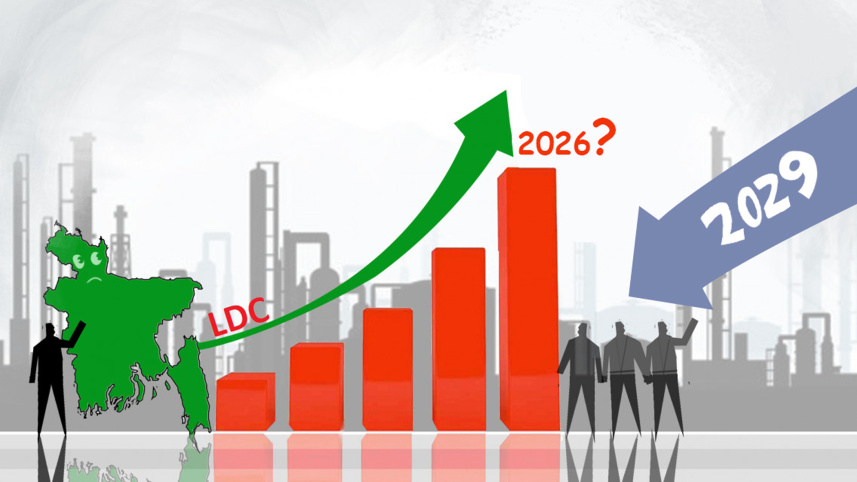
That tension sits at the heart of Bangladesh’s impending graduation from the LDC framework in November this year. A national consensus involving the government, major political parties, and the business community has emerged around seeking a deferment. A formal request has been made to defer graduation by three years to 2029, and the United Nations Committee for Development Policy (UN CDP) has started the process to assess the request. The deferment is understandable, but precisely what it is must be understood: a pause, or a solution. The more consequential question is what Bangladesh does with the time it has sought.

The arithmetic of graduation is sobering. Today, 73 percent of our exports benefit come from duty-free access to 38 countries under the LDC framework. Last year, 44 percent of our exports went to the EU alone. WTO estimates suggesting Bangladesh could forfeit up to 14 percent of total exports upon full graduation, portray a cliff, not a gentle slope. The safety net beneath that cliff is already fraying. Inflation in recent years has been persistently high compared to other South Asian countries, rising from 8.49 percent in December to 8.58 percent in January. Moreover, non-performing loans have ballooned to 35.73 percent of total disbursed loans as of September 2025. A deferment changes none of these realities. These are symptoms of a growth model that has reached a state that must be transformed now.
The depth of our vulnerability is rooted in structural concentration. Garments account for over 80 percent of our exports, generating $39.34 billion in FY2025. This dependence was rational when preferential market access was guaranteed and global labour arbitrage rewarded volume over value. That calculus is now shifting on two fronts simultaneously. First, automation is no longer a distant threat; it is a present reality. Robotic sewing systems, AI-powered quality control, and automated cutting technologies are progressively narrowing the human-machine cost gap. A competitive advantage built on cheap labour is a depreciating asset. Second, garments are precisely where our tariff exposure is most acute. The EU’s average tariff on imported clothing from countries that do not enjoy special trade preferences is about 12 percent; for general industrial goods, it is about three percent. Our export basket, dangerously concentrated on apparel, makes post-graduation exposure severe. No amount of operational efficiency within garments alone can fully absorb that structural cost.
So where do we go from here? Export diversification must become a measurable government priority, not a rhetorical aspiration. Pharmaceuticals offer a compelling near-term pathway, although LDC graduation will end TRIPS-based patent waivers and cost exemptions. Yet, with the right investment in regulatory capacity and raw material sourcing, pharmaceuticals can evolve into a competitive export industry under standard WTO rules. Beyond pharmaceuticals, ICT services, high-value food-processing, advanced engineering, and outsourced semiconductor assembly and testing represent sectors where our demographic dividend: a young, growing, increasingly connected workforce can be deployed with targeted skill investment. These industries reward technical excellence, not wage competition alone. But no diversification strategy succeeds without addressing two structural constraints that we have long acknowledged: education and bureaucracy.
Our universities continue to prepare graduates for a job market that is rapidly becoming obsolete. The shift required is not marginal but a fundamental reorientation towards STEM disciplines, data analytics, AI literacy, and technical-vocational training aligned with 21st-century industrial demand. Universities must cease functioning as degree factories and begin operating as incubators for data scientists, Very Large Scale Integration (VLSI) engineers, and software architects. Bangladesh can draw from models used in Germany and Singapore. Germany’s dual system blends apprenticeships with vocational schooling, while Singapore’s Technical and Vocational Education and Training (TVET) system is designed to respond quickly to economic needs. These models have shown that when technical education is genuinely valued by society and closely aligned with industry, it can drive broad economic transformation.
However, for such a transformation, the bureaucratic environment must be conducive. A dedicated single-window mechanism for FDIs staffed by officials who understand investors’ requirements of a biotech facility or a semiconductor design service is not a luxury but a competitive necessity. Bangladesh must pursue administrative digitalisation with an urgency to transform bureaucracy so that it facilitates rather than stalls trade and investment.
One chronically underutilised asset deserves particular attention: our global diaspora. More Bangladeshi professionals now hold senior technical and managerial roles in multinational corporations and lead research institutions worldwide. These individuals represent not just remittance flows but intellectual capital, international networks, and industry access that money alone cannot buy. India, China, and Israel have each demonstrated that diaspora engagement, when formalised and sustained through structured frameworks: advisory councils, targeted tax incentives, mentorship programmes, functions as a genuine strategic multiplier. Bangladesh must pursue this with equivalent sophistication and far greater urgency.
International investors seek reliability above everything. Our current image, built on resilience under difficult conditions, is admirable but insufficient for the next chapter. Safety compliance, transparent governance, and consistent regulatory enforcement are prerequisites for the transition from low-cost supplier to precision manufacturing or design partner. This rebranding cannot be achieved through marketing alone; it must be earned through performance. Rigorous enforcement of regulations, demonstrating superior labour and governance standards, and delivering consistently on commitments to international partners are the building blocks of that transition. The Chinese model of streamlined Special Economic Zones, the Indian model of technical education and English-language services, and the Singapore model of uncompromising efficiency in a constrained geography each offer Bangladesh distinct and actionable lessons.
This country now requires a synchronised national strategy with clear milestones rather than aspirational lists. An AI-ready workforce through integrated technical education at every level. Stable, clean power infrastructure is essential for sensitive manufacturing or data centres. What we require are: formalised diaspora engagement with genuine incentives and recognition; comprehensive administrative and tax policy reform to increase investment and a strategic focus on three to five high-value industries where competitive advantage is achievable within a decade.
LDC graduation and the rise of automation may be potential challenges, but properly navigated, they become the catalysts for a long-overdue transformation. The era of the stitch is our proud history—the foundation upon which our prosperity has been built. The era of the chip, the code, and the precision instrument must define what comes next. We possess human capital, geographic positioning, and the demonstrated capacity for rapid structural adaptation. With the graduation clock—deferred or not—already ticking, a synchronised national strategy cannot wait.
Dr Sabbir Ahmad is a researcher and expert in project delivery and engineering. He can be reached at sabbir@ieee.org.
Views expressed in this article are the author's own.
Follow The Daily Star Opinion on Facebook for the latest opinions, commentaries, and analyses by experts and professionals. To contribute your article or letter to The Daily Star Opinion, see our guidelines for submission.
 For all latest news, follow The Daily Star's Google News channel.
Comments