


Freight belongs on rail, but how can we make it work in practice?

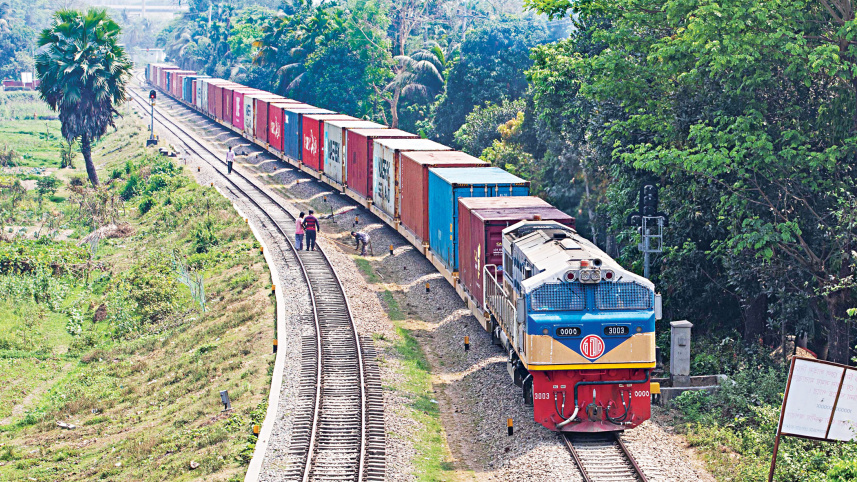
In a previous article, I argued that Bangladesh must rethink its reliance on a road-based transport system along the Dhaka-Chattogram corridor and move towards a more energy-efficient model. This article builds on that discussion by focusing on how such a transition can be implemented in practice. The railway offers a promising solution, but for it to play a meaningful role, Bangladesh Railway must overcome various long-standing structural and institutional challenges. Without reform, even the best ideas will not deliver results. The answer, therefore, lies not in choosing rail in principle, but in making it work in practice. This requires a clear and practical roadmap.
Firstly, structural inefficiencies must be addressed. Bangladesh’s railway system still uses a mix of metre gauge, broad gauge, and dual gauge lines. This creates delays and makes operations more complex. In many cases, cargo must be shifted from one system to another. For a busy corridor like Dhaka-Chattogram, this increases time and cost. A gradual plan to standardise the gauge—especially on major freight routes—can make train movement faster, smoother, and more reliable. This is a basic but foundational step.

Secondly, freight must be given priority. At present, the railway mainly focuses on passenger services. As a result, the railway has not been able to meet the growing demand for goods movement. There are not enough locomotives, wagons, or trained drivers to transport freight. Indeed, many freight trains depend on spare capacity from passenger services. This makes scheduling uncertain. If businesses cannot depend on rail, they will continue to use trucks. This is why investment in freight capacity is essential, so that the railway can become a reliable option for industries.
Thirdly, institutional reform is needed. Bangladesh Railway is run almost entirely by the government. While this ensures control, it also limits flexibility and investment opportunities. There is a strong case for allowing private participation in freight services under clear rules. This does not mean full privatisation, but private operators could run freight trains on selected routes while the government keeps oversight. This will invite investment, improve service quality, and increase efficiency.
Fourthly, infrastructure must be linked to logistical planning. Building railway lines alone is not enough; the system must include proper logistical facilities, especially inland container depots (ICD). ICDs near industrial areas—such as Narayanganj, Narsingdi, Pubail, Gazipur, and northern regions like Nilphamari and Rangpur—can reduce long-distance trucking. Today, many goods travel long distances by road before reaching the port. With ICDs, cargo can be collected near factories and then moved in bulk by rail.
Private investors have already expressed an interest in developing ICDs by investing in construction and operations. However, the location of an ICD is an important factor. ICDs should be built close to cargo sources and along existing railway lines, thus avoiding extra investment for new rail extensions. If executed properly, ICDs will reduce congestion, lower fuel use, and improve logistics efficiency.
Finally, transport planning must take into account the whole corridor. The Dhaka-Chattogram route, in this instance, should be seen as one complete system linking ports, industries, and markets. Roads and railways should not be planned separately.
One useful step could be a more direct railway route, such as a Dhaka-Narayanganj-Chattogram chord line. This will reduce travel distance and time, while also bolstering capacity. At the same time, new economic hubs like Matarbari port and Mirsarai industrial zone should be connected by rail. Expanding rail links towards the northwest, including areas like Nilphamari, could also enhance regional development.
Transport is not just about moving goods. It is also about energy and cost. Every additional truck increases diesel use and import costs. Rail, by contrast, uses much less fuel and can reduce overall transport expenses. Financing this transition will require a practical approach. Large railway infrastructure will still have to rely on public funding and investment from development partners. But ICDs, rolling stock, and freight services can be definite opportunities for private investment.
A structured financing model will help reduce pressure on government resources. Public-private partnerships (PPP) can play a key role, especially in locations where demand is emerging for alternative modes of transport for goods. In areas such as Nilphamari and Rangpur, private investors could bear the initial risk in developing rail-based logistics facilities. At the same time, the PPP Authority can support these projects through viability gap funding, making them financially viable while attracting investors. This approach will allow the government to support development without carrying the full financial burden.
Around the world, countries are linking transport planning with their energy and economic strategies. India is investing in dedicated freight corridors. China is strengthening rail links between ports and industries. Europe continues to rely on rail for efficient and low-emission logistics. Bangladesh can and should move in the same direction. The country has already shown that it can execute large infrastructure projects. The next step is to make those investments smarter. The choice is not between road and rail. Both are needed. Roads will remain important for short distances. But without a strong rail system, the overall network will remain costly and fuel-intensive.
Building a modern railway system will take time, of course. But with the right planning, investment, and reform, it can form a key part of Bangladesh’s economic future.
Ahamedul Karim Chowdhury is adjunct faculty member at Bangladesh Maritime University.
Views expressed in this article are the author's own.
Follow The Daily Star Opinion on Facebook for the latest opinions, commentaries, and analyses by experts and professionals. To contribute your article or letter to The Daily Star Opinion, see our guidelines for submission.
 For all latest news, follow The Daily Star's Google News channel.
Comments