


Justice for the weak, immunity for the powerful

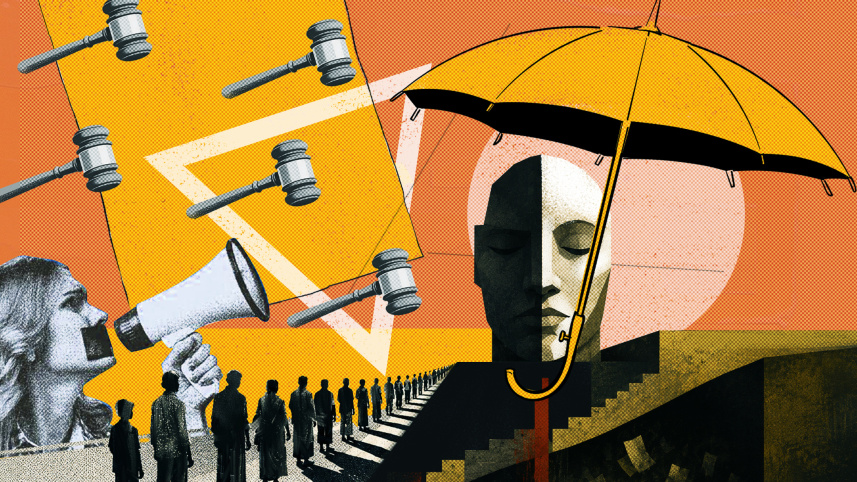
Justice often behaves like a one-sided weapon in our country. It falls quickly and harshly upon the poor, the powerless, and the socially insignificant; yet it becomes hesitant and restrained when the accused belongs to a higher socioeconomic class. This painful contradiction has become deeply rooted in our institutions, politics, and even social attitudes, leading to many ordinary citizens losing their faith in the rule of law. For many, the system appears to be one where punishment depends less on wrongdoing and more on the social standing, political connections, and financial power of the accused.
This can be illustrated in an example from last month, where a 25-year-old housewife in Tarash upazila of Sirajganj was sent to jail for defaulting on a Tk 25,000 microcredit instalment from an NGO. Meanwhile, defaulted loans in the banking sector reached an astonishing Tk 5.45 lakh crore by the end of 2025, as confirmed by finance minister Amir Khosru Mahmud Chowdhury in parliament. Interestingly, these loans were not taken out by struggling farmers or poor rickshaw pullers. They were largely linked to influential business groups and politically connected individuals. Yet, the country rarely witnesses meaningful punishment for those responsible for defaulting on such huge amounts of loans.

This same imbalance extends beyond the financial system and appears clearly in the treatment of streetside hawkers in our cities. The government regularly launches eviction drives in the name of reclaiming footpaths and reducing congestion. But everyone knows that hawkers do not operate independently. Behind the footpath economy lies a vast network of extortion involving local musclemen, political activists, corrupt officials, and organised syndicates that collect “rent” from vendors every day. The Bangladesh Hawkers Federation claimed that vendors on Dhaka’s footpaths are extorted for around Tk 3,000 crore annually, amounting to more than Tk 8 crore collected every day. These networks survive openly because they enjoy protection from influential quarters. Yet meaningful action against them remains rare. Instead of dismantling the structure of corruption, the state targets its weakest victims. The hawker loses both livelihood and dignity, while those profiting from the illegal system continue without consequence.
The same selective approach to imposing punishment can be seen in the destruction of canals, rivers, and wetlands across Bangladesh. Powerful land grabbers and politically connected developers have occupied water bodies for decades, filling canals and low-lying lands that once protected cities from flooding. According to the Ministry of Land, at least 70 percent of the country’s natural wetlands, such as haors and beels, have disappeared or been filled over the past 50 years for residential, industrial, and commercial development. Dhaka and other cities continue to suffer from severe waterlogging and environmental decline because those responsible for destroying natural drainage systems are rarely held accountable. So, a vegetable seller occupying a few feet of pavement can be evicted overnight, but those who swallow entire wetlands often escape untouched. Such contradictions expose the unequal character of governance itself.
Within the legal system, ordinary citizens often face swift action under strict laws, while cases involving powerful individuals drag on endlessly. Journalists, activists, and critics frequently face harassment through defamation cases and legal intimidation simply for exposing corruption or abuse of power. But at the same time, influential figures accused of major financial irregularities or political violence often benefit from endless delays, postponed hearings, and fading public attention. For the powerful, justice delayed can itself become a shield against accountability.
Corruption further deepens this inequality. For many poor citizens, even basic public services cannot be availed without paying bribes. Filing a complaint at a police station, obtaining land records, or accessing government offices are processes which often involve humiliation and unofficial payments. For the wealthy and well-connected, it becomes a form of protection that weakens investigations, influences enforcement, and creates immunity from consequences.
Society often judges ordinary people harshly for minor mistakes or personal choices, while remaining far more tolerant towards the misconduct of the powerful. Social media often turns into a courtroom when the accused is weak or socially vulnerable. Yet when influential figures face allegations of corruption, abuse of authority, or serious wrongdoing, excuses and justifications often emerge. Their actions are defended as political necessity, conspiracy, or unavoidable compromise. When people repeatedly witness injustice at the highest levels, they gradually lose faith in honesty, fairness, and institutions. Young people begin to believe that success depends not on merit or integrity, but on connections and manipulation. Social divisions deepen as ordinary citizens feel increasingly abandoned by the system meant to protect them. Even more dangerous is the gradual erosion of moral conscience: when injustice becomes routine, society stops reacting to it and corruption becomes normalised. Violence against the poor also becomes acceptable. This moral collapse weakens not only institutions but also the collective character of a nation.
A civilised society cannot survive on such contradictions for long. Justice cannot remain a privilege for the influential while becoming a punishment reserved for the powerless. The law must protect the farmer as firmly as it restrains the tycoon. It must defend the ordinary citizen with the same determination it shows towards political opponents or vulnerable groups.
Bangladesh today speaks proudly of economic growth, infrastructure development, and rising ambitions. But no nation can build a truly stable and humane future while fairness continues to decay beneath the surface. Roads, bridges, and skyscrapers cannot create a just society. Real progress on that front begins when the law no longer fears the powerful and no longer targets only the weak. Restoring equal justice is therefore not merely a legal necessity but a moral duty essential for the survival of a fair, dignified, and democratic society.
Abu Afsarul Haider is an entrepreneur. He can be reached at afsarulhaider@gmail.com.
Views expressed in this article are the author's own.
Follow The Daily Star Opinion on Facebook for the latest opinions, commentaries, and analyses by experts and professionals. To contribute your article or letter to The Daily Star Opinion, see our guidelines for submission.
 For all latest news, follow The Daily Star's Google News channel.
Comments