


A new Bangladesh demands new directions

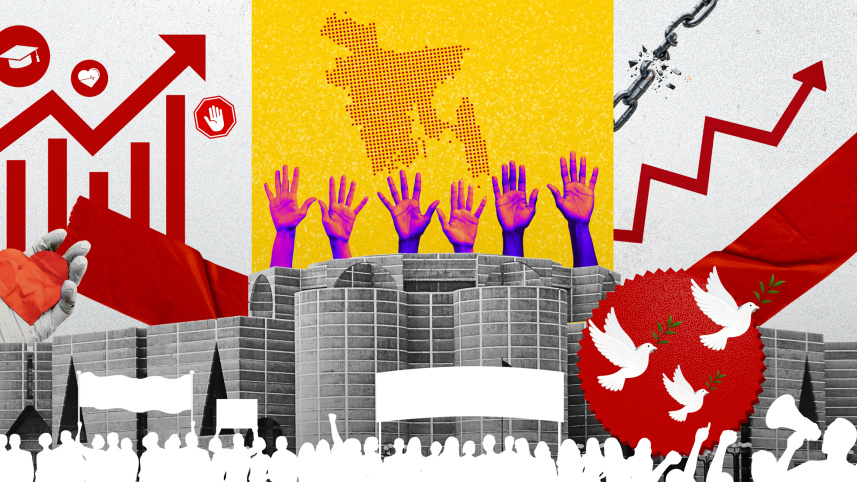
Today, Bangladesh begins a new journey. After over 18 months since the mass uprising, the long-awaited election has finally been held, opening up the path for a democratic transition. After any election, it is natural that one party will form the government and another will be the opposition. The question for now is whether a large section of the voters have participated in the election, and whether the electoral process has been relatively free from external interference or disturbance. Going by initial estimates, the election has certainly passed the test.
While all our expectations from this pivotal moment may not have been fulfilled, we have, nevertheless, obtained a roadmap for moving forward. Bangladesh is soon going to have a parliament with members elected through a largely credible competition. Citizens are going to have a team of their choice at the helm of the state and as their political guardians. In the coming days, political authority and a healthy political environment must be restored at every level of society. Instead of reactionary YouTubers and social media influencers, elected representatives must be at the helm of things, both in parliament and outside.

A new national parliament is also a nod to the rebuilding of our fragile political institutions. Through their campaigns prior to the elections, political parties have already begun reorganising themselves. Those who could not take part in the election could, in time, also return through a process of reorganisation. In other words, Bangladesh’s political reconstruction has begun anew.
Going forward, our primary expectation is that the new government will make parliament the central platform for all national decisions, be it political, economic, or social. Policy decisions must not be made at the Secretariat by bureaucrats, but by the elected representatives, and implemented through the executive branch. In this regard, we must stress the importance of empowering the local government, a vital but persistently ignored segment of the administration. Due to the lack of credible polls and support from the state, the union parishads, upazila parishads, zila parishads and other local government bodies have long been weakened, undermining grassroots democracy and service delivery, an imbalance the new government must fix. Our farmers are suffering. Local communities are struggling under the double-digit inflation. Poverty has risen. Past MPs showed little interest in developing or empowering the local government bodies, which has only obstructed the country’s overall development. At this moment of national renewal, we hope the new government will sufficiently empower and activate the local government.
Another area demanding immediate attention is the reconstruction of the police force. It still remains structurally and morally weak. The public does not want police to return to its pre-July uprising state. The resentment caused by the police during the uprising must be remembered objectively by the incoming government. People want a police force that is both corruption-free and free from political influence. The interim government, beyond changing uniforms, could do little to achieve that goal, so it is crucial that the new parliament and government focus on reorganising the force to make it truly professional.
Bangladesh cannot go back to the culture of enforced disappearance, extrajudicial killing or custodial torture of political opponents and ideological dissenters. Intelligence agencies, too, must therefore be transformed. Many within these agencies will likely seek favour with the newly elected government as soon as it is formed. Perhaps the government’s first test will be whether it considers such overtures strictly through a professional lens. If freed from partisan influences, police and intelligence agencies can certainly perform much better, and they should.
Another urgent task is a national initiative for social reconciliation. Both Jamaat-e-Islami and BNP mentioned this in their manifestos. The interim government also initially said it would form such a commission to free the country from the cycles of revenge and retaliation. But it could not do so. Perhaps it was too early. But the new government must undertake this task to signal the coming of a new era.
National reconciliation must proceed on two tracks: political and economic. Beyond ideological differences, class reconciliation within society must also be addressed. Both are difficult tasks, but must be accomplished anyway.
Political reconciliation must go beyond all forms of criminal offences. Past criminal offences must be tried with absolute neutrality and professionalism, but that doesn’t mean that local communities should be left in an endless wildfire of revenge. Many forces at home and abroad would like to see Bangladesh smouldering in such embers. But our socioeconomic prosperity lies in national unity and cohesion. From the outset, the new parliament and government must pursue social reconciliation through a participatory process that includes all political groups, as well as all socioreligious categories.
As part of its mandate and July National Charter obligations, the new government will likely soon start undertaking various reform initiatives. The sustainability of these initiatives will, however, depend on durable political unity, proper planning and enforcement, and reconciliation-oriented outcomes. Well-planned initiatives can also help manage the supervisory impulses of certain influential countries and also open the way for substantial domestic and foreign investment. In this connection, a foremost task will be to construct a non-discriminatory economy. The youth are waiting eagerly. They want change, and elected leaders must deliver that.
It is worth recalling that, as in Bangladesh, mass uprisings in Sri Lanka and Nepal were also largely driven by economic injustice. In our case, economic injustice has two aspects. On the one hand, income and wealth inequality are rising; on the other, we are witnessing growth without investment and employment. Both must be reversed.
Progressive tax reform is needed, and the additional domestic resources generated must be channelled into education and healthcare, especially in marginalised communities and districts. Both BNP and Jamaat pledged in their manifestos to allocate more than five percent of GDP to education and health, which means there is already broader political consensus on rebuilding and expanding these two sectors. The new parliament just has to translate that consensus into concrete legislation, proper budgetary allocations, and effective enforcement. Emphasis must be given on quality education and pro-poor healthcare.
However, any reform initiatives could collapse if the trend of mob violence witnessed over the past 18 months is not stopped. One of the parliament’s primary priorities must, therefore, be to rescue society from this anarchic atmosphere and establish a rights-based order in the country. During the interim period, mob violence has inflicted heavy damage on our social cohesion. Women and minority communities have especially suffered immense physical, psychological and material harm. In this climate, the seeds of armed extremism have been increasingly visible. Some political actors have even fuelled these tendencies, exploiting existing socioeconomic vulnerabilities.
To address this, three simultaneous actions are necessary: i) a pro-poor economic reform, giving priority to marginalised districts and upazilas in resource distribution; ii) ensuring democratic practice at every level of administration, from the centre down to the union level; iii) firm policing against any form of extremism. Without these measures, securing a peaceful future will be difficult. Let these be the foundation on which the new parliament operates.
Altaf Parvez is a researcher and political analyst.
Views expressed in this article are the author's own.
Follow The Daily Star Opinion on Facebook for the latest opinions, commentaries, and analyses by experts and professionals. To contribute your article or letter to The Daily Star Opinion, see our guidelines for submission.
 For all latest news, follow The Daily Star's Google News channel.
Comments