


West Bengal poll politics tests the limits of Dhaka-Delhi reset process

“Detect, delete, deport.”
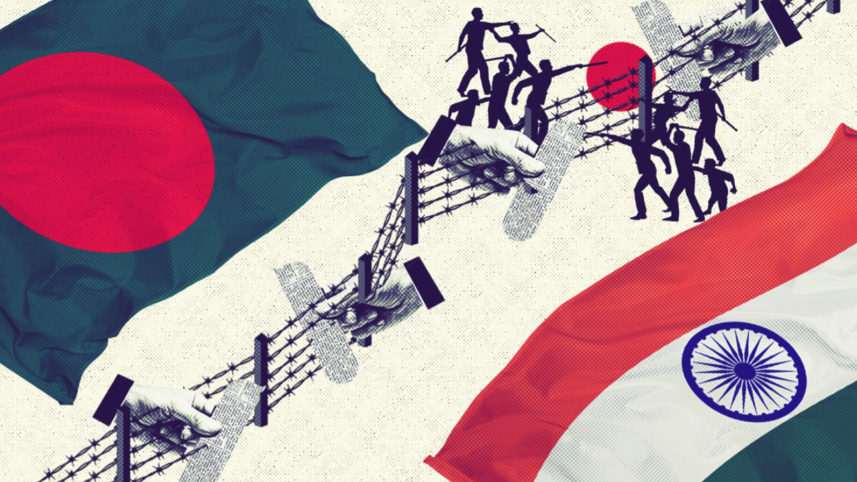
That three-word formulation has become the defining doctrine of India’s ruling Bharatiya Janata Party (BJP) in the run-up to West Bengal’s two-phase assembly elections scheduled for April 23 and 29. The party has placed illegal migration at the centre of its political and security narrative, more sharply than in previous campaigns, so Bangladesh has naturally emerged as a reference point. That has implications far beyond state politics, especially at a time when Dhaka and New Delhi are trying to rebuild ties after a sharp downturn following the fall of Sheikh Hasina in August 2024.

For years, BJP has used the issue of so-called “illegal infiltration” from Bangladesh as a political tool in Assam, where demographic anxieties have long shaped electoral behaviour. The Assam assembly election is now over, but the narrative has not receded—it has shifted, recalibrated, and intensified in West Bengal. Terms like “infiltrators,” “outsiders,” and “illegal entrants” are dominating campaign speeches, frequently without naming Bangladesh directly. But the subtext is widely understood.
The strategy is deliberate. Bengal’s politico-cultural landscape demands a more calibrated tone than Assam. Direct references to Bangladeshis—especially Bengali-speaking Muslims—carry electoral risks. But the core message remains intact: migration is a threat to identity, resources, and security. Prime Minister Narendra Modi, addressing a rally in Purba Bardhaman district on April 11, delivered one of the sharpest statements yet: “The infiltrators should start packing their bags; it is time to leave. Those who have helped the infiltrators will not be spared.”
The phrasing is striking not just for its directness, but also for its implied consequences. Across the campaign, BJP leaders have moved beyond general warnings. They are setting implicit deadlines for “infiltrators” to leave, linking migration to voter fraud and welfare leakage, and framing it as a national security issue.
In West Bengal politics, as an Atlantic Council columnist has noted, Bangladesh functions “less as a foreign policy concern than a domestic political proxy through which citizenship, demography, and belonging are contested. For the BJP, references to Bangladesh collapse cross-border history into a narrative of undocumented migration and demographic threat.” In effect, Bangladesh is no longer just a neighbour but a symbol within India’s domestic political contests.
This transformation simplifies a rather complex, historically rooted migration issue into a binary political narrative: insiders versus outsiders. The political utility of the narrative is clear. By linking migration to jobs, welfare, and security, BJP taps into local anxieties while aligning them with a broader national ideology. The result is a message that resonates across constituencies. Even administrative measures are framed within this lens. The revision of electoral rolls through the controversial Special Intensive Revision (SIR), which saw millions of names removed in West Bengal, has been projected by some as a clean-up of “illegal Bangladeshis.”
At the same time, any report of communal tension in Bangladesh is quickly amplified in West Bengal’s political discourse. BJP leader Suvendu Adhikari, seen as a potential chief ministerial face if the party wins, has repeatedly sought to link developments in Bangladesh to security and demographic anxieties in Bengal. In campaigns, he has expressed deep concern over Bangladesh’s February 2026 election results, specifically regarding the performance of Jamaat-e-Islami in constituencies along the Indo-Bangladesh frontier.
All of this is unfolding at a sensitive moment in bilateral relations since the 2024 political transition in Bangladesh. The new government under Tarique Rahman has signalled a pragmatic approach, emphasising mutual respect and reciprocity under a “Bangladesh First” policy. New Delhi, too, has indicated a willingness to engage. But the contrast between diplomatic engagement and campaign rhetoric is stark. While officials on both sides speak of cooperation, political messaging in Bengal continues to cast Bangladesh in a negative light.
For the BNP government, this is both embarrassing and politically uncomfortable. Built historically on an anti-India sentiment, the party chief has consciously repositioned it towards a more centrist and moderate stance. Notably, its election campaign avoided overt anti-India rhetoric. Since assuming office, Tarique Rahman has moved quickly to signal a reset in ties with New Delhi. Yet what he sees across the border is the public demeaning of Bangladesh by the very leaders he is keen to engage and rebuild ties with.
The Bengal campaign, in effect, is acting as a rhetorical drag on diplomacy. Some observers have already flagged this tension. Writing in Deccan Herald after a recent visit to Delhi by Bangladesh’s foreign minister, Smita Sharma suggested that India should tone down its rhetoric. “India would do well to ease up medical visas and resume cricketing ties with the neighbour once the unfortunate shrill rhetoric over Rohingya Muslims and Bangladeshi infiltrators by the BJP campaigners in Assam and West Bengal calms down,” she wrote.
For now, however, there is little indication that BJP is willing to soften its tone in the middle of a crucial election. The rhetoric may well subside once the dust settles following the West Bengal elections, but it is likely to leave a scar. In Bangladesh, memories remain sharp—particularly of Amit Shah’s 2018 remark describing illegal Bangladeshi migrants as “termites.” That phrase continues to resonate, reinforcing perceptions of hostility and making the task of rebuilding trust between the two countries more difficult.
Rhetoric matters in international relations, especially between neighbours with deep historical and cultural ties. India’s strong reaction to remarks by Prof Muhammad Yunus, who described India’s northeast as “landlocked” and Bangladesh as the “only guardian of the ocean,” illustrates how sensitive such language can be. From Dhaka’s perspective, the continued portrayal of Bangladeshis as “infiltrators” and sources of instability is equally sensitive. Ironically, India expects rhetorical restraint from Bangladesh on issues related to its security, but its own political discourse often overlooks Bangladesh’s concerns.
For the BNP government, this presents a delicate challenge. Although Tarique Rahman secured a strong electoral mandate, his government operates under domestic pressure. The Jamaat-NCP opposition coalition continues to mobilise anti-India sentiment, ensuring that any engagement with New Delhi is closely scrutinised. In this context, even routine diplomatic gestures may acquire political significance. If Dhaka appears overly accommodating while Indian leaders publicly link Bangladesh to infiltration and security threats, it risks triggering domestic backlash, a pattern evident during Sheikh Hasina’s tenure. Yet a confrontational approach would equally undermine the broader objective of stabilising bilateral ties. The space for manoeuvre is limited.
A significant segment of Bangladesh’s population, especially Gen Z youth who led the 2024 uprising, still view India with deep suspicion. The grievance is rooted, among other factors, in inflammatory rhetoric from sections of Indian media and political circles. This dynamic was evident during the interim government period, when Indian narratives about minority issues in Bangladesh triggered strong reactions in Dhaka. In West Bengal, the amplification of such issues for electoral gain further narrows the space for diplomacy.
At the heart of this strategy lies the politics of perception. Migration is a complex issue shaped by geography, economics, and history. But in electoral politics, it is often reduced to a simple narrative: outsiders taking what belongs to insiders. Research shows that perceived demographic threat, rather than empirical evidence, plays a decisive role in shaping voter behaviour. In this sense, the “Bangladeshi infiltrator” functions less as a measurable category and more as a political symbol.
The Bengal and Assam elections have turned Bangladesh into a central, if implicit, theme in India’s domestic politics. For BJP, the strategy is seen as electorally effective. For bilateral relations, the effects could be ruinous. Whether these contrasting scenarios—engagement in diplomatic corridors, confrontation on campaign trails—can be reconciled will determine the trajectory of Bangladesh-India relations in the months ahead.
Shakeel Anwar is a former journalist at the BBC.
Views expressed in this article are the author's own.
Follow The Daily Star Opinion on Facebook for the latest opinions, commentaries, and analyses by experts and professionals. To contribute your article or letter to The Daily Star Opinion, see our guidelines for submission.
 For all latest news, follow The Daily Star's Google News channel.
Comments