


West Bengal polls: The dubious logic of ‘logical discrepancy’

Today, the penny drops.
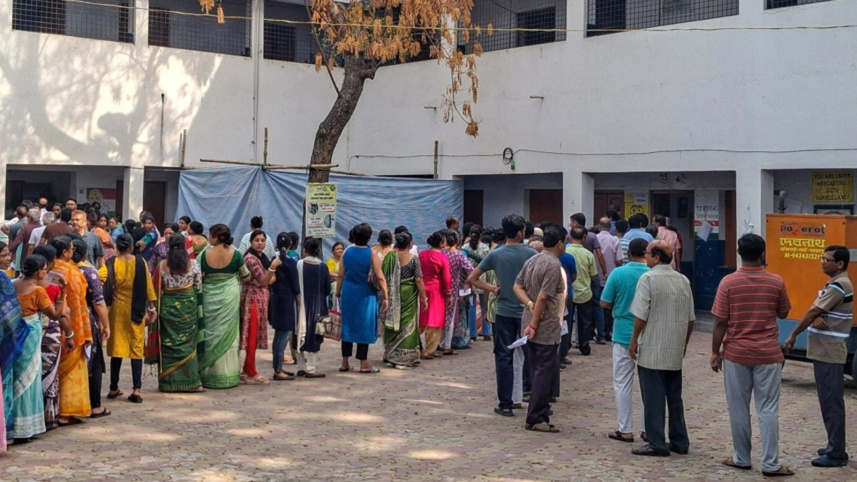
After a rambunctious and bitter electoral campaign followed by elections in two phases in West Bengal, vote counting begins today. By the end of the day, we will likely learn the verdict of our (mostly) Bengali neighbours across the border.

This assembly election has been marked by heavy-handed machinations of India’s election commission. Here’s an example of the Kafkaesque bureaucratic nightmare it is getting people into: according to reports, a number of poll officers (a significant number of them Muslim), while themselves barred from voting, are obliged to conduct the polls. This paradox reminds me of a situation I found myself in as a US graduate student decades ago. On the question of state residency, I was informed that for tax purposes I was considered in-state (I had to cough up the tax on my meager earnings), but for tuition purposes I was out-of-state (I had to cough up the extra out-of-state fees).
But let’s not digress. The Election Commission faces legitimate, serious questions, but it is mitigated considerably by the fact that at the end of the day, West Bengal elections were held relatively peacefully, a huge achievement given the state’s torrid record.
India’s Election Commission has a storied reputation to defend. Its first chief, Sukumar Sen, was a stern, no-nonsense ICS officer who built the entire system from scratch, no mean achievement. India’s first Lok Sabha elections were considered a huge success, and today’s system rests largely on Sen’s creation. Who can forget the delightfully cantankerous, straight-shooting, and fiercely independent curmudgeon, T.N, Seshan, India’s election chief in the 1990s, who brooked no nonsense from political heavyweights?
Today’s Election Commission, it is fair to say, has lost a bit of its sheen. Its attempt to prune the voter rolls through a process called Special Intensive Review (SIR) makes sense, but what has raised the hackles of a huge number of voters is the way it has gone about it in West Bengal.
Some 91 lakh names were initially deleted following a Special Intensive Revision (SIR) of electoral rolls, according to data released by the EC. The SIR is a process to verify voter lists by removing ineligible, duplicate, or questionable entries. Later, using a murky algorithm, about 27 lakh voters have been knocked off the voter rolls by a special procedure known as “logical discrepancy.” Logical discrepancy, a broad category for inconsistent voter data, is criticised because it relies on subjective judgment rather than clear-cut proof. Some of these cases are under adjudication.
However, plenty of anecdotal evidence show people had been wrongly removed from voter lists. A husband and children were voters, the wife was not. Somebody serving in the army for years was struck off. Kin of celebrities like Netaji Subhas Bose or Nandalal Basu were informed they could not vote. What made the situation precarious was that this was happening so soon before the elections that even if the court adjudicated in a person’s favour; the relief for the voter would come too late and the lofty pledge of making sure every vote would be counted would prove to be hollow.
The fearsome scrum that followed is heartbreaking. Desperate people, including the old and infirm, went from pillar to post with all their documents to have their names back in the voter rolls. The courts provided some relief by setting a deadline and ruling that anybody who got his or her name back in the voter roll by that deadline would be able to vote. But this was too little, too late. Out of the 27 lakh voters, barely a few thousand cases were adjudicated. And, here is the most remarkable part. Of the few thousand cases that were adjudicated, over 95 percent won back their right to vote.
This casts a heavy doubt on the entire process of logical discrepancy. If most of the cases that reached the appellate stage could be restored, how reliable were the original decisions that rendered these voters ineligible? And what does it say of an electoral verdict where millions of voters are effectively disenfranchised? Can it be enough to change the verdict?
Of course, there is the question of whether there is any discernible pattern in the way people have been struck off the voter rolls. Here’s where the Election Commission’s actions border on the sinister. The voter data it has provided is not in machine-readable Excel sheets, where number-crunchers can get to work to see if any particular group has been targeted. It has been given out as “I am not making this up” PDF lists. Which means names have to be manually entered to make any sense of the data. The EC excuse, that this is done to maintain the security of the data, is patently absurd.
The state polls will determine whether firebrand Trinamool leader and West Bengal Chief Minister Mamata Banerjee will win a fourth term, or the opposition Bharatiya Janata Party will finally be able to topple Trinamool. BJP has pulled out all the stops. Prime Minister Narendra Modi, several BJP chief ministers have been making the rounds, and BJP’s Machiavellian mastermind and central Home Minister Amit Shah has stationed itself in West Bengal. As is the BJP’s wont, its campaign is leavened with a heavy dollop of Muslim-baiting. BJP leader Shuvendu Adhikari likes to say there are about a crore Bangladeshi Muslims and Rohingyas in West Bengal. That’s a lot of people. Where on earth are they? Why would they go to West Bengal, whose own people are leaving in droves to work as migrant workers in states as far as Kerala?
For all the huffing and puffing, the EC exercise, for all the turmoil it has caused and all the genuine suffering of millions of people of West Bengal, has failed to identify a single ghuspetiya, Modi’s favoured epithet for (phantom) Bangladeshi Muslim migrant.
The Trinamool, to be sure, has its own handicaps. Allegations of extortion, large-scale corruption, and political shenanigans of all sorts bedevil the party but it has two solid strongholds in disadvantaged women through its Lakshmir Bhandar stipends, and Muslims who seem to depend on Didi to keep the big bad BJP wolf away. Ironically for the BJP, the whole SIR exercise might well turn out to be a Pyrrhic exercise. The anger it generated among multitudes of genuine voters who had to go through the indignity of their legitimacy being questioned has thrust this issue to the very top, undercutting the anti-incumbency sentiment.
Will Mamata Banerjee have the last laugh after all? We will know by the end of the day.
Ashfaque Swapan is an Atlanta (US) based freelance journalist.
Views expressed in this article are the author's own.
Follow The Daily Star Opinion on Facebook for the latest opinions, commentaries, and analyses by experts and professionals. To contribute your article or letter to The Daily Star Opinion, see our guidelines for submission.
 For all latest news, follow The Daily Star's Google News channel.
Comments