


Dhaka’s Metro: Why are we paying so much?

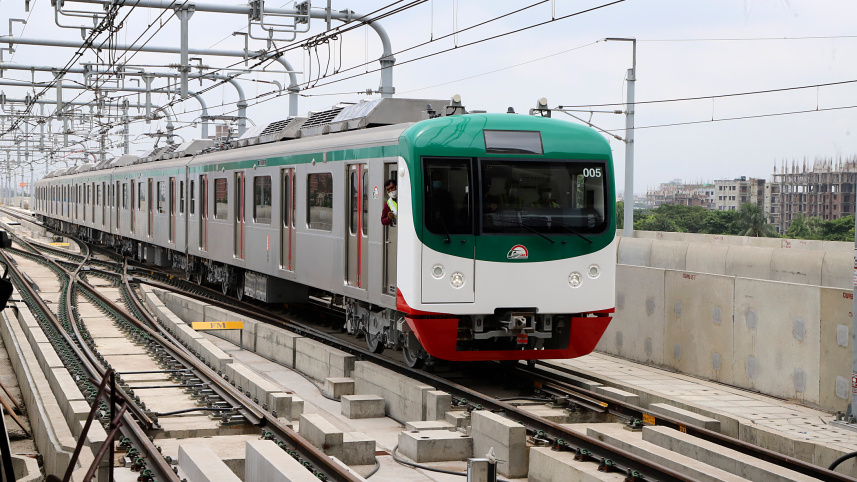
The issue of abnormally high costs in metro rail construction in Bangladesh has long been a subject of discussion and criticism. During the tenure of the Awami League government, the metro rail line from Uttara to Motijheel (MRT-6), built with loans from the Japan International Cooperation Agency (JICA), was alleged to have cost several times more per kilometre compared to similar projects constructed in other countries during the same period.
There was an expectation that after the fall of the AL government, the practice of excessive spending in infrastructure projects like metro rail would come to an end. However, as reported by Prothom Alo, for two new metro routes in Dhaka, Japanese contractors are now quoting costs per kilometre more than double those of the Uttara–Motijheel line.The cost per kilometre for MRT-6 was Tk 1,574 crore, whereas for the planned MRT-1 from Kamalapur to the airport to Purbachal and MRT-5 (North) from Hemayetpur to Bhatara, the estimated cost per kilometre would be Tk 3,618 crore .Such high costs will not only increase fare pressure on passengers but also add to the country’s debt burden.
 For all latest news, follow The Daily Star's Google News channel.
 A significant portion of Bangladesh’s infrastructure development projects relies on foreign loans. These lending agencies are often referred to as “development partners,” and their loans as “assistance.” However, there is an ongoing debate about whether these loans truly support the recipient country’s development or primarily serve to expand the lender country’s business and exports.
In many cases, institutions from the lending country are involved in planning the project, conducting feasibility studies, consultations, and even implementation as contractors. Most procurement is also sourced from the lender country. This creates a conflict of interest, undermines objective cost assessment, and leads to inflated project costs. While corporations from the lending country benefit, the people of the borrowing country bear the burden due to high costs and questionable feasibility. Bangladesh’s metro rail projects are a prime example of this dynamic.
JICA finances metro rail construction in Bangladesh. A Japanese consultancy firm, Nippon Koei, plays a key role in preparing and evaluating tender documents. According to a report by Prothom Alo, loan and tender conditions appear to be structured to make it easier for Japanese companies to secure contracts, effectively excluding competitors from other countries.
For instance, MRT-1 tender documents require the use of the “one-pass joint” method for tunnel construction, which is favourable to Japanese contractors. Similarly, only specific types of Japanese steel, produced by only three companies in Japan, are allowed for bridge construction. Even if contractors wish to use equivalent steel from other countries, they must obtain approval from the Japan Road Association.
Due to these conditions, even open tenders fail to attract contractors from outside Japan. Typically, only two or three Japanese firms participate in the final bidding process, and their quoted prices must be accepted. As a result, metro rail construction costs under JICA financing are several times higher than comparable projects in neighbouring countries.
For example, MRT-6 in Dhaka had cost Tk 1,574 crore per kilometre. In contrast, similar elevated metro systems in India cost about Tk 150 crore per kilometre, and underground systems cost up to Tk 450 crore per kilometre. In other countries, costs are also significantly lower. According to an analysis by Dhaka Mass Transit Company Limited (DMTCL) cited by Prothom Alo, metro construction costs per kilometre are Tk 672 crore in Turkey, Tk 448 crore in the Ivory Coast, Tk 784 crore in South Korea’s Seoul, and Tk 740 crore in Thailand’s Bangkok. However, as already stated above, under the current JICA conditions for MRT Lines 1 and 5, costs in Dhaka are projected at Tk 3,618 crore per kilometre, which is much higher than global benchmarks and more than double that of MRT-6.
India also implements infrastructure projects using foreign loans, but does not accept conditions that undermine competitive bidding. As a result, local contractors often secure contracts, keeping costs lower. For example, metro construction in Patna, Bihar—also financed by JICA—is being executed by Indian contractors at a cost of Tk 450 crore per kilometre for underground sections. In contrast, Bangladesh’s acceptance of restrictive loan conditions creates a severe conflict of interest in which the same country’s entities plan, finance, study, consult, and execute the project.
JICA justifies higher costs by citing superior quality standards, arguing that higher upfront costs reduce maintenance and repair expenses in the long run. This argument is unconvincing. First, if JICA can maintain quality in Patna at Tk 450 crore per kilometre, why is Bangladesh’s cost projected to be eight times higher?
Second, according to a DMTCL report, the Uttara–Motijheel metro system has 45 defects and deficiencies, which contradict claims of superior quality. These include 10 issues in signalling and telecommunications, 16 in electrical systems, 10 in civil engineering, and nine related to trains and associated systems. The report also notes water leakage at 89 locations across 16 stations. Trains sometimes fail to stop precisely at designated points. Rust has appeared on tracks in depot areas. Sensor malfunctions have disrupted operations. Air conditioning systems have frequently failed. Ticket vending machines and energy storage systems often break down. Due to substandard bearing pads and design flaws, a bearing pad detached in the Farmgate area, causing the death of a pedestrian.
JICA also attributes cost escalation to expanded project scope, currency depreciation, and rising material costs. However, to verify these claims, open competitive bidding is essential. Currency fluctuations and global price increases affect all contractors, not just Japanese firms. Only through genuine international competition can the true cost be determined.
There is no doubt that the metro rail is necessary to address traffic congestion in a densely populated capital like Dhaka. However, constructing such infrastructure at abnormally inflated costs is unacceptable. There should be no obligation to accept unreasonable conditions out of gratitude towards a foreign lender. Loan repayments ultimately come from taxpayers, and higher construction costs translate into higher fares for the public.
Therefore, metro rail projects must ensure open tendering and fair competition, control excessive costs compared to global standards, and rely on domestic experts and institutions in decision-making. Otherwise, under the guise of development, public funds will continue to serve the commercial interests of foreign entities rather than the people of Bangladesh.
Kallol Mustafa is an engineer and writer who focuses on power, energy, environment, and development economics. He can be reached at kallol_mustafa@yahoo.com.
Views expressed in this article are the author's own.
Follow The Daily Star Opinion on Facebook for the latest opinions, commentaries, and analyses by experts and professionals. To contribute your article or letter to The Daily Star Opinion, see our guidelines for submission.
Comments