


What cruelty to animals says about our society


A few days ago, I was scrolling through my social media feed when I came across a video from Patuakhali showing two men tying up two dogs and beating them to death. As horrifying as the act itself was, the comment section was equally disturbing. It was filled with people justifying the violence, saying things like, “There must have been a reason for this,” or “All street dogs do is harm pedestrians; they need to be dealt with.”
This raises an important question: what has happened to our moral values? How has such cruelty become so normalised in our society?

A society is often judged by the way it treats its most vulnerable members. When thinking about this, many people assume it applies only to humans. However, a country's inhabitants also include all living beings who share its land, not just humans. This principle is therefore equally relevant to animals, as they cannot speak for themselves, seek justice, or defend themselves against cruelty. Yet the way we treat them says far more about our moral character than we often realise. In Bangladesh, animal abuse and abandonment have become so common that they are often dismissed as everyday occurrences rather than recognised as serious ethical failures with long-term consequences for our society.
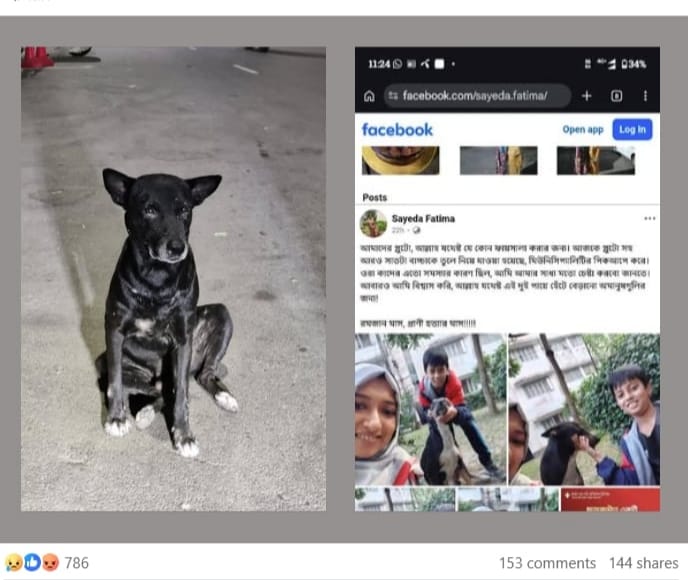
Across Bangladesh, stray dogs are beaten for wandering into neighbourhoods, cats are abandoned after families move away, and in some residential communities, cats are driven away or even poisoned because they are seen as a nuisance. Injured animals are left to suffer on roadsides with little hope of receiving help. Newborn kittens and puppies are frequently abandoned in boxes or sacks near markets, mosques, or garbage dumps because they are considered unwanted. Many people walk past these scenes without a second thought. Others justify such actions by claiming that they are "just animals." When society begins to accept such suffering as normal, it loses an important part of its humanity.
Abandoning a pet that has depended on humans for food, shelter, and protection is a form of cruelty. Leaving a sick or injured animal to fend for itself, knowing it has little chance of survival, is a moral decision with real consequences. Anyone who follows animal welfare communities on social media will regularly come across posts showing how often pet cats and dogs are abandoned simply because they are no longer wanted. These animals are treated as disposable rather than as living beings capable of experiencing fear, pain, and affection. But does their inability to speak make their suffering any less real?

The normalisation of cruelty is not merely a legal issue but also an ethical one. More than two centuries ago, the German philosopher Immanuel Kant, one of history's most influential thinkers on ethics, argued that morality is based on duty and respect for moral principles rather than acting out of convenience or self-interest. Although his philosophy focused primarily on duties towards other human beings, he also believed that cruelty towards animals could erode our capacity for kindness and compassion. Modern interpretations of Kant's philosophy build on this idea, suggesting that habitual cruelty towards animals weakens essential virtues such as empathy, self-control, and respect for life. A person who becomes comfortable inflicting pain on a defenceless animal may gradually become less sensitive to the suffering of fellow human beings. In this sense, protecting animals is not only about safeguarding their welfare but also about preserving our own moral integrity.
But we are witnessing the erosion of empathy in our society. Every day, people mock others' pain, dismiss genuine suffering as weakness, or disguise cruelty as "banter." Indifference towards animal suffering may be another symptom of this growing lack of compassion. Recognising the need for greater protection, Bangladesh enacted the Animal Welfare Act, 2019, replacing the outdated Cruelty to Animals Act of 1920. The law criminalises unnecessary pain, poisoning, disfigurement, and killing of domestic or captive animals. Yet legislation alone cannot bring change if it is not consistently enforced.
The woman who killed eight puppies in Pabna was arrested and later secured bail in December 2025. However, the Japan Garden City dog killings have yet to receive justice, although a case has been filed against the main perpetrators. Many other cases of cruelty never make headlines and receive little or no legal attention. While animal welfare organisations, volunteers, and compassionate citizens continue to rescue injured and abandoned animals, their efforts alone cannot solve the problem. Effective enforcement of existing laws, timely investigation of reported abuse, and appropriate penalties for offenders are essential if these laws are to serve their purpose. More importantly, society must stop treating animal welfare as a minor issue that can always be ignored.

The future of our younger generation also depends on the consequences of normalising such cruelty. Children learn empathy by observing the behaviour of the adults around them. When they see animals being abused, abandoned, or treated as worthless without consequence, they may begin to believe that such behaviour is acceptable. Conversely, teaching kindness towards animals encourages empathy, responsibility, and respect for life. These are qualities that strengthen not only individual character but also society as a whole. Some argue that Bangladesh faces many urgent human problems, including poverty, unemployment, and inequality, and that animal welfare should not be a priority. However, multiple problems can coexist, and compassion should never be a limited resource. Caring for animals does not diminish our concern for human beings. Instead, it reflects a broader commitment to justice, responsibility, and ethical living.
Animals are the silent victims of human choices. They cannot report abuse, demand justice, or explain their suffering. Their survival depends largely on our willingness to recognise that their lives have value beyond their usefulness to us. Ultimately, a truly developed society is not defined solely by its economic progress or technological achievements, but by the compassion, justice, and humanity it shows to every living being that shares the world.
Nazifa Tasmim is a BBA student at the University of Liberal Arts Bangladesh (ULAB).
Views expressed in this article are the author's own.
Follow The Daily Star Opinion on Facebook for the latest opinions, commentaries, and analyses by experts and professionals. To contribute your article or letter to The Daily Star Opinion, see our guidelines for submission.
 For all latest news, follow The Daily Star's Google News channel.
Comments