


Why Bangladesh should be patient in its nuclear journey

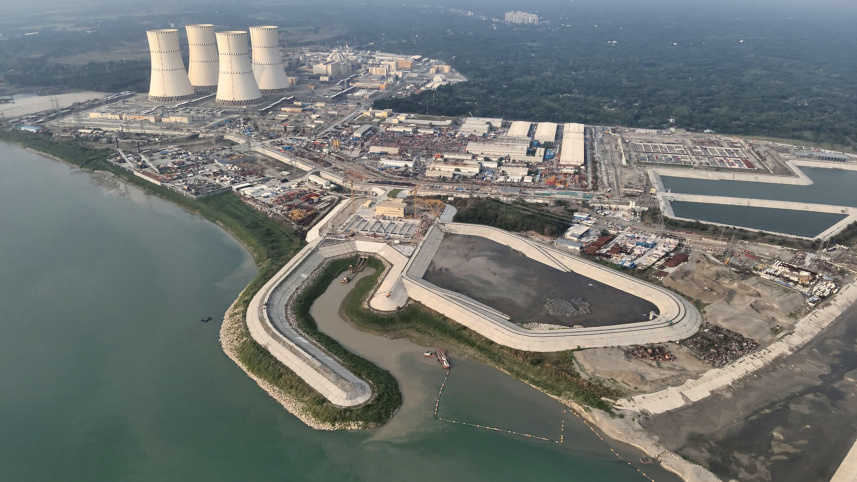
As Bangladesh’s first-of-a-kind nuclear power plant nears completion at Rooppur, policymakers are already discussing whether to deploy Small Modular Reactors (SMRs) or add two more large reactors to the energy portfolio. The ambition is understandable. However, the timing demands far greater caution.
Rooppur’s two VVER-1200 units are expected to be commissioned by 2028, with Unit 1 generating electricity within months and Unit 2 following next year. Yet even as this milestone approaches, and before gaining full operational experience, a critical question remains: should Bangladesh deploy SMRs or additional large reactors at Rooppur as Units 3 and 4, or at entirely new sites?

Bangladesh’s Power System Master Plan 2016 envisaged nuclear capacity well beyond Rooppur. Between 2017 and 2021, preliminary site surveys were conducted across the southern coastal belt. With electricity demand forecast to reach 61 gigawatts by 2041 and an installed capacity of nearly 30,000 MW that routinely underperforms during peak summer months, the urgency is real. The question is not whether to expand nuclear power, but how, and in what sequence.
What is an SMR?
An SMR is a nuclear reactor with an electrical output of up to 300 MW—a fraction of the 1,200 MW generated by each Rooppur unit. The International Atomic Energy Agency (IAEA) reports at least 72 distinct SMR designs under development across 18 countries. Their advantages are compelling: factory fabrication reduces construction time (typically three to five years) and upfront capital costs; passive safety systems make core meltdown far less likely than in conventional large plants; and refuelling is needed only once every 10 to 20 years, eliminating continuous fuel import dependency. Beyond electricity, SMRs can supply high-temperature process heat for green hydrogen production and seawater desalination—pressing needs for a rapidly industrialising nation.
Of the operational SMRs, Russia’s floating pressurised water reactor (KLT-40S) at Pevek port generates 2×35 MW, and China’s high-temperature gas-cooled reactor (HTR-PM) at Shidaowan Bay produces 2×10⁵ MW. Several are under construction: Russia’s floating RITM-200M (50 MW) at Kep Nagloin Island and lead-cooled fast reactor BREST-OD-300 (300 MW) at Seversk; China’s ACP100 (100 MW) at Changjiang, Hainan; and Argentina’s indigenous CAREM30 (30 MW). The US-Japan-developed BWRX-300 (300 MW) has secured construction agreements or MoUs in Canada, Poland, and the Czech Republic. Most other designs, however, remain at the conceptual or regulatory approval stage.
Why Bangladesh needs SMRs, eventually
Bangladesh’s energy insecurity has three structural roots. First, the country relies on imported LNG, oil, and coal for 62.5 percent of its energy, leaving it acutely vulnerable to global price volatility and geopolitical supply disruptions. Second, it imports 2,656 MW of electricity from India—roughly 11 percent of installed capacity—posing a quiet risk to energy sovereignty. Third, grid-connected solar contributes just two percent of the energy mix, and land scarcity imposes hard limits on large-scale solar expansion; intermittency further creates grid stability problems that baseload nuclear power can help resolve. In this context, SMRs represent a genuinely attractive long-term pathway—gradually replacing ageing coal and oil plants, reducing import dependency, and extending reliable power to remote coastal islands and the Chittagong Hill Tracts, currently beyond the national grid’s reach.
Why is now too soon?
Four fundamental constraints make an immediate SMR commitment premature. The first is a deficit of operational experience. Bangladesh has not yet run Rooppur’s units 1 and 2. The institutional memory, technical workforce, and managerial maturity required to safely operate a nuclear facility take years to build. The IAEA notes that building genuine nuclear competence typically requires at least a generational cycle. The second is a regulatory gap. The Bangladesh Atomic Energy Regulatory Authority (BAERA) is relatively new and has limited capacity to develop licensing and regulatory frameworks even for large reactors such as the VVER-1200. SMRs are a diverse and advanced technology, with each design requiring its own safety analysis, licensing procedures, and inspection protocols.
The third is technological immaturity. Of over 72 SMR designs under development worldwide, only two are commercially operational. Most have not yet completed regulatory approval, even in their own countries. The fourth is vendor selection complexity. Which country’s technology should Bangladesh choose? How will long-term fuel supply be secured? Who will manage radioactive waste? Deep dependence on a single supplier carries serious geopolitical risk in the current international landscape.
A three-stage roadmap
The argument here is not against SMRs; it is an argument for proper sequencing. The IAEA’s Milestones Approach makes clear that a nuclear programme requires at least 10 to 15 years of systematic institutional development to mature. Bangladesh is still in the early stages of that journey.
In the first stage, Bangladesh must commission Rooppur units 1 and 2 and accumulate at least three to five years of operational and regulatory experience—the foundational knowledge base upon which everything else depends. Simultaneously, serious investment is needed in strengthening the regulatory body to internationally recognised standards and in building the next generation of nuclear engineers and regulatory specialists.
In the second stage, Bangladesh should proceed with two additional large reactors, each with a capacity of at least 1000 MW, as Units 3 and 4 at Rooppur. Units 1 and 2 alone cannot solve the energy deficit, and expanding to a four-unit site unlocks economies of scale that maximise the long-term profitability of the initial $14 billion investment. By sharing the existing 1,962-acre infrastructure—including cooling systems, transmission lines, exclusion zones, and a trained workforce—Bangladesh can substantially reduce per-unit capital costs. This approach leverages proven technology, a familiar regulatory framework, and operational synergies with units 1 and 2. However, future reactor selection should look beyond a single supplier to diversify geopolitical risk and broaden nuclear diplomacy.
In the third stage, SMRs enter the picture — but only when mature technology, credible supply chains, and a competent regulatory system are in place. Feasibility studies, technology assessments, international partnership frameworks, and SMR-specific workforce development should begin now in parallel, so Bangladesh is ready when the conditions are met. At that point, distributed SMR networks could play a transformative role: replacing ageing fossil fuel plants, electrifying remote coastal communities, and powering export processing zones with reliable baseload electricity.
Bangladesh’s long-term energy security requires a decisive shift away from fossil fuels toward domestically reliable clean energy sources. Nuclear power—large reactors today and SMRs tomorrow—must be central to that strategy. The country that takes its time now, running Rooppur Units 1 and 2 first, strengthening its institutions, training its engineers, and preparing its regulatory framework, will be best positioned to exploit the full potential of nuclear energy. The road to energy security is long. Only deliberate, well-sequenced steps will lead Bangladesh to its destination.
Dr Md Shafiqul Islam is professor of nuclear engineering at the University of Dhaka. He can be reached at msislam@du.ac.bd.
Views expressed in this article are the author's own.
Follow The Daily Star Opinion on Facebook for the latest opinions, commentaries, and analyses by experts and professionals. To contribute your article or letter to The Daily Star Opinion, see our guidelines for submission.
 For all latest news, follow The Daily Star's Google News channel.
Comments