


The solution to Bangladesh’s dengue problem is in our own soil

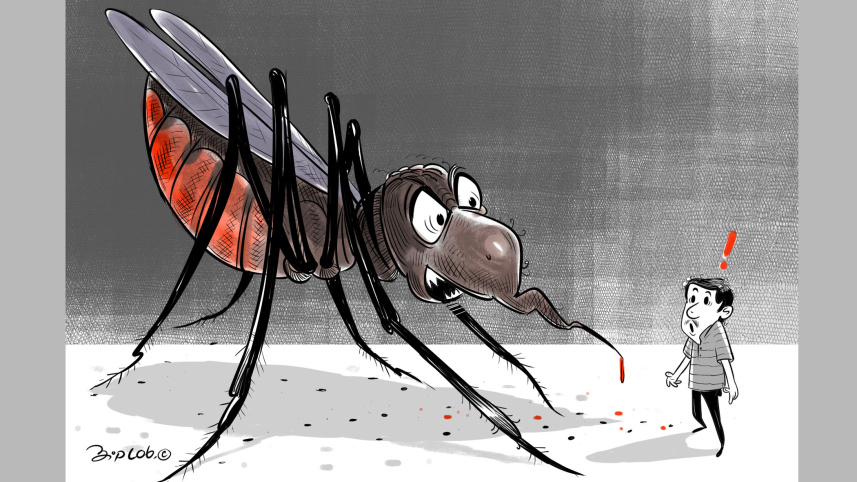
The prime minister recently rejected a proposal for Chattogram City Corporation officials to study innovative mosquito control programmes in Florida, and remarked that spending two or three hours beside any stagnant water body in the country after sunset would be enough to inspire innovative methods for mosquito control. This remark signalled a call to move away from dependence on foreign expertise and focus on domestic solutions built on local knowledge, research, and innovation. It also calls for a discussion on the environmentally friendly Bacillus thuringiensis israelensis (Bti) bacterium and the prospects for producing it in Bangladesh.
Bti is a naturally occurring, soil-dwelling, Gram-positive bacterium recognised as both highly effective and safe for killing mosquito larvae. During sporulation, it produces several toxic proteins that act specifically inside a larva’s gut, killing it outright. Yet the bacterium has no harmful effects on humans, livestock, birds, fish, or other non-target organisms, making it entirely safe for use. Both the World Health Organization and the US Environmental Protection Agency have approved Bti as an eco-friendly pesticide, and many countries have long used this mosquitocidal bacteria-based biopesticide successfully to fight mosquito vector-borne diseases such as dengue, malaria, and chikungunya. Alongside Bti, another bacterium, Lysinibacillus sphaericus, is also being used effectively against Culex and other mosquito species.

Given all this, Chattogram City Corporation’s recent decision to spend nearly Tk 4.5 crore purchasing Bti produced by the US firm Valent BioSciences (which was reportedly meant to fund the official’s visit to Florida) for mosquito control, raises serious questions. There is no clear public information on how effective this imported product actually is, what its environmental impact might be, or how much scientific evaluation it has undergone locally. In an earlier scandal surrounding Dhaka North City Corporation’s Bti imports, Chinese products were found to be passed off as Singaporean by one tendered supplier in 2023, indicating irregularity and opacity hiding inside this import-dependent system. Beyond wasting public money, such unregulated imports also pose real risks to public health if not following national biosafety regulations properly.
But can we not produce Bti-based biopesticides in Bangladesh? And if so, why aren’t we giving our own scientists and laboratories the trust and investment they deserve?
Various Bti strains occur naturally in soil, water, and other natural bodies in Bangladesh. Studies in other countries have found that locally collected strains often control local mosquito populations more effectively than imported ones, as they adapt over years to the region’s temperature, humidity, water chemistry, and mosquito species. An imported strain cannot easily replicate this ecological fit. Bangladesh’s wetlands, ditches, canals, paddy fields, and other farmland harbour a wealth of promising Bti strains. Through systematic collection, purification, and quality testing, we could readily build a domestic biopesticide industry. All that is needed is far-sighted policy, institutional coordination, and a comparatively modest investment.
The gap here is not one of potential but of policy support and willingness to invest. Bangladesh Agricultural University, the University of Dhaka, Shahjalal University of Science and Technology, and other research institutions already have scientists skilled in Bt bacteria, biopesticides, and vector-borne disease control research, many of whom boast internationally recognised work. There is also no shortage of young scientists eager to return home after studying abroad. What holds this talent back is the lack of modern laboratories, stable funding, and policy incentives. The message to policymakers needs to be unambiguous: mosquito-control technology should not be treated as an “importable product,” but as an opportunity for developing domestic innovation.
Building a domestic Bti-based biopesticide industry could follow a few clear steps. First, samples should be collected from wetlands, soil, and other sites nationwide to identify promising Bti and Lysinibacillus sphaericus strains, while laboratory testing should be used to select the most effective ones. Second, a proper biopesticide research facility should be built around these strains, equipped for their preservation, fermentation, spore-drying, and formulation. Third, a low-cost pilot production unit could be set up with relatively little risk as an initial investment of Tk 5-10 crore would be enough to get a scalable facility running. Finally, field trials in the most mosquito-inhabited areas could confirm safety and effectiveness before a nationwide rollout.
Additionally, the aforementioned initial investment could help establish a modern biopesticide industry that would be under domestic ownership and save millions in foreign currency every year over the long term. If Dhaka’s two city corporations and other urban authorities formed a joint consortium, the investment burden would be shared rather than falling on a single institution. A coordinated national biopesticide initiative involving the ministries of local government, science and technology, and health would make this far from difficult to implement, while grants or low-interest financing from bodies such as the WHO, Unicef, or climate-finance platforms could also be tapped into.
Beyond meeting domestic needs, there is real scope to export Bangladeshi Bti to neighbouring countries. Myanmar, Nepal, Bhutan, Sri Lanka, and several African nations face heavy demand for affordable biopesticides to fight malaria and dengue, and India, Thailand, and China are already working to expand into these markets. Bangladesh’s low production costs, favourable climate, and skilled workforce could make the industry competitive. The payoff would be twofold: lower risk from mosquito-borne diseases at home, and new jobs and foreign-currency earnings from abroad. In effect, a green industrial revolution.
Demand for biopesticides extends beyond public health into agriculture. A study by the Department of Entomology at Bangladesh Agricultural University, supported by the UN Food and Agriculture Organization, found that at least 109 biopesticides are currently registered in Bangladesh. Most of these are pheromones and other semiochemicals or botanical products, while microbial biopesticides represent a very small share. Even so, the rising number of registered products, supportive government policy, and growing private-sector interest, all point to increasing use of microbial agents, pheromones, and botanical pesticides in recent years.
The prime minister’s remark about “sitting by a ditch” carries real symbolic weight. His point was that solutions often lie right at our doorstep, in the soil, in the water, in our laboratories, and in the minds of our own scientists. What is needed is simply the willingness to look, and a problem-solving mindset. Using Bti or similar mosquito-killing bacteria is exactly that kind of solution.
The dengue situation in Bangladesh in 2025 was severe, with the death toll at 413 against 1,02,861 reported cases. As per data from the Directorate General of Health Services (DGHS), there have been 19 recorded dengue deaths and 6,597 cases this year so far. Experts have also predicted high incidence later this year.
With hundreds of people dying every year from dengue and chikungunya, there is no moral or practical justification for continuing to deepen our dependence on foreign suppliers for solutions. We should choose to stand behind our own scientists, research institutions, and entrepreneurs to start a new chapter of made-in-Bangladesh biopesticides. The opportunity is still within reach. But if we let it slip, the same cycle of spending crores abroad without receiving a lasting solution will repeat itself. The time to build our own self-reliant, environmentally sound mosquito-control system is now.
Dr Mohammad Tofazzal Hossain Howlader is professor in the Department of Entomology at Bangladesh Agricultural University, Mymensingh. He can be reached at tofazzalh@bau.edu.bd.
Views expressed in this article are the author's own.
Follow The Daily Star Opinion on Facebook for the latest opinions, commentaries, and analyses by experts and professionals. To contribute your article or letter to The Daily Star Opinion, see our guidelines for submission.
 For all latest news, follow The Daily Star's Google News channel.
Comments