Why technological progress isn't making us freer

Human civilisation is the story of transcending the limits that the activities of life face. Through their creative labour, human beings can change their surroundings, making them conducive to their sustenance and reproduction. They could grow staples, codify experience through language, build communities and then cities, roads, telephones, aeroplanes, shopping malls, and all that is required to make life easier. In this process, they not only change their environment but also change themselves, acquiring new skills, deploying inorganic extensions of their bodies in the form of ancient tools and modern machines, and becoming endowed with more complex social engagements.
Knowledge is the condensation of creative experience through which human beings can supersede the natural and social obstacles to progress. Knowledge has been passed to successive generations either in codified form, embodied in hymns, scripts, books, or digital signals, although some continue to remain uncodified or 'tacit', such as experiences, memories, and feelings that can hardly be expressed through language. Technologies refer to particular uses of knowledge that help solve problems we face in our daily lives. In the pre-modern stage, tools were created, and solutions were sought through trial and error, without understanding the science behind their functioning. Later, science became the driving force of technological progress.
In capitalism, science and technological progress were largely conditioned by the imperatives of capital accumulation. In this phase, technology assumed spontaneous growth. For an entrepreneur, technological innovation became the means to outcompete rivals. Technologies help reduce production costs either through process innovation or by reducing circulation costs through improvements in transaction modes and transportation. They can also develop new products, creating new markets for consumption. All these accelerate capital accumulation, and hence, in the long run, growth is synonymous with technological progress. In terms of use, technologies are meant to reduce direct human effort. Therefore, the use of technology is supposed to reduce direct human engagement, at least at the point of application. At the aggregate level, whether more labour would be required depends on the nature and extent of production in complementary sectors. For instance, producing hardware components for computers, developing content, or managing warehouse activities for digital platforms can be labour-intensive, and if they grow faster, the net employment effect of new technology may be positive at the aggregate level.

We see contesting evidence in the previous two industrial revolutions. In the one driven by steam power, machines replaced craft workers, and they could hardly find alternative jobs. The Luddite movement swept across Europe during the late eighteenth century, and the dispossession and distress of workers were noted in historical chronicles and contemporary literature. During the Industrial Revolution, driven by electricity, a different picture emerged as the gains of technology diffused among the wider public. Factories became cleaner, the enhanced scale of operations created demand for office-related service jobs, the mechanisation of household activities released women to join paid work, and the large assembly lines and automobile boom provided alternative earnings for displaced workers. Also, the mass production of consumer goods and services made many things accessible to the working class that had previously been restricted to a few elites. Workers came to realise that, instead of opposing technology, it would be prudent to fight for the equitable distribution of the gains produced by it. Hence, in some way or another, the contestation between the winners and losers of new technology must be reconciled by sharing a slice of the gains to compensate those who lose out. This must be mediated by society, as collective interests should prevail over narrow self-interests. Conflicts are momentary and driven by the rational responses of economic actors for and against the status quo. There is ample historical evidence that unresolved contestations derailed the trajectory of technological progress that could have benefited all in the long run.
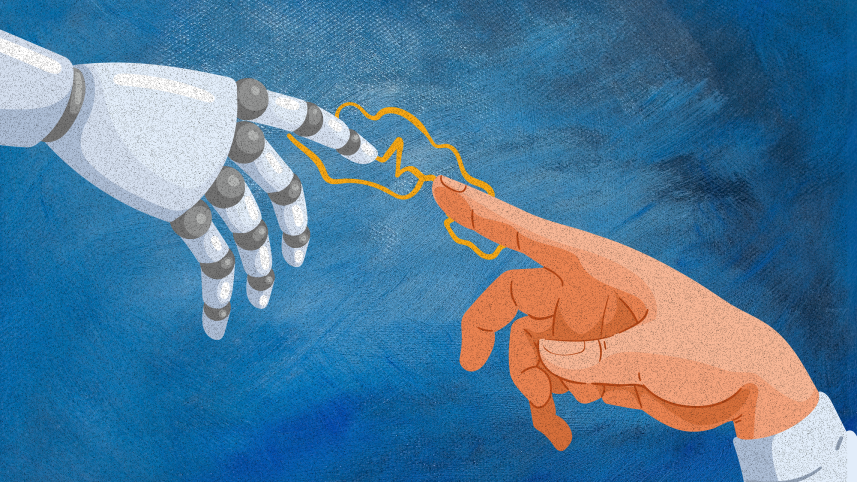
Machines have not become intelligent; rather, human intelligence is increasingly embedded in machines.
We are amid a new technological wave driven by artificial intelligence, the Internet of Things, solar power, robotics, nanotechnology, drones, and so on. The evolving economy is often referred to as a 'knowledge economy'. This, however, does not mean that earlier phases of technological progress were mindless. It simply means that the creation of new use value, or production today, entails greater cognitive intervention in value addition rather than changes in the product's physicality. For instance, a new version of a mobile phone fetches higher prices because of additional features developed through software, not due to a proportionate increase in, or change to, the metals, plastics, and components used in the phone.
The product created, and the labour involved, are not 'immaterial', as they are sometimes treated. They offer uses responsive to material senses, and the cognitive labour involved entails the expenditure of brains and nerves. But what do these knowledge workers produce? They produce designs, software programmes, aesthetic inputs, and many other cognitive value additions, which are embedded in machines through the application of symbolic analytics. In earlier technological revolutions, physical human labour was mechanised, and in the current wave, part of mental labour is being appropriated by AI. Repetitive work is vanishing very fast; robots are replacing humans in both manufacturing and services, and AI, as the new general-purpose technology, is going to radically disrupt human engagement in production.
But why does such a decline in human effort in productive activities create anxiety about displacement and dispossession? Why does such anxiety not arise when one buys a washing machine or a refrigerator? Simply because the washing machine or the refrigerator is owned by the user, and the time saved through its use increases the disposable time of the possessor. On the contrary, in capitalism, at the systemic level, machines, software, and digital platforms are owned by a few, and workers can only earn by selling their labour power to these owners of the means of production. The worker is neither the owner of the machine nor of the disposable time. In fact, with the use of new machines, working hours do not decline because the owner of the machine is always in a race to recoup the investment before it becomes obsolete through further innovation.

The use of new technology should have increased free time for human beings, enabling us to meet our needs in fewer working hours. But that is not going to happen because direct producers do not own the technology. Since technology and science have become the power of capital, time saved must be converted into unpaid surplus labour time, and hence declining labour effort gives rise to a bipolar outcome in capitalism: those who are employed should work more intensively, while a vast majority would lose their jobs instead of people producing what they need while being left with more free time. Also, needs change over time, and new goods and services enter the consumption basket while some old ones may be dropped.
Knowledge is distinct from other inputs. It is essentially non-rival and does not diminish through its use. Knowledge grows through the sharing of ideas, feedback, iteration, and the accumulation of data. As production depends more on knowledge inputs, the production process becomes increasingly socialised. Writing a paper, creating a design, developing a software programme, or creating any content may involve innumerable inputs from the internet.
On the other hand, human interactions on social media and other digital platforms generate a large amount of data that can be processed to uncover nuanced trends in human behaviour and consumption patterns. These data are produced free of cost through social interactions, which serve as raw material for understanding and influencing human choice. This offers the potential to understand real-time trends in demand and supply in the economy, helping reduce waste within the system. But these data are procured free of cost from society and then appropriated by global techno-corporate giants such as Apple, Google, Amazon, Facebook, and Microsoft. They are creating data empires not only to establish control over our current choices but also to colonise our future demands.
The concentration and centralisation of capital, although unprecedentedly high, are relatively invisible in this case because they do not manifest themselves in bricks and mortar, as in the large factories of the twentieth century. The concentration is now planetary because resources are flowing across the web and are not confined to particular geographies, as might be the case with other resources such as oil, coal, or minerals. TNCs are finding ways and means to establish control and ownership over these data and the knowledge that can be derived from them. The progress of knowledge, hence, faces a limit, not because of the nature of knowledge and technology, but because of capital relations that seek to derive private rent from resources that are socially produced.

Human capabilities are magnified through the use of intelligent machines. In fact, machines have not become intelligent; rather, human intelligence is increasingly embedded in machines. This enhanced machine capacity will reduce the direct human effort required for processing and analysing data, planning, and production. They have the potential to reduce waste and overcapacity through real-time adjustments. But because of capital relations, this greatly augmented productive capacity will face the challenge of distribution, with too much being produced and too few people able to buy it.
Capitalism, being a society driven by exchange value, recognises returns only through the equivalence of value in commodity exchange. It pays workers wages for the labour power they sell. If there is a substantial decline in the need for direct human effort, which is likely to be the case with the increasing use of new technology, labour power will be less sought after, and hence the 'circular flow of income' will be broken. Productivity gains will not be converted into income. In other words, capitalism produces goods and services on a magnified scale and with a diversified scope, but produces hardly enough buyers for those products. Here, it reaches a limit that restricts the growth of knowledge-intensive production. This must be superseded by a production structure that is far more collaborative and transforms ownership in a way that enables society to decide on the optimal use of the knowledge and data it collectively produces, rather than leaving them as assets to be exploited by the rentiers of the world.
Dr Satyaki Roy is an Associate Professor at the Institute for Studies in Industrial Development (ISID), New Delhi.
Send your articles for Slow Reads to slowreads@thedailystar.net. Check out our submission guidelines for details.

Will Bangladesh's social security budget help the poor?
Should political parties be publicly funded?

Can outcome-based education survive the age of AI?
Remembering Ishaque Ali / When Bengalis stood up to racism in the UK

Bangladesh's cottage industries need more than nostalgia

Can a social media ban for children work in Bangladesh?
Why Bangladesh keeps suffering from an epidemic of bad projects

Big Picture / The long transformation of rural Bangladesh

Islamic banking’s problem is the model, not the name