Disappearing middle class and the decline of Dhaka's club culture
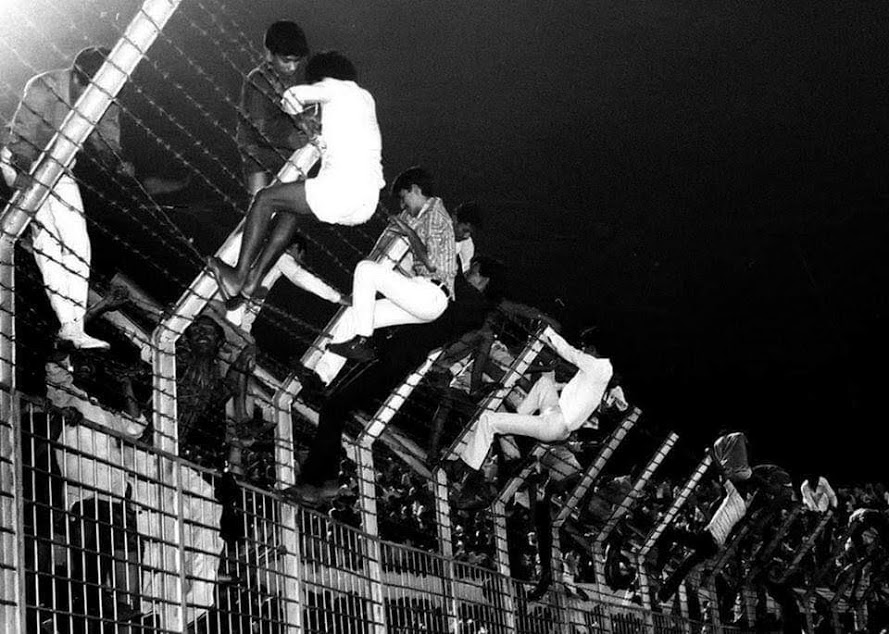
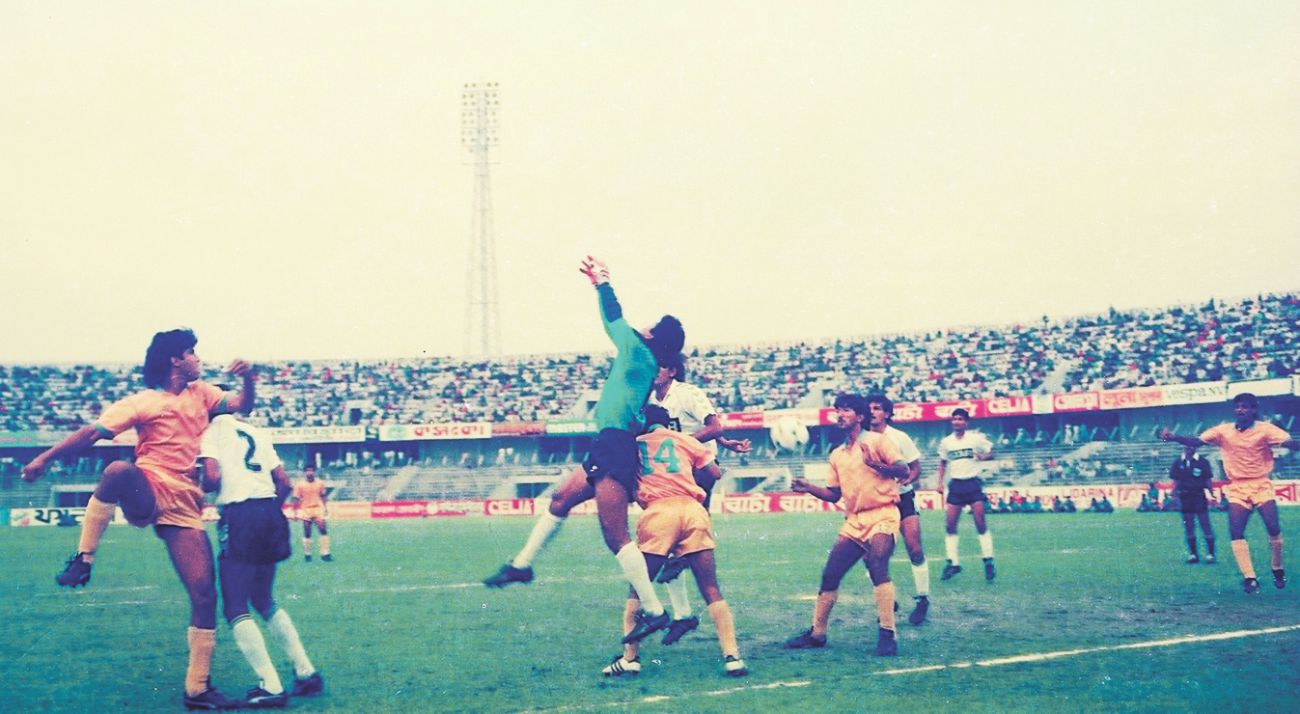
The story of Ahmed (name changed to protect his privacy) is a saddening one. During a football match in the 1980s between two arch-rivals of the Dhaka League, Abahani and Mohammedan, he unknowingly sat in the wrong gallery. The hapless Abahani supporter, Ahmed, who did not realise what a grave mistake he had made, jumped for joy when his favourite team scored a goal. Unfortunately, he has no memory of that moment or of the following ten days, as he remained in a coma throughout that period and only miraculously survived. It was later learnt that the furious Mohammedan supporters in the gallery could not endure such a blasphemous expression of ecstasy from a rival in their own den and threw him from the second tier of the stand, leaving him suspended between the purgatory of this world and the next.
Ahmed's story may be a grim one, but for football romantics the nostalgia derives from the excruciating pain of watching the great hype, rituals, and euphoria associated with club football evaporate. It is well known that football clubs are the pillars of modern football culture and help shape wider society, but Dhaka has lost that culture almost completely. Many theories and explanations have been put forward to comprehend the phenomenon. In my view, the fall of Dhaka's club culture is inseparable from the decline of the middle class. The loss of its identity and hegemony in politics and urban culture has directly affected the fate of club culture.
There was a time when the clubs of Dhaka acted as binding agents of community and symbols of middle-class culture. Abahani, Mohammedan, Brothers Union, and numerous other smaller clubs represented the pride of particular localities. People socialised by gathering at the club and helped them thrive through various means, including public fundraising. It was the epitome of para culture. Dhaka's educated middle class controlled a culture that was shaped alongside other institutions such as libraries, music circles, and more.
Why did this vibrant way of life disappear? It is the result of a complex interaction between globalisation, consumerism, the rise of neoliberalism, the decay of political ethos, and the erosion of social cohesion. Football clubs, along with libraries, cinema halls, and other places of mass gathering, have either decayed into objects of nostalgia, been captured by political clientelism, or simply been emptied out. Many clubs have become hubs of rampant gambling and other anti-social activities controlled by political goons.
The death of club culture in Dhaka is not an isolated event. It is the visible expression of a much deeper social and structural decline.: the dissolution of Bangladesh's urban middle class as a coherent social formation. To understand how and why this happened, we must read the evidence through several sociological lenses simultaneously: Pierre Bourdieu's theory of capital and field, Max Weber's analysis of status groups and rationalisation, Anthony Giddens's concept of late-modern disembedding, and Antonio Gramsci's framework of hegemony and cultural leadership. Together, these frameworks reveal a story of class formation, class fragmentation, and the particular cruelty of postcolonial economic acceleration.
According to Bourdieu's concept of social capital, the resources accrued through membership in durable networks of mutual acquaintance help explain the structural function of club membership during this period. The club was not merely a recreational venue; it was a field, in Bourdieu's technical sense, a structured social space with its own rules, its own forms of capital, and its own struggles over legitimate membership. That spirit held the cultural fabric together.
What made the club particularly powerful as a class institution was its capacity to naturalise this conversion. A child who grew up attending games at the stadium with parents and peers, inheriting loyalty and a sense of pride, was receiving an education in habitus, an embodied sense of how a certain kind of person moves through the world. This was class reproduction at its most intimate and effective form.
The 1980s and early 1990s introduced the first systemic shock to this formation. The structural adjustment programmes imposed by the World Bank and IMF under the Ershad government began the long process of reorienting Bangladesh's economy away from a state-centred model towards export-led growth anchored in the garments sector. This transformation did not destroy the middle class; if anything, it generated new middle-class entrants at a staggering rate. But it fundamentally bifurcated the class along new lines.
The death of club culture in Dhaka is not an isolated event. It is the visible expression of a much deeper social and structural decline: the dissolution of Bangladesh's urban middle class as a coherent social formation. To understand how and why this happened, we must read the evidence through several sociological lenses simultaneously: Pierre Bourdieu's theory of capital and field, Max Weber's analysis of status groups and rationalisation, Anthony Giddens's concept of late-modern disembedding, and Antonio Gramsci's framework of hegemony and cultural leadership. Together, these frameworks reveal a story of class formation, class fragmentation, and the particular cruelty of postcolonial economic acceleration.
On one side stood what we might call the old middle class: state-sector employees, academics, and professionals whose livelihoods derived from the public apparatus and whose cultural orientation was towards education, seniority, and institutional prestige. On the other side emerged a new commercial class: garments exporters, import traders, construction entrepreneurs, and later participants in the mobile telephony and IT sectors, people whose wealth accumulated rapidly, whose relationship to the state was instrumental rather than constitutive, and whose cultural formation was shaped more by the logic of the market than by the logic of the old social structure. In short, the neoliberal ethos gradually displaced the culture of social cohesion that had previously underpinned middle-class life.
The 1990s and 2000s saw a profound reordering of cultural authority in Bangladesh. The secular, liberal, and broadly left-leaning social formation that had shaped Dhaka's public culture since Liberation found itself increasingly unable to set the terms of the national conversation. The Islamisation of public culture was not merely the result of political intervention. It also reflected a broader shift in the country's cultural centre of gravity as rural-to-urban migration introduced new social groups and value systems into the city.
The 2000s and 2010s brought another, and in many ways more profound, transformation. The spread of mobile telephony, internet connectivity, and global migration networks reshaped the social geography of Dhaka's middle class. Social capital, once accumulated through face-to-face institutions such as clubs, university associations, and professional societies, could now be cultivated and mobilised through entirely different channels: diaspora connections, Facebook groups, WhatsApp networks, and alumni communities spanning continents and linking Bangladesh to the wider world.
Anthony Giddens's concept of disembedding, the lifting of social relations out of local contexts of interaction and their restructuring across indefinite spans of time and space, captures something essential about this transformation. Modernity in general, and globalisation in particular, systematically disembed social relations from place. The club was a paradigmatically embedded institution. It required physical presence; it was constituted by local face-to-face interaction; it generated trust through repeated co-presence. As Dhaka's middle class became incorporated into global networks through migration, digital connectivity, and the aspirational culture of international education, the local, embodied institutions of class reproduction became increasingly peripheral to actual social life. Trust was re-embedded in abstract systems: international degrees, global brands, and diaspora networks rather than local institutions. Para culture collapsed into a neoliberal way of life in which every neighbour became a stranger and there was no longer any emotional space for clubs.
The economic data tell a stark story. Bangladesh's GDP growth has been among the most sustained in Asia, consistently above 6 per cent annually for most of the 2000s and 2010s. Yet this growth has been strikingly unequal in its distribution. The Gini coefficient has risen steadily and, crucially, the pattern of inequality has been polarising rather than merely stratifying: the gains have accrued disproportionately to the top decile, particularly the top 1 per cent, while the middle, defined loosely as households with stable formal-sector incomes sufficient to support a certain lifestyle, has been squeezed.
The mechanisms of this squeeze are multiple and interactive. First, urban land and property prices in Dhaka have inflated at rates entirely disconnected from formal-sector salary growth, effectively pricing the professional middle class out of the neighbourhoods and housing types that had previously defined its residential identity. Gulshan, Banani, and Dhanmondi, once the natural habitat of the civil servant and the professor, have been colonised by a much wealthier commercial elite and the luxury-service infrastructure that serves it. The middle class has been displaced to Mohammadpur, Mirpur, and Uttara, peripheral zones whose distance from the city centre undermines the very density of social interaction on which club culture depended.
Second, the relationship between education and income has changed dramatically. For the generation that came of age before the 1990s, a Dhaka University degree was a reliable passport to middle-class stability. The subsequent explosion of private universities produced a vast credentialed workforce whose degrees bore little relationship to labour-market outcomes. The result was a generation of nominally educated young people whose economic position was structurally precarious, too educated to accept the conditions of factory or informal-sector work, yet too numerous and too poorly trained to be absorbed into the formal professional sector. This generation has no stable class identity and no institutional infrastructure through which to develop one.
Bourdieu's framework of capital conversion illuminates the deeper logic of this process. In a functioning middle-class field, educational capital converts reliably into economic capital, which in turn funds the acquisition of cultural and social capital through institutions like the club. When the conversion mechanism breaks down, when degrees no longer reliably produce income and when income no longer reliably produces the social access that converts economic into social capital, the entire field loses its coherence. Bourdieu's concept of hysteresis is apt here: the dispositions and expectations formed during the era of reliable conversion persist in individuals long after the structural conditions that produced them have changed, generating a painful mismatch between subjective expectations and objective possibilities. The middle-class Dhakaite who expects the kind of life their parents had, the flat in Dhanmondi, the club membership, the domestic help, the summer trip to Sylhet, increasingly finds that aspiration structurally unreachable.
Modernity in general, and globalisation in particular, systematically disembed social relations from place. The club was a paradigmatically embedded institution. It required physical presence; it was constituted by local face-to-face interaction; it generated trust through repeated co-presence. As Dhaka's middle class became incorporated into global networks through migration, digital connectivity, and the aspirational culture of international education, the local, embodied institutions of class reproduction became increasingly peripheral to actual social life. Trust was re-embedded in abstract systems: international degrees, global brands, and diaspora networks rather than local institutions. Para culture collapsed into a neoliberal way of life in which every neighbour became a stranger and there was no longer any emotional space for clubs.
No analysis of the collapse of middle-class institutions in Bangladesh can avoid the central role of political economy. The deepening of patronage politics, in which access to state resources, licences, contracts, and protection is mediated through party-political networks rather than through impersonal bureaucratic rules, has systematically undermined the civic institutions of the middle class.
The process has operated on two levels. At the direct level, specific institutions, clubs, professional associations, university campuses, and trade bodies, have been captured by the organisational networks of the dominant political party, transforming them from spaces of civil society into extensions of political machinery. The independence that made them valuable as generators of trust and social capital has been destroyed. At the indirect level, the patronage system has fundamentally altered the incentive structure for social mobility: the fastest route to economic advancement in contemporary Bangladesh runs through political connections, not through the accumulation of human capital and professional reputation. This systematically devalues the currency in which the club economy traded.
The result is a civic vacuum at the centre of urban Bangladeshi life. The institutions through which a coherent middle class might recognise itself, articulate common interests, and exercise cultural and political leadership have been either colonised, delegitimised, or simply abandoned. What remains is a vast, internally differentiated population of urban households whose economic position places them above subsistence but below security, too numerous to ignore, too fragmented to organise, and too squeezed to sustain the institutional overhead of class reproduction.
The club survived as a physical institution but lost its social function as a field of class reproduction. The vacuum was filled by an aggressive culture of encroachment, using these institutions as vehicles for siphoning money through whatever illicit means were available. In a broader sense, the clubs became akin to many public institutions that have turned into hunting grounds for people who drain them like parasites for personal financial gain. The logic of late capitalism, combined with an indomitable greed unrestrained by social resistance, created a horror story of plunder and a bonanza of corruption.
The fall and decline of club culture and the middle class in Dhaka is indeed a sad saga. In a sense, it is also the saga of a Bangladesh that was once liberated with visions of harmony and collective joy.
Syed Faiz Ahmed is a sports historian and writer. He can be reached at faizbsu006@gmail.com.
Send your articles for Slow Reads to slowreads@thedailystar.net. Check out our submission guidelines for details.

Why Chittagong never became a maritime city
The many worlds of Ghulam Murshid

Operation Jackpot: How Bangladesh’s naval commandos struck at Pakistan’s lifeline in 1971
The Yellow Butterfly: How Sheba shaped my world growing up

What Bangladesh’s historic Test victory in Australia means for Bangladeshi-Australians
Remembering Sumit Sarkar, a historian who questioned orthodoxy
The unfinished histories of Partition
In conversation with William Dalrymple / ‘Britain didn't conquer India’
Sheikh Mujib’s killing: What the newspapers told and what they omitted