


Conte Verde: The ship that carried the first World Cup
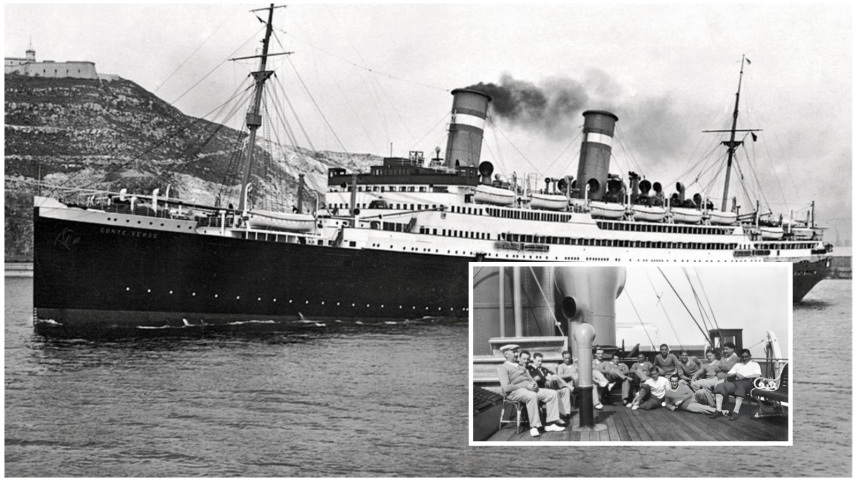
In April 1923, a new ship slipped into the waters from the Dalmuir shipyard near Glasgow in Scotland. Built as a luxury Italian liner, its first-class cabins were decorated by craftsmen and artists specially brought in from Florence. Its library carried the elegance of Tuscan Renaissance architecture, complete with stained-glass windows and intricate ceiling artwork.
Named after Count Amadeus VI of Savoy, the ship was called Conte Verde. It was not built merely for another voyage across the sea. Years later, it would sail directly into football history.

Seven years after its launch, the world was preparing for something unprecedented. In 1930, Uruguay was set to host the inaugural FIFA World Cup -- the beginning of what would become the biggest sporting spectacle on earth. But Europe was trapped in a deep economic crisis. Travelling across the Atlantic to South America meant a long, exhausting and expensive sea journey, prompting European nations to pull away from the tournament one by one.
At the centre of the uncertainty stood Conte Verde, the ship that would ultimately rescue FIFA’s dream. Carrying European teams across the Atlantic waves to Uruguay, the vessel became inseparably linked with the birth of the World Cup itself.
Football’s soaring popularity at the Olympic Games had convinced FIFA that the sport deserved its own global championship.
Uruguay had established South American dominance on the world stage by winning back-to-back Olympic gold medals in 1924 and 1928. The 1924 Olympic final alone drew around 60,000 spectators, with Uruguay beating Switzerland 3-0 to claim the title.
Driven by the relentless efforts of then FIFA president Jules Rimet, the idea of a World Cup became reality. On May 26, 1928, the FIFA Congress in Amsterdam approved the proposal, giving birth to the tournament. Uruguay, celebrating the centenary of its independence in 1930, was awarded hosting rights for the first edition.
The decision, however, failed to inspire much enthusiasm in Europe. Economic hardship, the physical toll of the journey and the prospect of clubs losing their best players for nearly two months -- an issue football still grapples with today -- discouraged many nations.
Sweden, Spain, Italy and the Netherlands had initially expressed interest in hosting the tournament themselves, but lost enthusiasm after Uruguay was chosen. In protest, Italy withdrew, with several others following suit. One after another, European countries backed away from the World Cup.
Even with only two months remaining before kickoff in July 1930, no European nation had officially confirmed participation. It took the personal intervention and tireless persuasion of Rimet for four countries --Belgium, France, Yugoslavia and Romania -- to finally agree to make the trip.
The stories behind those decisions were dramatic in their own right. Romania’s participation was largely ordered by the country’s new king, Carol II, an avid football enthusiast who reportedly selected the squad himself. He also helped convince Yugoslavia to send a team, while Belgium agreed after persistent lobbying from FIFA vice-president Rodolphe Seeldrayers.
On June 21, 1930, Conte Verde departed from the port of Genoa in Italy carrying the Romanian squad towards South America. The journey was anything but comfortable. Romania captain Rudolf Wetzer later recalled: “We spent two nights on the train to Genoa. The seats were terrible. Our bones felt broken. But the suffering was worth it.”
The ship next stopped at Villefranche-sur-Mer in France, where the French squad and several FIFA officials boarded. Among them was Rimet himself, carrying inside his suitcase the precious World Cup trophy that would later bear his name. The vessel later picked up Belgium’s squad from the port of Barcelona in Spain.
Yugoslavia, meanwhile, became the only European team unable to board Conte Verde because of a lack of space. After a three-day train journey, they departed from Marseille aboard another ship called Florida.
Maintaining fitness during the 15-day Atlantic crossing posed a major challenge. The players trained daily on the deck of the ship itself. Lucien Laurent, who would later score the first goal in World Cup history, fondly remembered those days.
“There was no discussion about tactics or anything like that, no coaching. We just ran on the deck all the time. Below deck we exercised -- stretching, jumping, climbing stairs and lifting weights. There was also a swimming pool, and until the weather became cold, we all used it.”
“It felt more like a camping holiday. At that time, we did not fully realise the enormity of why we were going to Uruguay. Years later, we understood our place in history. Back then, it was simply an exciting adventure. We were just young men having fun. Our journey on Conte Verde lasted 15 days, 15 wonderful days,” Laurent added.
After crossing the Atlantic, Conte Verde reached Rio de Janeiro on June 29, where it picked up the Brazilian squad. Finally, on July 4, the ship anchored in Montevideo, the capital of Uruguay.
With no qualification process in place, 13 invited nations ultimately participated in the first World Cup. Seven came from South America -- hosts Uruguay, Argentina, Brazil, Chile, Paraguay, Peru and Bolivia -- while Mexico and the United States represented North America.
Before the tournament began, United States goalkeeper James Douglas had dismissed concerns over the absence of more European teams.
 For all latest news, follow The Daily Star's Google News channel.
 “In my opinion, the absence of Europe’s footballers will not diminish this tournament. The Olympic Games have shown that the world’s finest footballing nations are situated on both sides of the River Plate.”
Douglas’s words proved prophetic. The first World Cup, which began on July 13, 1930, became a remarkable success both financially and competitively. On July 30, in front of more than 68,000 spectators, hosts Uruguay roared back from a 2-1 halftime deficit to defeat Argentina 4-2 in the final and become football’s first world champions.
In the end, Conte Verde carried far more than a few hundred passengers and a trophy across the ocean. Slicing through the blue waters of the Atlantic, the ship’s voyage opened the gateway to the epic phenomenon now known as the FIFA World Cup.
Comments