


The great Asian collapse
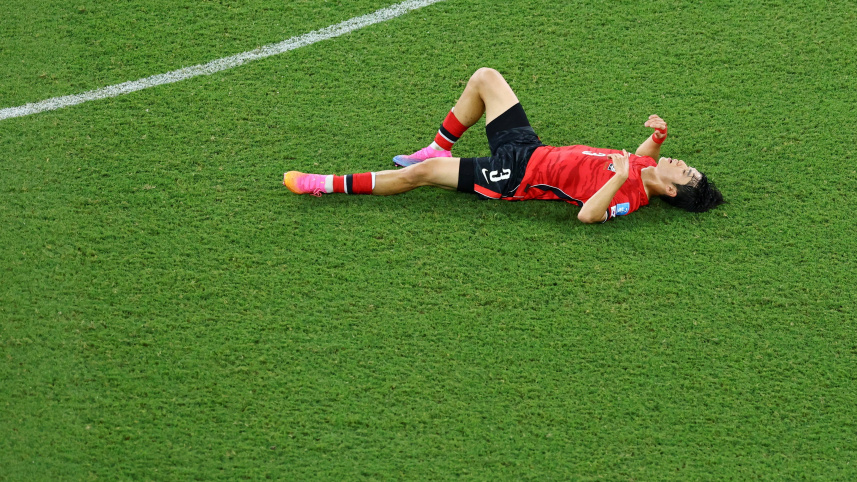
It was supposed to be a historic celebration of Asian football. With the World Cup expanded to 48 teams in North America, a record nine nations from the Asian Football Confederation (AFC) arrived with genuine ambitions. Instead, the tournament became a sobering reality check, exposing the vast gulf between Asia's best and the world's elite - a reality compounded on Tuesday as Japan, the continent's brightest hope, bowed out in the most agonizing fashion imaginable.
Across the tournament, AFC teams managed just three victories in the group stage. Only Australia and Japan survived to see the knockout rounds. But any hopes of a deep run evaporated in the Round of 32 when Japan fell 2-1 to heavyweights Brazil, courtesy of a devastating 95th-minute winner by Gabriel Martinelli. While the Samurai Blue fought with immense valor, their departure officially leaves Australia as the sole remaining flagbearer for a continent reeling from a painful underachievement.

The tournament laid bare an uncomfortable truth. When the stakes were highest, Asia's finest simply could not cope with the intensity of elite opposition. Five AFC teams - Jordan, Iraq, Uzbekistan, Saudi Arabia, and reigning Asian champions Qatar - finished bottom of their respective groups.
Sides that had impressed on the continental stage suddenly looked overwhelmed against world-class opponents, undone by tactical confusion, defensive fragility, and an inability to match the relentless pace of the game. Even Japan, despite a heroic defensive shift and a stunning 40-yard rocket from Kaishu Sano that initially silenced Brazil, ultimately succumbed to the late, suffocating pressure that elite sides exert until the final whistle.
The reasons behind the failure
At the heart of this collective failure lies a lack of exposure to elite-level competition.
As Jordan's Moroccan coach Jamal Sellami reflected after the tournament, Asian football remains trapped in something of a domestic echo chamber. Too few of the continent's best players test themselves week in, week out against the world's strongest opposition, leaving them ill-equipped for the physical and tactical demands of a World Cup.
Despite the enormous financial investment pouring into leagues across the Gulf and East Asia, many of the region's leading players remain confined to relatively insular competitions. They operate in environments where the tempo is slower, the physical demands are more familiar, and their status as established stars is rarely challenged.
That creates a false sense of security.
A side like Jordan can reach an Asian Cup final by outperforming teams operating at a similar level. The World Cup, however, is an entirely different examination, where every mistake is punished and every second on the ball is contested.
Modern elite football is built on relentless pressing, athleticism, and tactical precision. Opponents close down space with astonishing speed, leaving virtually no time to think or recover. Players accustomed to enjoying an extra second or two in their domestic leagues suddenly found themselves harried into mistakes.
The consequences were devastating. Uzbekistan conceded nine goals across three matches, while Jordan were torn apart by Argentina after repeatedly losing possession in dangerous areas. More than a question of quality, it exposed a lack of conditioning. These players simply lacked the muscle memory to deal with such relentless physical and mental pressure.
The contrast with Africa only reinforces the point.
African football has long functioned as a pathway to Europe, with many of its brightest talents moving abroad at a young age. By the time they represent their national teams at a World Cup, they are already accustomed to facing elite attackers, coping with high-intensity pressing, and operating within sophisticated tactical systems. For many Asian internationals, those demands remain unfamiliar until they arrive at football's biggest stage.
Heads roll in Seoul and Riyadh
South Korea's so-called golden generation, featuring Son Heung-min, Lee Kang-in, and Kim Min-jae, had been widely tipped to reach the knockout stage. Instead, a solitary victory over the Czech Republic was followed by defeats to Mexico and South South Africa, sending them crashing out.
The backlash was swift. Head coach Hong Myung-bo, one of the country's most celebrated football figures, resigned on Sunday amid mounting criticism from supporters and growing political pressure. In a symbolic reflection of the public mood, there will be no official welcome ceremony when the squad returns to Incheon Airport.
Saudi Arabia endured an equally humiliating campaign.
Having invested almost two billion dollars in transforming its domestic league and attracting global stars such as Cristiano Ronaldo and Neymar, the kingdom's national team finished bottom of Group H with just two points. Following a crushing 4-0 defeat by Spain, Saudi Arabian Football Federation president Yasser al-Misehal announced his resignation, underlining the scale of the failure.
With Japan's heartbreaking exit on Tuesday, the harsh post-mortem for Asian football expands from the group stage casualties into the knockouts, leaving the continent to ponder how to bridge a gap that currently feels wider than ever.
 For all latest news, follow The Daily Star's Google News channel.
Comments