The lost Khoda art of Santals: Tattoos, identity and the legacy of the Santal Hul
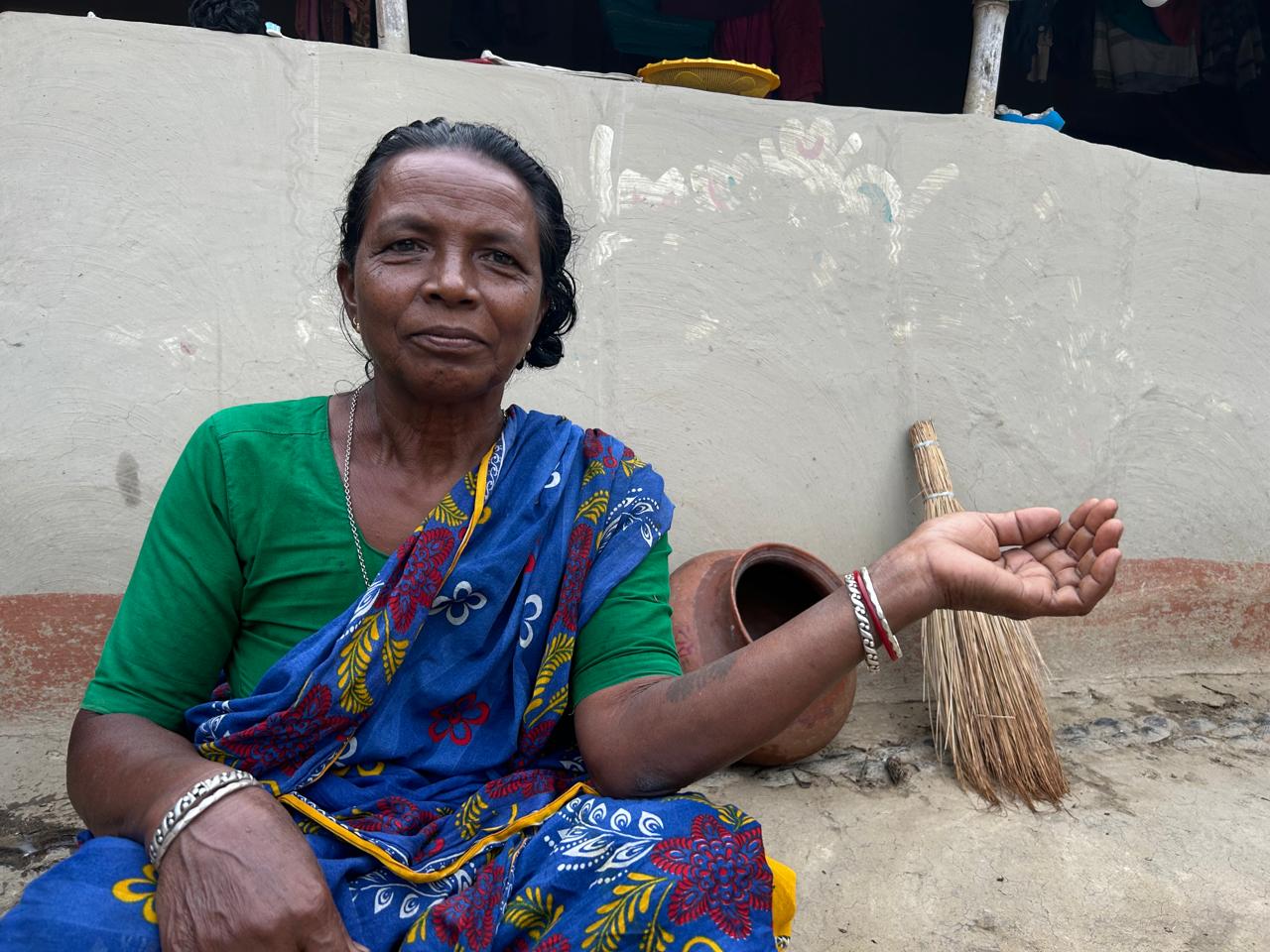
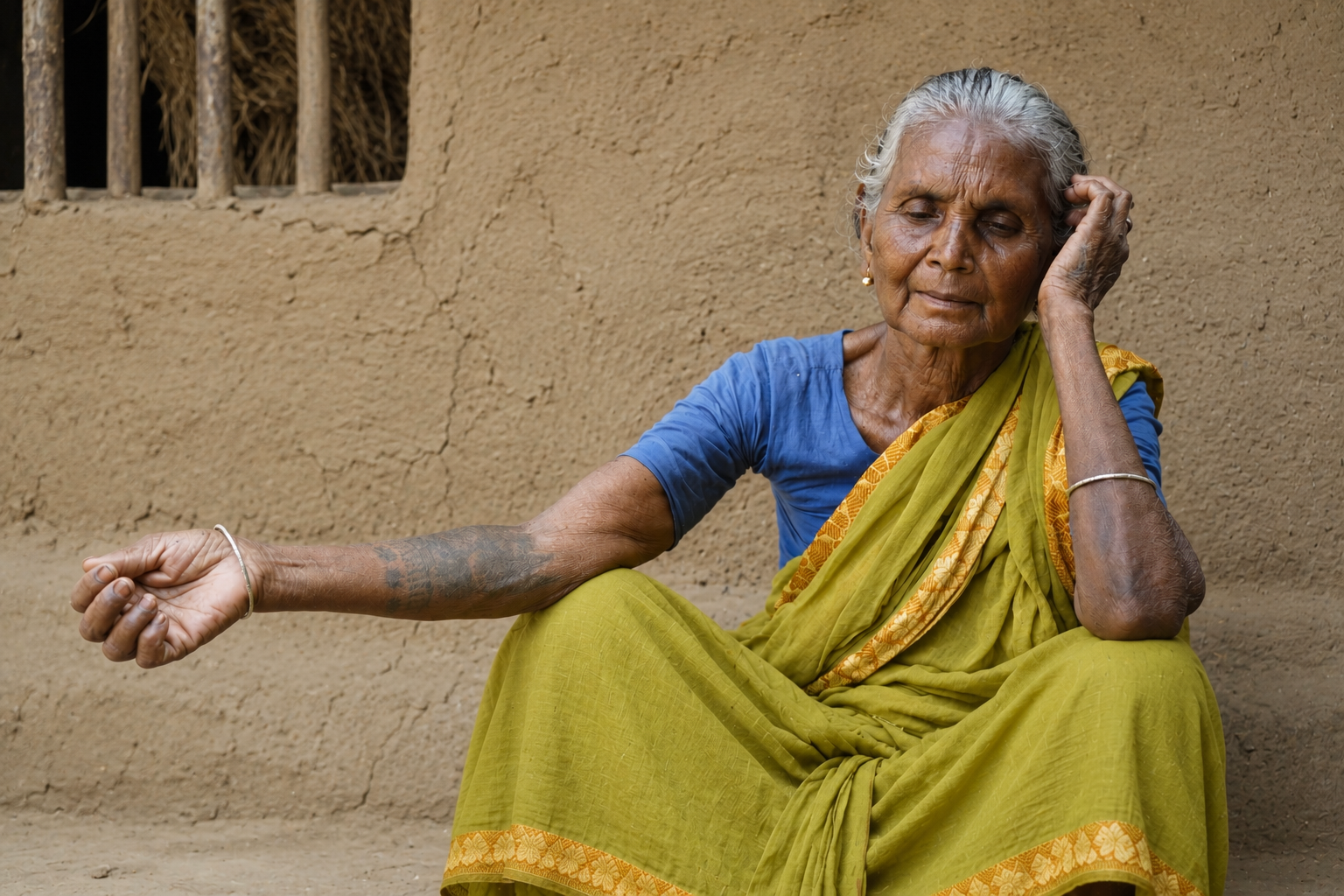
In a small Santal village in Uttar Hatshahar under Khetlal Upazila of Joypurhat District, only eight families reside. A few months ago, while visiting there, I met an elderly Santal woman named Chumki Kisku. Her body was frail and ravaged by old age and illness, yet the body marking tattoos (khoda) on her chest and neck remained strikingly visible, like ornaments etched into her skin. When asked about them, she smiled gently and said, “My guardians had them drawn on me when I was a child. I no longer remember why they were done. These were our ornaments.”
Chumki Kisku’s words reflect the reality of Santal society today. The Khoda that once served as a powerful symbol of religious belief, social identity, cultural memory and ethnic existence is gradually losing its meaning. People still carry the marks on their bodies, but the history behind them is slowly fading into oblivion.
Body markings such as Khoda (tattoos) and Shika (branding) are extremely sacred rituals in Santal society. They held deep significance in both this world (earthly life) and the afterlife. This traditional art is deeply intertwined with history, cultural heritage and ethnic memory.
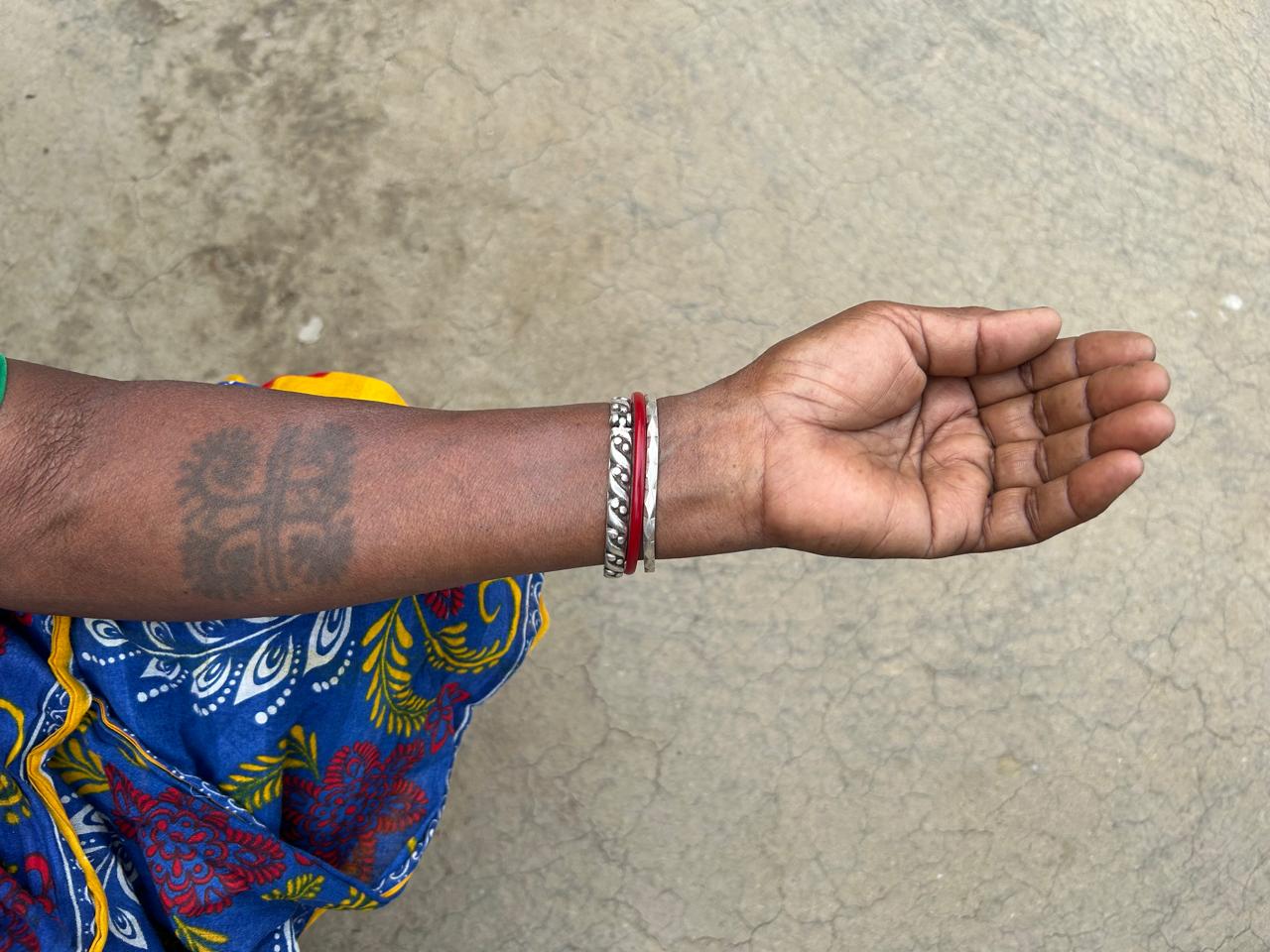
Traditionally, these rituals were performed during childhood. Boys would receive ‘shika’ at the age of seven. A piece of cloth was tightly rolled, lit on fire and used to brand the right arm. The number of marks was usually odd — one, three, five, or seven. W.W. Hunter referred to these marks as “Santal spots” in his 1868 book Annals of Rural Bengal. On this occasion, handi (rice beer) was prepared and relatives and neighbours were invited to the ceremony.
Girls would be tattooed (khoda) at the age of ten or twelve. Traditionally, designs were drawn on the left arm and left breast. After marriage, the body markings would be completed on the right breast and neck. This was a symbol of a woman’s full recognition. Since society considered women as the primary means of reproduction, this custom was strictly followed. According to ancient Santal beliefs, without khoda, one would not gain entry into the afterlife. The guardians of the afterlife would not recognise them. They would also not be able to identify their family members.
Elders say that without the marks, evil spirits would punish them by inflicting pain with a giant caterpillar as big as a thick tree branch. An elderly Santal woman from Begunbari village in Dhamoirhat Upazila of Naogaon said that if the khoda was present, her husband and children would recognise her in the afterlife. The tattooing work was done in winter and it often took two to three winters to complete across the whole body.
There is some ambiguity regarding the significance of women’s tattoos. Santal historian Guru Koleyan says that tattoos were drawn to avoid punishment in the afterlife, but no specific design was mandatory. Many also drew them for beauty. In 1949, in W.J. Culshaw’s Tribal Heritage: A Study of the Santals, an elderly woman said, “After death, my jewellery will be lost but at least I will be able to take these with me.” Culshaw further observed that the tattoo designs were used like ornaments. Santal women usually tattooed those parts of the body where wealthy women of high-caste Hindu society wore gold jewellery. This was a reflection of both beauty and socio-economic deprivation.
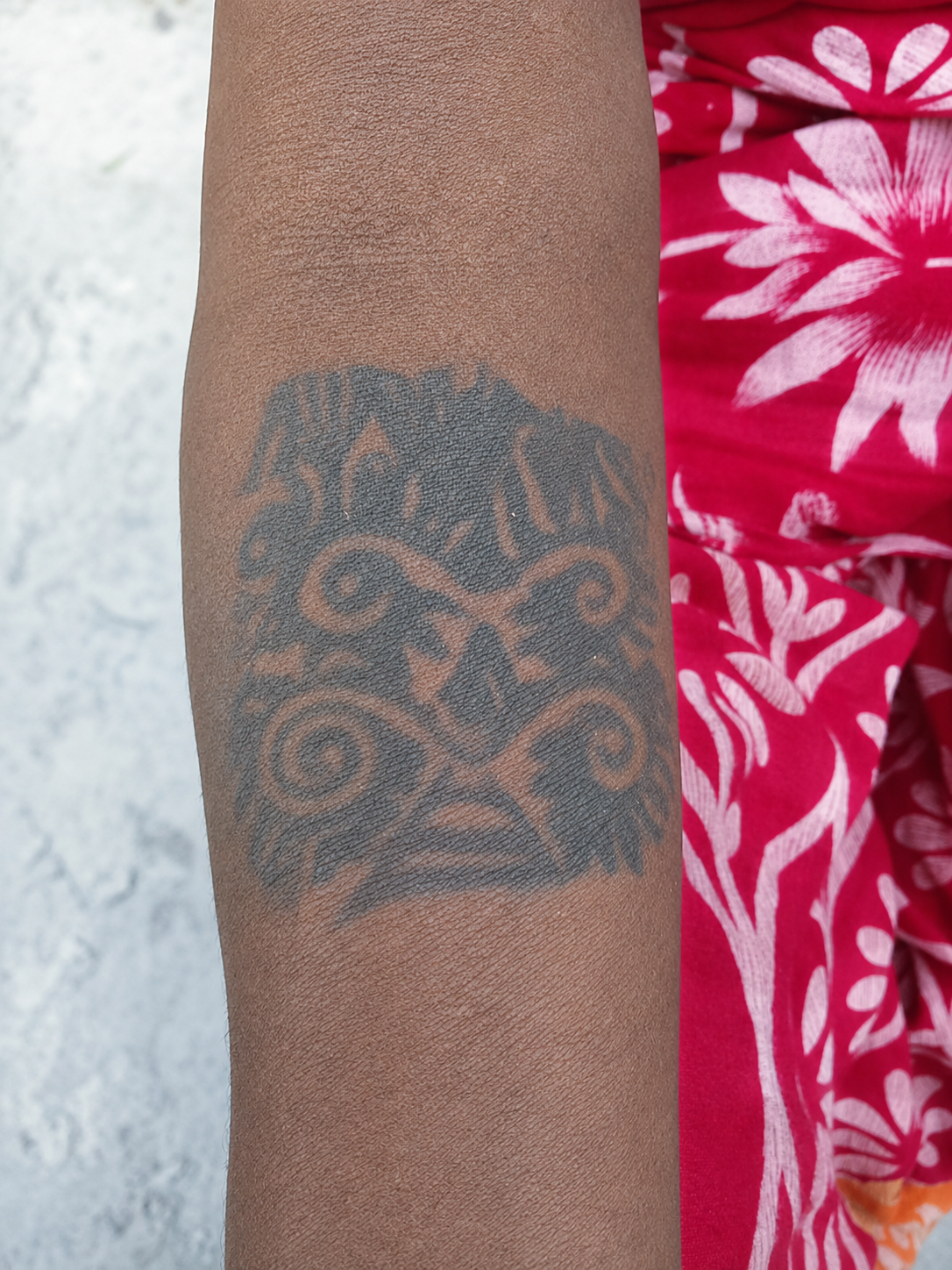
During the great Santal Hul of 1855, these body markings acquired a new meaning. When the Santals revolted against colonial rule under the leadership of Sidhu, Kanhu, Chand and Bhairo, ‘Khoda’ and ‘Shika’ became visible symbols of ethnic identity, unity and resistance. Along with the Santals, the Munda, Oraon, Ho and Birhor communities also had the tradition of wearing these tattoos and they too became victims of British state oppression. The British administration, on the contrary, tried to portray these marks as symbols of “uncivilisation” and “savagery.” E.G. Man’s Sonthalia and Sonthals (1861) is an example of that colonial viewpoint, where tattoos were depicted as symbols of criminal tendency according to European ideas.
Besides, from the records of some other writers of that time, it is known that as the marginalisation of the Santals increased during British rule, the social importance of these body marking traditions also increased. After the 1855 rebellion, the Santals became a major challenge for British rule, which made even the smallest aspects of Santal culture important at that time. This, on one hand, reflected the ignorance and bias of the colonial rulers.
The great rebellion, or Santal Hul of 1855–56, had shaken British rule. Thousands of Santals had sacrificed their lives for their land, dignity and freedom. After the rebellion was bloodily suppressed, the British government formed a separate administrative area, the Santal Pargana, for the Santals. But this administrative change could not remove exploitation and deprivation from the lives of the Santals. The atrocities of Bengali zamindars, mahajans and outsider dikus continued as before. Falling into the trap of high-interest loans, many Santals started losing their ancestral lands. On the other hand, due to increased British control over forests and natural resources, their traditional livelihood became restricted. The burden of taxes, the corrupt police and the injustice of the courts again created deep anger among the Santals. In this situation, around 1871, a new resistance started in Santal Pargana and adjacent areas, which many researchers have called the ‘Kherwar’ Movement. Many writers have called this event the "Second Santal Rebellion". This movement was not only against economic exploitation, but also a collective mass movement demanding self-respect, religious revival, social reform and land rights. One of the main leaders of this movement was Bhagirath Manjhi.
The British administration took initiatives to suppress this movement quickly. Police and military forces launched operations in various areas, arrested many Santals and punished many severely. As a result, the movement could not last long. Yet it proved that the spirit of the 1855 Hul had not died out but continued to live in Santal society in a new form. In the continuity of this movement, the Santals boycotted the 1872 Census, built resistance against the survey and land settlement and laid the foundation for the subsequent Sapha Hor movement.
Later, in the nineteenth century, colonial administrators and Christian missionaries began documenting the life and culture of the “tribal” regions primarily from a capitalist perspective, with the aim of incorporating them into the administrative structure. Moreover, during the 1874 famine, several missionaries were appointed as administrators by the British government. From this perspective, policies targeting these body marking traditions were introduced during that period. Tattooed women were even branded as witches.
During the 1874 famine, Scandinavian and British missionaries got a major opportunity to spread Christianity. Some self-reliant initiatives were taken at church mission centres where Santals could get food. A large section of the famine-stricken Santals converted to Christianity at that time. According to Santal mission historian G. Gausdal, apart from the Church of England and the Anglican Church, nearly ten thousand Santals converted to Christianity in the Lutheran Church alone. Later, in 1876, a policy was introduced prohibiting Christian Santals from marrying followers of their traditional Indigenous religion. From then on, the historic body marking tradition of the Santals became a victim of further divisive policies.
After the end of colonial rule in India, Indian anthropologist Promode Chandra Roy conducted field research in Santal Parganas and the suburbs of an industrial town from December 1965 to May 1966. This was presented in his book Socio-Cultural Process and Psychological Adaptation of the Santal (1975). According to him, the intensity of the beliefs behind these body marking practices had greatly diminished. After the 1947 Partition, the post-colonial process could not reduce the marginalisation of indigenous societies. Instead, the power of the market economy and the process of urbanisation gained dominance and indigenous societies continued to be exploited by non-indigenous populations. The traditional rural social structure also gradually broke down due to political changes.
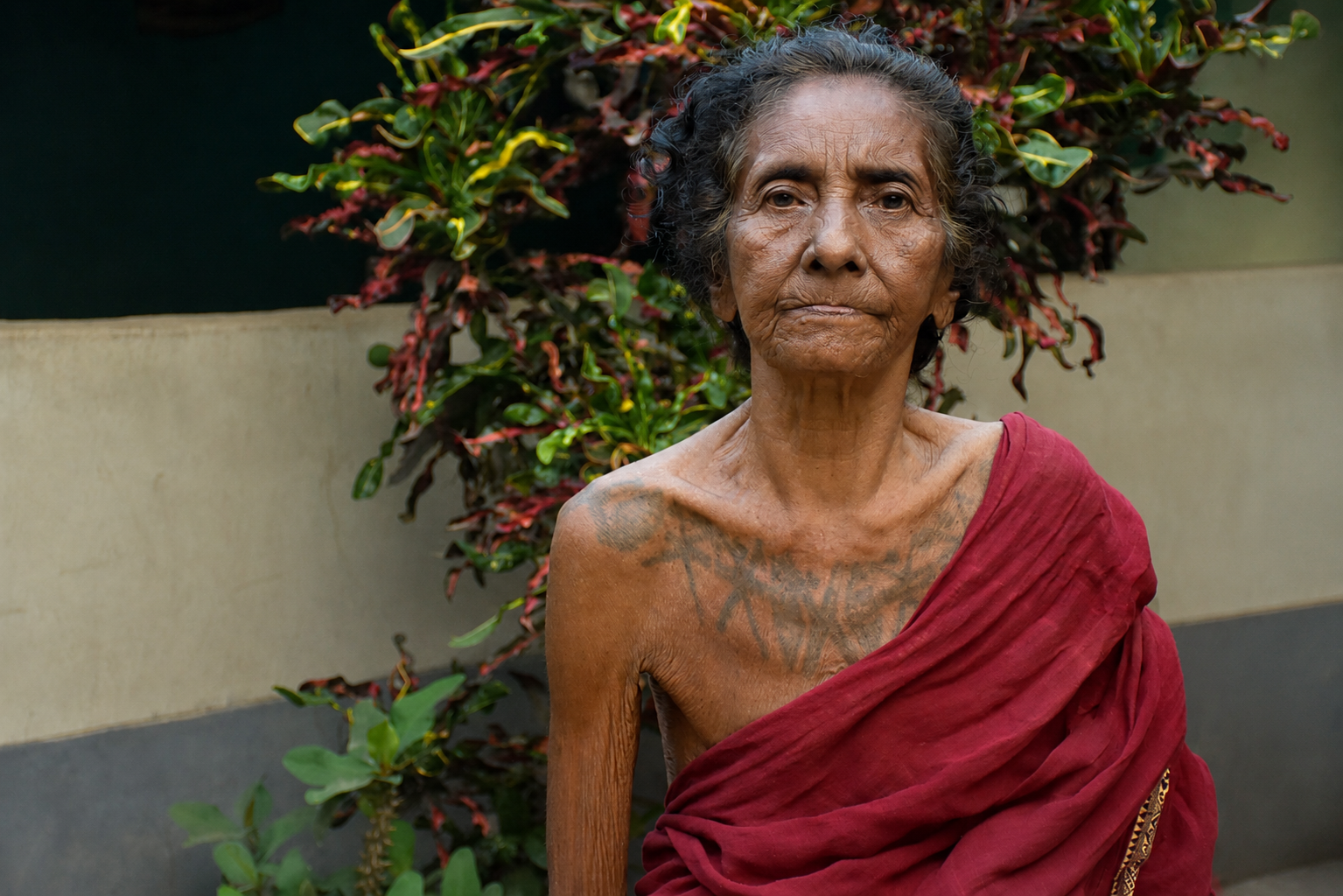
Even today, the last traces of that history survive on the bodies of a handful of elderly Santal women in Bangladesh. One of them is Chumki Kisku. She may not know why those khoda were etched on her chest and neck. Yet her body still bears silent witness to a nation’s history, a lost art and an immortal resistance against colonial rule.
In my childhood, I saw the bodies of the elderly women in my village adorned with geometric patterns, alpana designs, kadamba flowers, Sin Sadom (sacred horses), and crab-scorpion motifs. Today, such sights have become rare. Only a few elderly women, such as Chumki Kisku, still bear these living testimonies. The artisans who once created these khoda have also disappeared. For the Santals, these body markings were never mere decoration, they were enduring symbols of social existence, identity and resistance. These khoda remain silent witnesses to the 1855 Hul, continuing to tell the story of a lost art and an undying struggle.
Samar M. Soren is a language activist, indigenous language technologist, and head of the Language Resource Hub (LRH). His work focuses on Indigenous languages, language technology, cultural heritage, and digital language preservation. He is currently engaged in collaborative research on Indigenous heritage and cultural history with the University of Tromsø – The Arctic University of Norway and the International Centre for the Study of Bengal Art (ICSBA).
Send your articles for Slow Reads to slowreads@thedailystar.net. Check out our submission guidelines for details.
APO 433: Dhaka’s forgotten post office of World War II
Dadabhai Naoroji: The man who exposed the economics of British colonialism
Untold stories of 1971 through private letters
The extraordinary journey of Atish Dipankar Srigyan
Forgotten story of Jeanette Van Tassel, the American woman who flew over Dhaka in 1892
Beyond 1947 / A personal essay
Abul Mansur Ahmad / A global quest in search of a nation
Chand Bibi and the forgotten history of Muslim women’s political resistance
Women’s voices in Nazrul’s Dhumketu