


The night Ser Dan the Tall answered the call

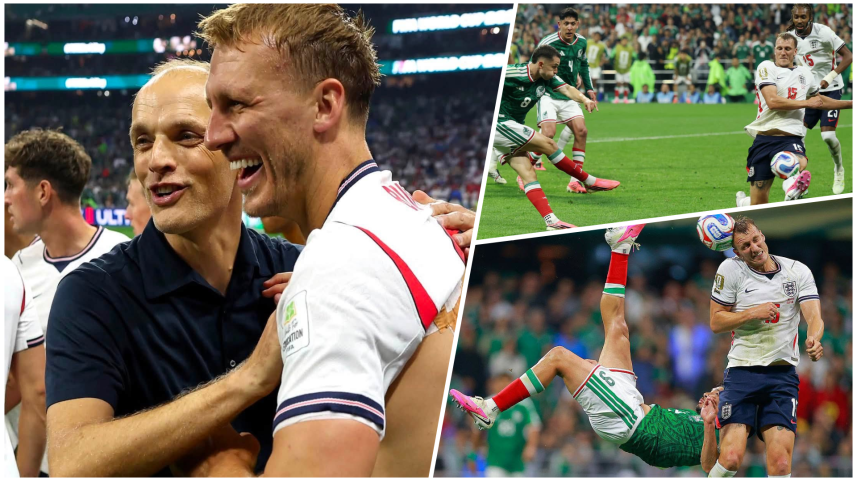
What is a World Cup if not a collection of stories to remember? The making of fairy tales, the emergence of the unlikeliest heroes, and the crushing weight of the harshest realities, all mixed into one cauldron, brewing stories to be remembered for a lifetime.
And some of the most memorable stories come out of the most gruelling battles. When the chips are down, backs are against the wall, knees are on the ground, and the heart is billing you for every breath, that is when characters evolve and unforgettable performances come to the fore.

The siege of the Azteca
England’s triumphant 3-2 win over World Cup co-hosts Mexico in a Round-of-32 clash at the Azteca Stadium on Monday was no different. On top of the gruelling altitude, a hostile atmosphere, a penalty and a number of harsh decisions by the referee, England had to lay down a siege to eke out an outstanding win with a man down for much of the second half and then some. Forty-eight minutes and then some. That is how long England played with 10 men. And among a few others, a towering Dan Burn came out with the biggest heart, stood tall, and produced one of the greatest defensive cameos fitting of the occasion and the history of the iconic venue.
Introduced in the 75th minute, Burn, standing at 6ft 7in tall, answered Thomas Tuchel’s call and planted the English banner firmly as part of a resilient back five -- a 5-3-1 -- to help 10-man England secure one of their most memorable World Cup wins and a place in the quarterfinals.
The arrival of the hedge knight
Out of necessity, England had turned protection into their only path to victory. They did not merely defend a lead; they retreated behind the walls, barred the gates and prepared for the Mexican storm. And up came Burn, standing as tall as Ser Duncan the Tall -- one of the most famous knights in George RR Martin’s Game of Thrones universe -- to make his World Cup debut and do the most Ser Duncan-like thing possible -- serve, suffer, protect and ask for no glory in return.
It was a record-breaking show from the 34-year-old Newcastle United centre-back that helped keep Mexico at arm’s length. Burn made six clearances -- including four headed clearances -- and two blocks in a gargantuan display, the most clearances made by a player subbed on in the 75th minute or later in a World Cup game on record since 1966, protecting England’s 3-2 lead and making sure the Three Lions came away with victory.
From anonymity, much like Ser Duncan, Dan Burn had announced himself with a remarkable display. The hedge knight from Blyth, the footballer who was never really supposed to be here, emerged from World Cup obscurity to become one of the protagonists of one of England’s and the 2026 World Cup’s most famous wins.
Weathering the storm
Just for context of how much pressure England had to deal with, here are a few numbers. In the final 20 minutes – which ended up being the final 32-plus minutes due to the amount of additional time -- Mexico had 83 percent possession, made 79 passes in the final third, and put 32 crosses into the box. But they could not breach the England defence. In fact, they did not even create a big chance. England made 37 clearances in the second half, 20 of them after the clock had already shown 81 minutes.
That was the siege. And in the middle of it stood Burn, not as the knight with the finest armour or the most songs written about him, but as the one who happened to be exactly where duty required him to be. That, more than the height alone, is where the comparison with Ser Duncan truly breathes. Duncan is not remembered because he was the most polished knight in Westeros. He is remembered because when the world around him became cruel, chaotic and unfair, he remained simple, stubborn and brave enough to do what was needed.
Too tall for the room
And there was Burn, a fantastic penalty-box defender with great aerial ability, having helped win England the match, finding himself in the middle of a humorous moment when he was too tall for the microphone while sitting down for the post-match interview. After failing to adjust himself to the low height of the microphone, he was attended to by a woman who quipped, “You’re too tall,” to which Burn, in his grounded nature, replied, “Yeah, I know. Sorry, my bad,” before simply getting up to answer the press’s questions.
It was almost too perfect. The giant defender, awkward in the chair, too big for the setting, apologising for the inconvenience of his own size. Much too similar to the humble hedge knight who often finds himself in goofy situations because of his height and responds in playful, almost childlike ways. Burn had just defended England’s World Cup life with his head, body and everything else, and yet there he was, still seeming like the least self-important man in the room.
Straight after he went back through the tunnel to the dressing room, Tuchel seemed to whisper something in his ear, to which Burn replied, “Thank you, appreciate it,” almost as if a 34-year-old had been reminded that he too had a purpose. This was the central argument behind Tuchel leaving top talents and stars out of the squad in favour of “specialists” who would serve and solve different purposes and problems for England -- players for various scenarios, such as chasing a result or protecting a lead.
Tuchel's stratagem pays off
“I don’t think I’ll ever forget that night... the stadium, the occasion, playing against Mexico there and listening to the Mexican national anthem with 100,000 people, it was surreal. We knew it was going to be a challenge and were a little bit of the underdog but we rose to the challenge,” he said post-match.
“I knew that I was being brought here for a certain reason. I probably wasn’t going to start but there was going to be opportunities in the game whether we’re trying to see a game out or maybe go for a goal that I was going to get it, so yeah, I’ve been desperate to get on the pitch. I didn’t want to leave the World Cup without getting out there, so proud to play for England here. Never thought I’d be saying that when I first started.”
Tuchel has preferred two from the trio of Marc Guehi, Ezri Konsa and John Stones for his centre-back pairing this World Cup, and it was unlikely that Burn would get any game time under normal circumstances, let alone start.
It would not be a stretch to say that Burn was not supposed to be here. Aged 33 last year, it was Tuchel who gave the boy from Blyth his maiden national team call-up and then his debut in a World Cup qualifier against Albania in March 2025. It was not Burn’s defensive acumen but his age that raised many eyebrows, but Tuchel seemed to have no doubts back then. He became one of the oldest England debutants in the modern era, the oldest since Kevin Davies made his solitary England appearance against Montenegro in 2010 at the age of 33 years and 200 days.
“I was surprised that Dan was never called up. He is such a tall guy, but obviously it is easy to overlook him. It almost happened to me,” Tuchel said after picking Burn in his first England squad.
“I can tell you from these two phone calls with Jordan Henderson and Dan Burn, you instantly know that you picked the right guys.”
Two days after he received the news of being called up, Burn scored at Wembley and lifted the Carabao Cup for his boyhood club Newcastle against Liverpool to end their 70-year domestic trophy drought, before being handed an England debut.
 For all latest news, follow The Daily Star's Google News channel.
 Bruising, necessary work
And Tuchel’s faith in Burn’s ability to deal with aerial threats has paid off, and the German coach has certainly proved people wrong, having played him in five World Cup Qualifiers before the Mexico match. It seems Burn is one of those “specialist” players who gives England something different -- seemingly now an integral part of Tuchel’s masterplan to go all the way in the tournament. And the match against Mexico was enough evidence that Tuchel can activate this “specialist” not just to deal with aerial threats but also to be a big presence in the opposition box, while being able to handle more physically imposing attackers such as Norway’s Erling Haaland, whom England will face in their quarterfinal in Miami on Sunday.
“I did just what he expected from me. That’s knowing with my height and the way I defend... it’s blocking shots, blocking crosses, just really trying to grind it out,” Burn said.
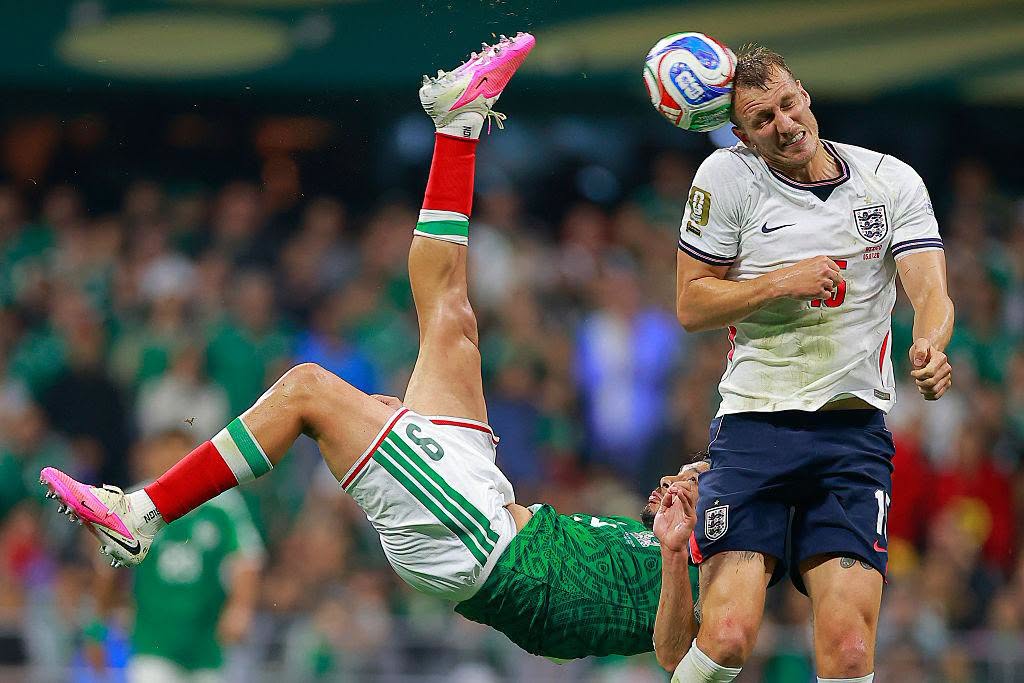
The image that has gone viral on social media is of how steadfast and fearless he was when he stuck his head in to clear away a looping ball against the onrushing threat of Raul Jimenez’s boot from an attempted overhead kick. That was his moment among Jude Bellingham and Kane’s brilliance. Not a goal, not an assist, not a piece of genius that would be replayed with music, but something more primitive and, in its own way, more heroic; a man placing his head where another man’s boot was coming because England needed the ball gone.
And he was heading it quite well. Most of his clearances were robust and travelled close to the halfway line, away from the England box, giving them time and space to breathe amid the Mexican pressure. In a match of princes and kings, this was the work of the hedge knight. Unglamorous. Bruising. Necessary.
The long-winding road to greatness
Burn’s journey is one of football’s great underdog stories that now deserves to be told on the biggest stage. Released by Newcastle United as a youngster in 2003, the towering defender worked his way through the lower leagues before eventually returning to his boyhood club and becoming one of the leaders of the team. He got his big break at Fulham, moving from non-league Darlington to the Premier League side in 2011. From non-league football to scoring in Newcastle’s historic 2025 League Cup final, he has consistently proved that determination can overcome setbacks.
Because of his lanky frame, he was a goalkeeper until the age of 14. It was during that time that he suffered a harrowing experience that shaped him. An accident in which his ring finger was caught in a fence resulted in him losing that finger. And why did he jump that fence? The answer is quite Ser Duncan-like. He wanted to show off to girls and jumped the fence to retrieve a rabbit that had gotten loose. His finger caught a spike and was severed.
There is something almost absurdly fitting about that story. A boy too tall for his age, clumsy and brave enough to chase after a loose rabbit, trying to impress and ending up marked for life. It belongs in the same emotional world as a hedge knight’s tale; a little foolish, a little painful, slightly comic, and yet deeply human.
In an interview with Sky Sports, Burn revealed how the traumatising ordeal impacted his life. He recalled going to a McDonald’s drive-thru with his girlfriend and struggling to exchange cash as the money would fall through his hands. “I would have to leave the change and just drive off,” he said. He added that contactless payment has made his life a lot easier in that respect.
From pushing trolleys in British supermarket and petrol station chain Asda to pushing to turn his career around, Burn has gone through it all. That is the kind of hardship he overcame.
Not every football career follows a straight path. And much like Ser Duncan’s long-winding road, filled with many adventures and twisting turns on the way to greatness, Burn’s has been built on resilience, hard work and never giving up on the dream of representing both his hometown club and his country.
Holding the door
And hence, an ordinary hedge knight rose when duty called. All battle-hardened, all arms and legs and heart, Burn etched himself into the folklore of an iconic evening for the Three Lions’ 2026 World Cup campaign. After the 112-minute battle, Ser Dan Burn the Tall quietly went about his business, did his media duties, and stepped aside as King Kane and Prince Bellingham garnered all the headlines.
But that is how these stories often work. The songs are not always loudest for the man who holds the door! Sometimes the knight who matters most is the one who arrives late, clears everything, says sorry for being too tall, and waits above everyone else in the England camp, eagerly and ever ready to answer the call whenever duty comes.
Comments