


The other World Cup

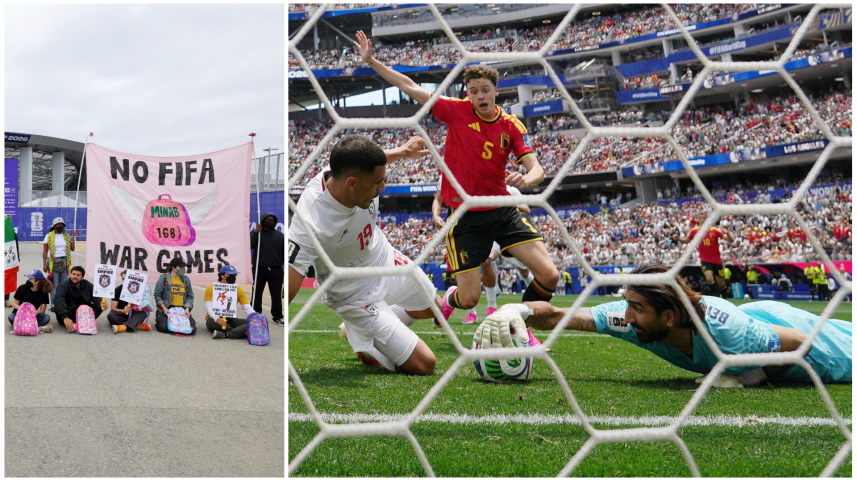
There are two World Cups taking place across North America right now.
The first belongs to the giants, returning to luxury team bases, carefully managed recovery schedules and the certainty of knowing exactly where they will be from one day to the next.

The second belongs to Iran. For Team Melli, this tournament has become a commuter campaign fought against border restrictions, shifting travel plans and geopolitical realities that have little to do with football.
The odds were stacked against them long before they stepped onto the pitch.
Facing a European heavyweight such as Belgium is a daunting challenge for any side under ideal circumstances. Doing so while navigating logistical obstacles and political restrictions makes the task exponentially harder.
Forced to remain at their base camp in Mexico’s Tijuana amid visa complications, Iran were only cleared to enter the United States less than sixteen hours before kick-off. They spent more time negotiating travel arrangements and border procedures than preparing on a match pitch.
Modern football is a game of marginal gains, where elite teams invest millions into recovery, sleep management and carefully planned travel schedules. Standing in security queues and waiting for border clearance is not part of any high-performance preparation plan.
Yet when the lights came on in Los Angeles yesterday, Iran looked anything but disadvantaged. They matched Belgium stride for stride, pressed aggressively and refused to be intimidated by The Red Devils.
At the heart of the resistance stood Alireza Beiranvand.
Long before he became Iran’s No. 1 goalkeeper, obstacles had followed him throughout his life. He ran away from home to chase a football dream, arriving in Tehran with little money and surviving through odd jobs in a car wash, a dressmaking factory and a pizza shop.
Against Belgium, he produced a seven-save masterclass, including a stunning reflex stop to deny Maxim De Cuyper in the second half. Throughout the match, his positioning, composure and fearlessness left frustrated Belgian forwards shaking their heads.
Perhaps that is why Iran’s performance felt so fitting. Beiranvand’s journey mirrors the team’s World Cup campaign itself: delayed, disrupted and repeatedly tested, yet somehow still standing.
The result was a hard-earned point that felt like far more. And according to midfielder Alireza Jahanbakhsh, the adversity has only strengthened the squad.
“I think it is part of our culture that in a difficult situation, we perform better,” Jahanbakhsh said after the match. “It has united us even more, and that’s one of the things that we’ve shown today. We showed great team character.”
The irony was laid bare before kick-off. Head coach Amir Ghalenoei revealed that US authorities would ease restrictions ahead of Friday’s decisive group-stage meeting with Egypt in Seattle.
“They said in Seattle, you can come earlier,” Ghalenoei told reporters before posing a question that cuts to the heart of the issue: “Why didn’t they let us come earlier for the first two games as well?”
That sudden change does not solve the problem. If anything, it highlights it: one team are allowed to focus entirely on football, while the other forced into a logistical guessing game, constantly adapting to changing circumstances beyond their control.
Expecting a national team to reorganise travel plans and preparations at short notice is hardly an advantage. It merely reinforces the unequal reality under which Iran have been operating throughout the tournament.
Ghalenoei believes the world has not fully appreciated the scale of what his team have faced. “I think that we came to the World Cup in the worst condition possible,” he said. “This is something that I wanted all the world to know.”
Yet despite everything, Iran remain firmly in the race for the knockout stage.
 For all latest news, follow The Daily Star's Google News channel.
 Before the World Cup began, geopolitical uncertainty raised questions about whether Iran would even be allowed to participate without disruption. Now they stand one match away from the last 32.
In a tournament increasingly defined by precision, preparation and marginal gains, Team Melli have been asked to overcome obstacles that have little to do with football. So far, they have done exactly that.
The standings will show points, goals and positions. What they will not show are the hours spent waiting, travelling and adapting simply for the right to compete.
And perhaps that is what makes Iran’s story one of the World Cup’s most remarkable. Not because they have been given every chance to succeed. But because they have succeeded despite everything standing in their way.
Comments