Sheikh Mujib’s killing: What the newspapers told and what they omitted

The assassination of Bangabandhu Sheikh Mujibur Rahman and his family is a dark chapter in the political history of Bangladesh. August 15, 1975, was a Friday. That morning, the newspapers that reached readers in the capital and across Bangladesh prominently featured Sheikh Mujib. On that day, he was supposed to visit Dhaka University as Chancellor. To commemorate the occasion, special supplements were printed in the newspapers. Apart from this, there was extensive coverage of Sheikh Mujibur Rahman’s new political philosophy—BAKSAL—on the pages of the newspapers.
However, as power changed hands following the killing of Bangabandhu, the content and tone of the newspapers also changed. This transformation began to be reflected in the newspapers from August 16. In the newspapers of August 15, Sheikh Mujib was portrayed as a great leader, the Father of the Nation and the architect of the Second Revolution, among other accolades. By August 16, however, the portrayal had changed dramatically: he was presented as an unpopular and ruthless ruler, his prominence disappearing almost overnight from both the pages of the newspapers and national life. An order was even issued to confiscate photographs of Sheikh Mujibur Rahman.
It is important to note that newspapers published from August 16, 1975, were subject to strict surveillance by the Khandaker Mushtaque Ahmed government and a section of the Bangladesh Army. Without their approval and permission, it was impossible to publish anything. Yet even under such constraints, these newspapers offer a revealing record of the period—not only through what they reported, but also through what they left unsaid.
Armed Forces takeover hailed as ‘historic’ and in the ‘larger national interest’
In 1975, The Daily Ittefaq was one of the leading newspapers in Bangladesh. The newspaper had once been a mouthpiece of the Awami League. Sheikh Mujibur Rahman also had a very cordial relationship with the newspaper’s founding editor, Tofazzal Hossain Manik Miah. On 16 August 1975, The Daily Ittefaq published a news item titled খন্দকার মোশতাকের নেতৃত্বে সশস্ত্র বাহিনীর শাসনক্ষমতা গ্রহণ (Armed Forces Takeover Under the Leadership of Khandaker Mushtaque).
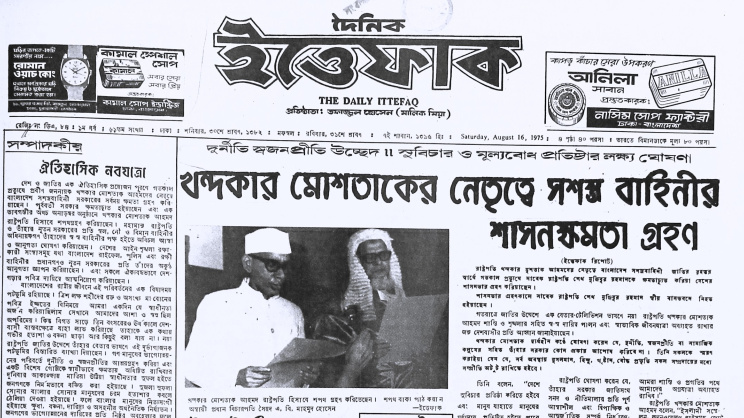
The report read:
The Bangladesh Armed Forces, led by President Khandaker Mushtaque Ahmed, had overthrown former President Sheikh Mujibur Rahman and taken over the government of the country in the larger interest of the nation the previous morning. Former President Sheikh Mujibur Rahman was killed at his residence during the takeover of the government.
In a radio and television address to the nation that night, the new President, Khandaker Mushtaque Ahmed, called on the people of the country to carry out their responsibilities peacefully and in an orderly manner and to continue their normal lives.
Khandaker Mushtaque Ahmed declared unequivocally that his government would not compromise with corruption, nepotism or social corruption. He reminded everyone that harmony among all communities—Muslims, Hindus, Christians, Buddhists, etc.—must be maintained at all times.
He said, "Justice must be established in the country and values must be established in society so that people can be established with dignity." (The Daily Ittefaq, 16 August 1975)
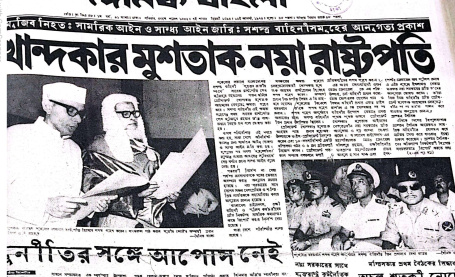
Like The Daily Ittefaq, another leading Bangla daily, Dainik Bangla, published the news of Khandaker Mushtaque’s assumption of power. A photograph of the oath-taking ceremony was also published. The main headline of Dainik Bangla published on August 16 was খন্দকার মোশতাক নয়া রাষ্ট্রপতি (Khandaker Mushtaque is the new president), under which the news of the oath-taking and the declarations of allegiance by various forces was published. However, information about the murder of Sheikh Mujibur Rahman and his family members was not published anywhere in the main news report of Dainik Bangla, although the overthrow of his government was mentioned.
The lead report published in Dainik Bangla read:
On Friday morning, the armed forces of Bangladesh overthrew former President Sheikh Mujibur Rahman in the ‘larger national interest’ and seized power under the leadership of President Khandaker Mushtaque Ahmed. It was announced that former President Sheikh Mujibur Rahman was killed at his residence during the takeover of power by the armed forces.
This news, circulated by BSS, said that martial law was declared for an indefinite period throughout the country and a curfew was imposed. However, after noon, the curfew was lifted for one and a half hours ‘to facilitate the Muslims’ to offer Jumma prayers’.
One phrase here is particularly significant: the reports described the overthrow of Sheikh Mujibur Rahman’s government as being in the ‘larger national interest’—a characterisation that warrants closer scrutiny and discussion.
‘Historical step’ and ‘historical new journey’
Editorials are the voice of newspapers. They reflect the principles and ideals of a publication. Although editorials are generally printed on the inside pages of newspapers, there is sometimes a practice of publishing them on the front page because of their importance. On August 16, 1975, editorials were printed on the front pages of The Daily Ittefaq and Dainik Bangla. The editorial in The Daily Ittefaq was titled ঐতিহাসিক নবযাত্রা (Historical New Journey), while that in Dainik Bangla was titled ঐতিহাসিক পদক্ষেপ (Historical Steps).
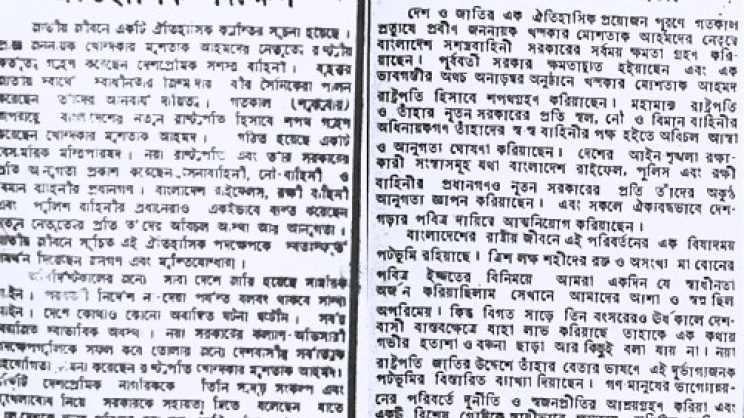
The Daily Ittefaq editorial read:
Yesterday morning, in order to fulfil a historical need of the country and the nation, the armed forces of Bangladesh, under the leadership of veteran public figure Khandaker Mushtaque Ahmed, assumed all the powers of the government. The previous government had been overthrown and, in a solemn yet unpretentious ceremony, Khandaker Mushtaque Ahmed had taken the oath as President. The law-and-order forces of the country, namely the Bangladesh Rifles, the police and the Rakshi Bahini, had also expressed their unwavering loyalty to the new government, and all had united in dedicating themselves to the sacred responsibility of building the country.
There is a sad background to this change in the state life of Bangladesh. In the independence that we achieved one day in exchange for the blood of three million martyrs and the sacred honour of countless mothers and sisters, our hopes and dreams were immeasurable, but what the people of the country have achieved in reality over the past three and a half years can be described in one word as nothing but disappointment and deprivation.
The language and title of the editorial in Dainik Bangla were almost the same as those of The Daily Ittefaq.
The Dainik Bangla editorial read:
National life had reached a historic turning point.The patriotic army had assumed state authority under the leadership of the wise public figure Khandaker Mushtaque Ahmed. The brave soldiers had fulfilled their obligatory duty. Khandaker Mushtaque Ahmed was sworn in as the new President of Bangladesh yesterday (Friday) afternoon. A civilian cabinet had been formed. The chiefs of the army, navy and air force had expressed their loyalty to the new President and his government. The chiefs of the Bangladesh Rifles, Rakshi Bahini and police forces had also expressed their unwavering trust and loyalty to the new leadership. The people and freedom fighters had spontaneously supported this historic step in national life.
Now, let us turn to the English dailies of the time: The Bangladesh Observer and The Bangladesh Times. On August 16, both English-language newspapers published special editorials reflecting on the change of power, giving them prominent placement on their front pages.
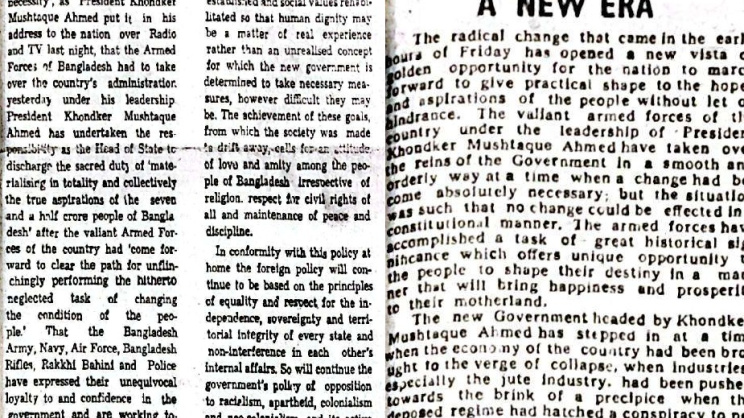
The editorial in The Bangladesh Observer was titled ‘Historical Necessity’.
Its first few paragraphs read:
It was in greater national interest and in response to ‘the historical necessity’, as President Khondker Mushtaque Ahmed put it in his address to the nation over Radio and TV last night, that the Armed Forces of Bangladesh had to take over the country's administration. Yesterday under his leadership President Khondker Mushtaque Ahmed has undertaken the responsibility as the Head of State to discharge the sacred duty of “materialising in totality and collectively the true aspirations of the seven and a half crore people of Bangladesh’ after the valiant Armed Forces of the country had ‘come forward to clear the path for unflinchingly performing the hitherto neglected task of changing the condition of the people’. That the Bangladesh Army, Navy, Air Force, Bangladesh Rifles, Rakkhi Bahini and Police have expressed their unequivocal loyalty and confidence in the government and are working together shows how widely and genuinely this ‘historical necessity’ was felt and how sincerely the consequent concern was shared by all of them.’
The editorial offered an extensive justification of the change as a ‘historical necessity’. It accused the Sheikh Mujibur Rahman government of attempting to consolidate power and alleged widespread corruption and the seizure of national resources. At the same time, the editorial called on everyone to work for the country in the changed circumstances.
The editorial in The Bangladesh Times on August 16 was titled ‘On the threshold of a new era’. It was also published on the front page.
The editorial read:
The radical change that came in the early hours of Friday has opened a new vista of golden opportunity for the nation to march forward to give practical shape to the hopes and aspirations of the people without let or hindrance. The valiant armed forces of the country under the leadership of President Khondker Mushtaque Ahmed have taken over the reins of the Government in a smooth and orderly way at a time when a change had become absolutely necessary: but the situation was such that no change could be effected in constitutional manner. The armed forces have accomplished a task of great historical significance which offers unique opportunity to the people to shape their destiny in a manner that will bring happiness and prosperity to their motherland.
Like The Bangladesh Observer, The Bangladesh Times presented the change of power against a backdrop of renewed optimism. Its editorial, however, portrayed the transition as peaceful. In reality, the 1975 change of power was anything but peaceful; it was accompanied by one of the bloodiest episodes in Bangladesh’s political history.
Reporting on the murder of Sheikh Mujib and his family
On the morning of August 15, people across the country first heard the news of President Sheikh Mujibur Rahman’s assassination through an announcement by Major Dalim on Bangladesh Betar. Yet, surprisingly, the newspapers of August 16 carried no detailed reports on his assassination. The assassination of a country’s president, particularly a leader of Bangabandhu Sheikh Mujibur Rahman’s stature, along with members of his family, would ordinarily have received extensive coverage. Yet, for reasons that remain unclear, it did not. It was only said, ‘... Former President Sheikh Mujibur Rahman was killed in his own residence’ (The Daily Ittefaq, August 16, 1975). Dainik Bangla reported only that Sheikh Mujib had been killed, without saying who had killed him or how. Nor did the newspapers report the deaths of his wife, Begum Sheikh Fazilatunnesa Mujib, his sons, daughters-in-law and young son Sheikh Russel. The murders of Sheikh Moni and members of the Serniabat family were similarly absent from their pages. In fact, the newspapers said virtually nothing about the other victims. Altogether, 18 people, including Sheikh Mujib, were killed in the early hours of August 15. Army officer Colonel Jamil was also killed, but his death, too, received no coverage in the newspapers.
Sheikh Mujibur Rahman’s burial reported in just 23 words
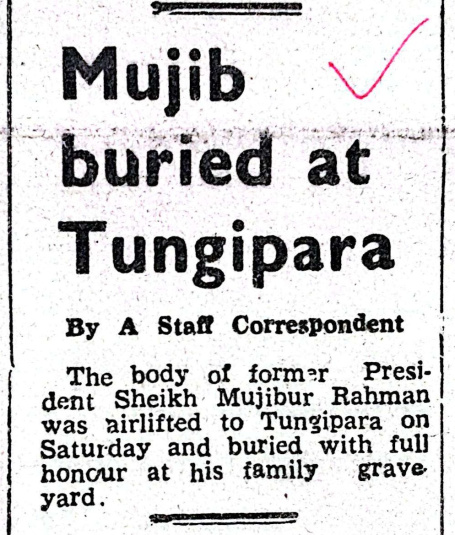
The newspapers after August 15 not only suppressed details of Sheikh Mujibur Rahman’s brutal killing but also largely refrained from reporting on his burial. At the time, none of the newspapers provided any substantial coverage of the burial of Sheikh Mujibur Rahman. On August 18, however, The Bangladesh Observer carried a very brief report under the headline ‘Mujib buried at Tungipara’. It was an extraordinarily short news report, consisting of only 23 words. It said, ‘The body of former President Sheikh Mujibur Rahman was airlifted to Tungipara on Saturday and buried with full honor at his family yard.’ Although The Bangladesh Observer carried this brief report, no other newspaper at the time appears to have published the news of his burial. And, needless to say, it did not publish any photograph of Sheikh Mujibur Rahman.
Photographs of Sheikh Mujibur Rahman seized
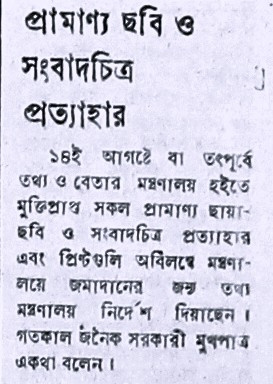
It is common journalistic practice for photographs of the deceased to accompany reports of their deaths. Yet, following the assassination on August 15, no photograph of Sheikh Mujibur Rahman appeared in Bangladesh’s newspapers. More strikingly, photographs of Sheikh Mujibur Rahman kept in various government offices were also seized at the time. A news item on the matter appeared in The Daily Ittefaq under the headline ‘Withdrawal of documentary photos and news photos.’ The report said: ‘all documentary photos and news photos released by the Ministry of Information and Broadcasting on or before 14 August had been withdrawn and that the prints had been immediately submitted to the Ministry. A government spokesperson said this yesterday.’ (18 August 1975, The Daily Ittefaq)
Recognition of the Mushtaque government given highest priority
While newspapers in Bangladesh portrayed the 1975 change of government as peaceful and historic, the international media gave considerable prominence to the killing of Sheikh Mujibur Rahman and members of his family. The brutal murder of his young son Sheikh Russel and the female members of the family, in particular, could not be justified under any circumstances. Questions about the legitimacy of the new government therefore arose from the very beginning. Against this backdrop, the recognition of the Khondker Mushtaque Ahmed government by other countries, as well as their diplomatic contacts with the new administration, began to receive extensive coverage in Bangladeshi newspapers.
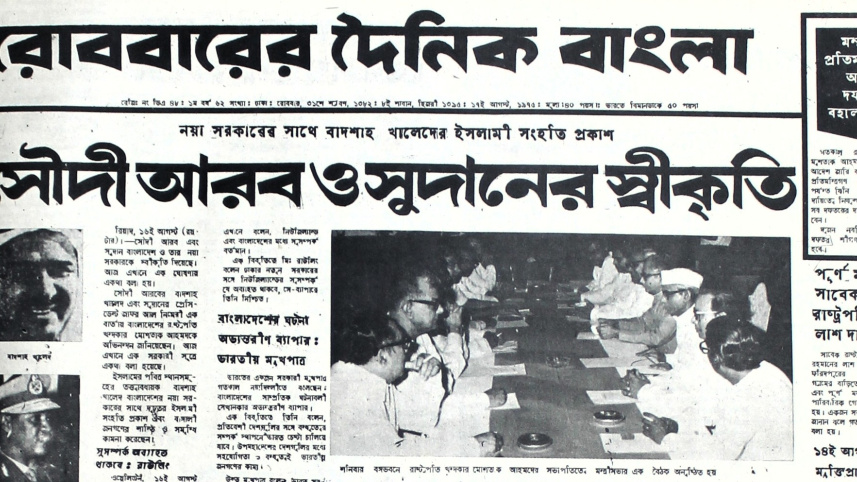
On 17 August 1975, Bangladeshi newspapers prominently reported the recognition of the Mushtaque government by Saudi Arabia and Sudan. Quoting Reuters, Dainik Bangla reported that the Saudi Arabian and Sudanese governments had recognised Bangladesh and its new government. An announcement to this effect had been made that day. Saudi Arabia’s King Khalid and Sudanese President Gaafar Nimeiry had sent messages congratulating Bangladesh President Khandaker Mushtaque Ahmed, according to an official source.
Meanwhile, news of the Soviet Union’s recognition was also published. The headline of the report published on the front page of The Bangladesh Observer was ‘Soviet Union gives recognition’. The report said, ‘The Government of the USSR has accorded recognition to the new Government of Bangladesh and assured to continue to maintain relations with the Government of People’s Republic of Bangladesh, reports BSS.’
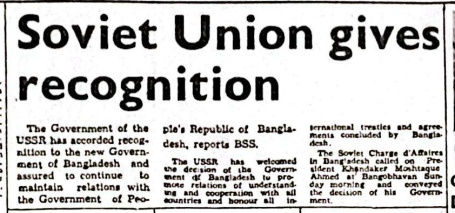
The Soviet Chargé d’Affaires in Bangladesh called on President Khandaker Moshtaque Ahmed at Bangabhaban and conveyed his government’s decision, reported The Bangladesh Observer.
Reports about international recognition of the Khandaker Mushtaque Ahmed government continued to appear in the newspapers over the following days. During this period, the newspapers carried reports of recognition and support from Yemen, Britain, Jordan, Japan, Myanmar, Malaysia, Indonesia, Nepal and various other governments.
Special importance given to the Indian government’s response
India played a significant role in Bangladesh’s Liberation War in 1971, both through its active involvement and its humanitarian assistance. Indian Prime Minister Indira Gandhi also shared close political and personal relations with Sheikh Mujibur Rahman, the undisputed leader of Bangladesh’s independence. Against this backdrop, the 25-year India-Bangladesh Friendship Agreement was signed on March 19, 1972. The agreement contained provisions covering various areas of military and civilian cooperation. It was therefore natural that there would be considerable interest and apprehension over how India would respond to the assassination of Bangabandhu Sheikh Mujibur Rahman and the overthrow of his government.
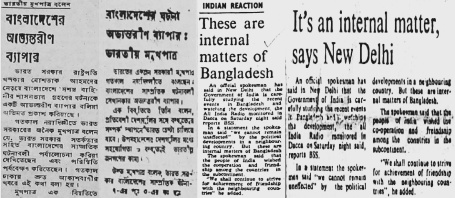
Against this backdrop, India’s response received prominent coverage in almost all Bangladeshi newspapers on August 17, 1975. The Daily Ittefaq carried the headline ‘Indian spokesperson said: Internal affair of Bangladesh’. The report said: The Indian government has expressed its opinion that the ‘taking over of power by the armed forces’ in Bangladesh under the leadership of President Khandaker Mushtaque Ahmed is an internal affair.
The report further said that the Indian spokesman had stated that ‘we cannot remain idle’ in the face of political developments in a neighbouring country, but that these developments were the internal affairs of Bangladesh. The spokesman said that the people of India desired cooperation and friendship among the countries of the subcontinent. He added, ‘We will continue to strive to establish friendship with many countries.’
Indications of warm relations with the United States
The United States had strongly opposed Bangladesh’s cause during the 1971 Liberation War. Even after Bangladesh gained independence, the country faced opposition from the United States on various fronts. The Nixon-Kissinger administration also withheld wheat shipments to Bangladesh despite having promised food assistance at a time when the country was facing a devastating famine. There have also been allegations that the US intelligence agency, the CIA, was involved in the overthrow of Sheikh Mujibur Rahman’s government and his assassination. It is difficult to determine the exact nature and extent of the US relationship with the new administration after Khandaker Mushtaque Ahmed assumed power. The newspaper coverage of the period, however, offered indications of warming relations between the two countries.
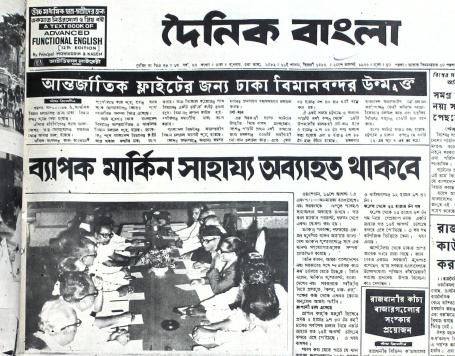
On August 20, 1975, one of the headlines in Dainik Bangla was ‘Massive US aid will continue’. The report, published by AFP from Washington, said that ‘America will continue to provide huge amounts of aid to the new government of Bangladesh. This was announced yesterday by the US State Department.’
The report further said that a spokesperson for the US State Department had stated that Bangladesh had established a deep cooperative relationship with the United States in the past. The spokesperson added, ‘We are willing to continue normal work with the new government of Bangladesh.’
According to the report, he also said that the United States was ready to recognise the new government of Bangladesh, but ‘we have not received any request from the Dhaka authorities yet’.
Taken together, the newspapers of those extraordinary days tell a story not only through what they published, but also through what they omitted. The marginal coverage of Sheikh Mujibur Rahman’s assassination and burial, the absence of reporting on the killing of his family members, and the prominent descriptions of the new order as ‘historic’ and necessary reveal the severe constraints under which the press operated after August 15. At the same time, the attention given to international recognition of the Khandaker Mushtaque Ahmed government shows how quickly the media narrative shifted towards legitimising the new political order. These newspapers, therefore, should not be read simply as objective accounts of what happened. Their silences, omissions, language and priorities are themselves part of the historical record. Five decades later, they offer a valuable window into not only one of the darkest moments in Bangladesh’s history, but also how that moment was presented to the nation as it unfolded.
Rahat Minhaz is an assistant professor in the Department of Mass Communication and Journalism at Jagannath University, Dhaka. He can be reached at minhaz_uddin_du@yahoo.com.
Send your articles for Slow Reads to slowreads@thedailystar.net. Check out our submission guidelines for details.
In conversation with William Dalrymple / ‘Britain didn't conquer India’

Mirrors of Empire / The bureaucrats and intellectuals who shaped the Mughal Empire
To feel Bengali, to think beyond Bengal: Dipankar Gupta in conversation
Bangladesh's visual history / The enduring allure of vintage photographs
The enduring legacy of the 2nd Bangladesh Liberation War Course
In conversation with Harbans Mukhia / Beyond kings and dynasties: Rethinking medieval Indian history
Reading Ardhakathanak / What a 17th-century merchant's autobiography reveals about Mughal governance

The blind spots of Bangladesh studies

Rediscovering Santal history through Scandinavian archives