


In the ranks of legends: Forlan, the Jabulani ball magician

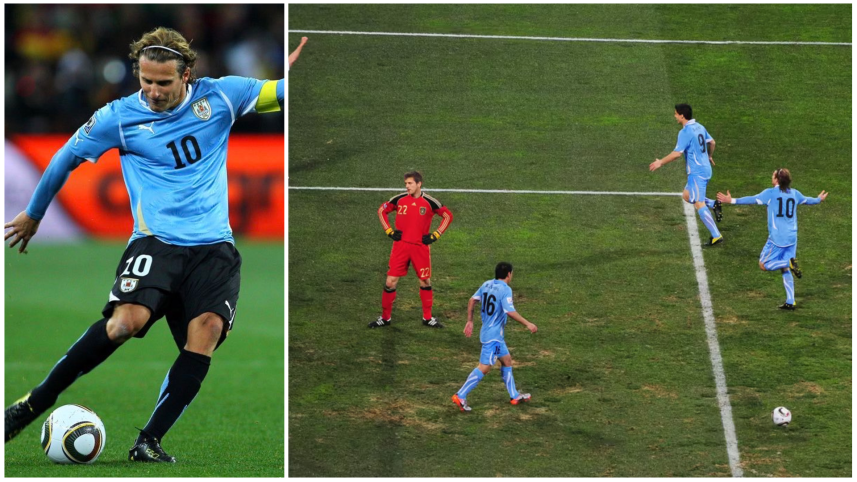
Thierry Henry, Andres Iniesta, Kaka, Lionel Messi, Cristiano Ronaldo, or Wayne Rooney -- before the 2010 World Cup in South Africa, many of these stars were on the list of potential Golden Ball winners. Amid this constellation of talent, the name of an experienced Uruguayan striker was barely mentioned.
Yet it was Diego Forlan, with his golden hair, who tamed the unruly Jabulani ball and won the tournament’s best player award on African soil. With a series of goals and assists, and performances that seemed almost magical, he earned his place among the legends.

With this extraordinary achievement, Forlan inscribed his name on one of the most prestigious lists in FIFA World Cup history. Winning the Golden Ball for taking Uruguay to the semifinals after a 40-year gap, he joined the ranks of Italy’s Paolo Rossi (1982) and Salvatore Schillaci (1990), Argentina’s Diego Maradona (1986), Brazil’s Romario (1994) and Ronaldo (1998), Germany’s Oliver Kahn (2002), and France’s Zinedine Zidane (2006). Displaying consistent brilliance, he scored five goals and added one assist over seven matches.
Forlan arrived at the World Cup in top form from club football, having once each won the Golden Shoe as Europe’s top scorer with Villarreal and Atletico Madrid in LaLiga. Just before stepping onto South African soil, he had scored twice against English side Fulham in the UEFA Europa League final. Riding on his shoulders, Atletico tasted a European trophy for the first time since 1962 -- a wait of 48 long years.
It wasn’t just at the club level; Forlan was equally in rhythm for the national team. He had scored seven goals during the South American qualifiers for the World Cup. At 31, his goal was to change Uruguay’s fortune with two young talents, Luis Suarez and Edinson Cavani, then just 23. After Daniel Fonseca’s header gave Uruguay a 1-0 win over South Korea in the 1990 World Cup, the team had gone 20 years without a World Cup victory.
In the 2010 tournament, the biggest fear for opponents seemed to be Adidas’s ‘Jabulani’ ball. Its unusual design -- made with only eight panels, far fewer than any previous ball -- reduced air resistance, causing it to shift direction unpredictably at the last moment. Italian goalkeeper Buffon called it “completely unsuitable,” while Brazilian striker Luis Fabiano described it as “very strange.”
While the stars criticised the ball’s erratic behavior, Forlan quietly sought ways to master it. Three months before the World Cup, he requested a Jabulani from Adidas. After training, when everyone else left the field, he stayed behind alone for hours, meticulously studying the ball’s movement and characteristics.
The first glimpse of success from Forlan’s visionary preparation lit up South Africa. In a group-stage match, when he took a shot from 30 yards, the goalkeeper could do nothing as the ball twisted unexpectedly in midair. His bullet-speed strike hit the net, and the deafening roar of vuvuzelas immediately erupted across the stands. The football world marveled at his exceptional control over the Jabulani.
In that match, Forlan scored twice, sending South Africa packing with a 3-0 defeat. Former champions France, who had drawn goalless in their opening match, defeated Mexico in the final group match. As group leaders, Uruguay advanced to the knockout stage and edged past South Korea 1-0 to reach the quarterfinals.
The quarterfinal against Ghana became memorable for Suarez’s infamous handball, yet Forlan’s contribution to Uruguay’s victory was undeniable. He singlehandedly pulled the trailing team back into contention.
His perfectly curved free kick from the left side of the box in the tenth minute of the second half leveled the score and shifted momentum, giving Uruguay the confidence to eventually win in the penalty shootout. After a thrilling, tense, and controversial match, Uruguay secured a World Cup semifinal spot for the first time since 1970.
Forlan’s extraordinary mastery over the Jabulani even sparked conspiracy theories. Some claimed he had secret knowledge about the ball. Shaking off the rumors, he later said, “There’s no mystery -- just a lot of practice, a lot of sweat, and even more practice. I was fortunate, and the Jabulani behaved well. We developed a great relationship!”
Inside the Uruguayan squad, there was quiet yet firm confidence, though few outside believed in them. Reflecting on the journey, Forlan added, “We always trusted ourselves. From day one, we knew we had to take it step by step. Drawing against France in our first match gave us great confidence, and from there we built our foundation.”
In the semifinal against the Netherlands, Forlan shone again. Just before halftime, his dazzling long-range strike with his relatively weaker left foot demonstrated that no one had better control over the Jabulani in the tournament. Although Oscar Tabarez’s men ultimately lost 3-2, Forlan’s dominance was clear.
In the third-place match against Germany, Uruguay narrowly lost again, but Forlan maintained his supremacy over the Jabulani. An acrobatic volley, dropping the ball just before the ground to deceive German goalkeeper Hans-Jorg Butt, produced another brilliant goal -- his fifth of the tournament. It also won the award for the tournament’s best goal.
Forlan earned the Golden Ball with 23.4% of votes, ahead of runner-up Wesley Sneijder (21.8%) and champion Spain’s David Villa (16.9%). After Schillaci, he became the first and only player to win this prestigious award without playing in the final. His selfless work, outstanding finishing, and intimate understanding of the Jabulani set him apart and brought him the honor.
Reflecting on the achievement, Forlan said, “Winning an individual award at the World Cup was never my goal. I went there to give my best for my country. But winning the Golden Ball is an indescribable feeling. It is a reward for our entire team and Uruguayan football. Thinking of the great players I surpassed to win this prize, I feel especially proud. Villa, Iniesta, Sneijder, Thomas Muller -- they all could have been deserving winners. It was one of the happiest moments of my life.”
What Forlan achieved during that electrifying month in South Africa cannot be measured by statistics alone. Where the criticised Jabulani was an unruly enigma for others, Forlan was the master craftsman.
Restoring Uruguay’s prominence on the global football map after decades, surpassing major stars, and winning the Golden Ball -- together, these feats placed him at a historic pinnacle, reserved only for the best of the best.
 For all latest news, follow The Daily Star's Google News channel.
Comments