


The tears of a crownless king

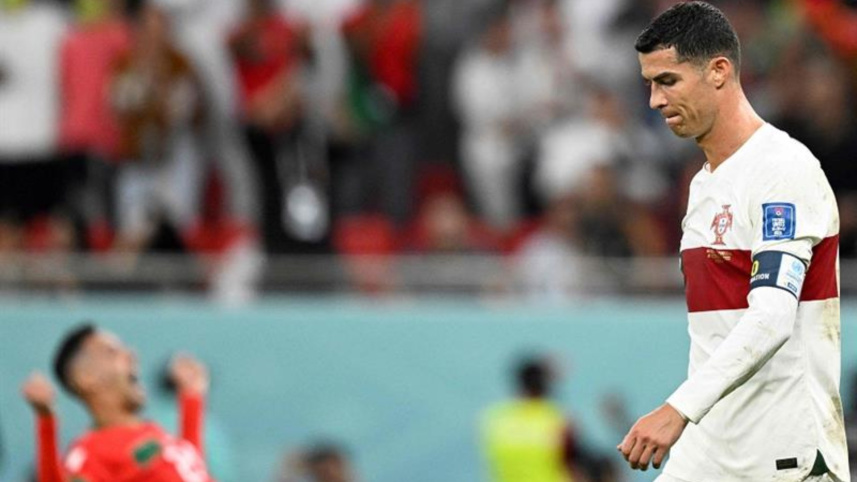
It was deep into the night. Under the floodlights of the Al Thumama Stadium, the lush green pitch still glowed with celebration in Morocco’s green and red.
But in the opposite direction of that light, at the mouth of the tunnel, one of the world’s most famous footballers was walking alone into the darkness – leaving behind the glow, the heat, the roar.

And then, in the final frame caught by the cameras, was Cristiano Ronaldo – his hand pressed to his chest, face covered, he was in tears. This was no ordinary defeat. It was of a man clutching, for one last time, the greatest unfulfilled dream of his life.
Think back to the days leading up to the 2022 FIFA World Cup. The dressing room at Manchester United had become a battleground. Ronaldo, in a candid interview, launched a scathing attack on the club – its manager Erik ten Hag, its structure, everything. The moment those words were spoken, it was clear there was no way back. Just before the World Cup began, his contract was terminated. He had to leave one of the world’s biggest clubs – alone, exhausted, and scorched by controversy.
To step into a World Cup in such a state is no easy task. His mind carried the weight of a broken club relationship, a bitter ending, and the creeping reality of age. At 37, how much is really left? How much can those muscles still give – the same muscles that once seemed to defy gravity itself?
In the group stage against Ghana, he scored from the penalty spot, becoming the first player to score in five different World Cups. He raised his fist to the sky in that familiar pose. But if you looked into his eyes, the fire felt different – more desperate, more fragile.
Then came the decision that stunned the footballing world.
In the knockout match against Switzerland, coach Fernando Santos left Ronaldo on the bench. In his place came Goncalo Ramos, a 21-year-old many had barely known. Ramos scored a hattrick, and Portugal won 6–1.
On the pitch, there was a wave of joy. On the bench, Ronaldo watched it unfold. The cameras panned on his face again and again, as though the world wanted to know what was happening inside him. But the familiar fire was gone, replaced by a strange emptiness. His team was scoring, yet he had no part in it. That day, one of the biggest stars in the world was merely a spectator.
Throughout his career, Ronaldo had been like Atlas from Greek mythology, carrying Portugal on his shoulders. Even during UEFA Euro 2016, after leaving the pitch injured, he had stood on the touchline, urging his teammates on like a coach. He was a man who believed his presence alone could change destiny.
But in 2022, even Atlas could no longer bear the weight. The invincible image he had built, piece by piece, was beginning to crack. The tragedy of a superhuman slowly becoming human – football has witnessed few sights more painful.
In the quarterfinal against Morocco, he once again started on the bench. He came on in the second half, but by then Morocco were ahead. He wanted it – his body could not deliver. His legs no longer moved with that same speed; his leaps no longer reached those same heights. He chased a goal with desperation, but the ball seemed to evade him.
The final whistle blew.
Morocco had won. Portugal were out. And for Ronaldo, perhaps the last chance to do something extraordinary at a World Cup was gone.
He did not collapse at the centre circle. He did not scream. He simply walked, quickly and alone, towards the tunnel. Behind him remained the lights, the flashes of cameras, Morocco’s celebrations. Ahead lay only darkness.
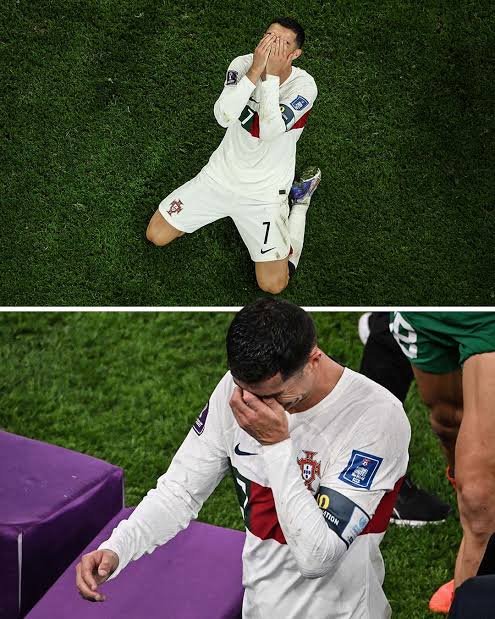
That walk seemed like acceptance – not slow, but hurried, as if he wanted to embrace the darkness as quickly as possible.
And then, inside the tunnel, the wall broke.
Hand pressed to his chest, face covered, Ronaldo wept. The world saw it. The man once perceived as a machine, whose veins pulsed with nothing but the hunger to win, now had tears streaming down his face. A myth was collapsing, and the whole world heard it – not in sound, but in silence.
It was not just the grief of defeat. It was the pain of watching a lifelong dream, built piece by piece, slip forever from his grasp. The World Cup – the trophy for which he had given everything – would not come to him. At least, that is how it felt in 2022.
When Roberto Baggio stood with his head bowed after missing that penalty in the 1994 World Cup final, the image etched itself into football’s memory forever. In the same way, Ronaldo’s tearful face in the Al Thumama tunnel will endure — a poem of ultimate helplessness in a man defined by his fight.
Even without the trophy, history will remember him. Because there are things greater than a crown – the relentless will, the unyielding desire, the courage to return again and again despite failure.
 For all latest news, follow The Daily Star's Google News channel.
 But the story is not over.
The 2026 FIFA World Cup is around the corner. And Ronaldo will be there.
At 41, he will take to the field once more – in the stadiums of the United States, Canada and Mexico – in Portugal’s red and green, carrying the same dream he refused to abandon even in tears inside that tunnel in Qatar.
Perhaps this time it will happen. Perhaps it will not. But as long as Ronaldo is on the pitch, the possibility always exists – that is the greatest truth about this great footballer.
Comments