


Welcome to football’s ultimate theatre

Waking up, rubbing the sleep from your eyes and reaching for your phone should not feel like stepping into an alternate universe. Yet that was exactly what greeted this writer on Tuesday morning.
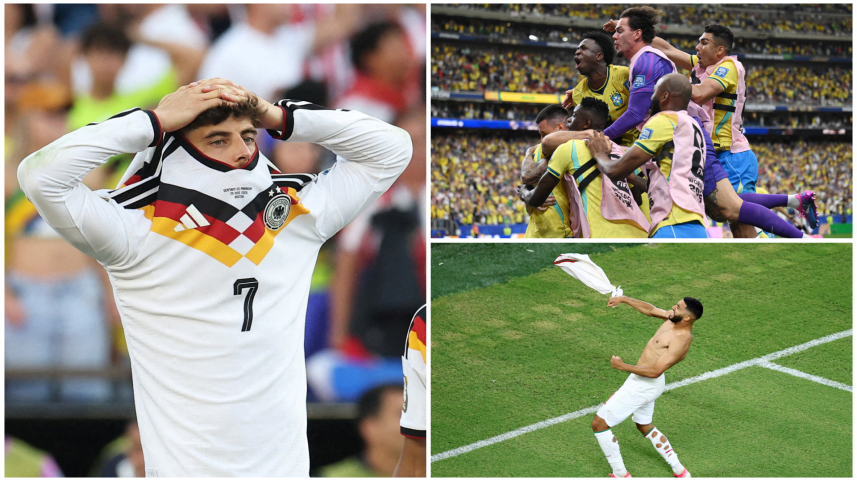
Germany were out of the World Cup. Knocked out by Paraguay. On penalties.

The browser was refreshed once. Then twice. Then again, just to make sure tired eyes were not playing tricks. But the score refused to change.
Germany, four-time world champions, had lost a World Cup penalty shootout for the first time in their history. They missed three penalties on the night, having previously missed only one in four tie-breakers.
It was the sort of result that made one wonder whether international football had quietly abandoned logic overnight.
Then you remember this is the 2026 World Cup knockout stage, where logic goes to die and chaos takes centre stage.
The night's madness had begun hours earlier.
Brazil looked destined for extra time after Japan stunned the five-time champions with a thunderous first-half strike from Kaishu Sano. Casemiro restored parity, but Japan defended with extraordinary discipline and seemed within touching distance of another famous upset.
Then, with virtually the last kick of the match, Gabriel Martinelli slipped behind the defence and squeezed a low finish beyond Zion Suzuki.
One moment Japan were dreaming of the Round of 16. The next, Brazilian players were sprinting towards the corner flag while their opponents collapsed to the ground in disbelief.
While Brazil escaped, Germany were not to be so fortunate.
Julian Nagelsmann's side thought they had found the winner in extra time when Jonathan Tah powered home, only for VAR to intervene.
After a lengthy review, the goal was ruled out for a foul on goalkeeper Orlando Gill, a decision that immediately divided opinion.
"I don't agree with that decision at all. The goalkeeper has conned the referee and the VAR," BBC pundit Alan Shearer said.
Former Premier League assistant referee Darren Cann also described the contact as ‘too soft’ to justify disallowing the goal.
The psychological blow proved devastating.
Tah, who had believed he was Germany's hero only minutes earlier, returned in sudden death and blasted his penalty over the crossbar. Jose Canale calmly converted the next one, sealing Paraguay's place in the last 16 and Germany's first-ever World Cup defeat in a penalty shootout.
If that script felt unbelievable, the early morning still had one final act to deliver.
The Netherlands appeared to have done enough after Cody Gakpo's emotional opener, only for Morocco to snatch an equaliser through Issa Diop in the first minute of stoppage time.
The Dutch never recovered.
Yassine Bounou, already renowned as one of football's finest shot-stoppers from penalties, once again took command of the shootout as Morocco held their nerve.
 For all latest news, follow The Daily Star's Google News channel.
 Then came one final twist.
The winning penalty was buried by Ismael Saibari, a player who has spent his entire professional career in the Netherlands. On football's biggest stage, it was a familiar face who delivered the final blow to the Oranje.
In the space of one extraordinary night, the World Cup produced a stoppage-time winner, two penalty shootouts, one of the tournament's biggest upsets and enough twists to fill an entire knockout round. The old hierarchy has been turned on its head.
Reputations count for little once the knockout stage begins. Every underdog believes. Every favourite suddenly looks vulnerable. No analyst can confidently predict what comes next.
No supercomputer can account for the emotion, pressure and sheer unpredictability that unfold once the stakes reach this level. Nobody knows what tomorrow's headline will be.
And perhaps that is the greatest beauty of the World Cup. It remains football's ultimate theatre because, just when you think you have seen everything, it reminds you that the impossible is always only one match away.
Comments