


Shot clock and 16 seeds in new rules

Tennis chiefs have agreed to reduce the number of seeds in the four Grand Slam tournaments from 32 to 16 as part of a raft of rule changes aimed at widening the sport's appeal.
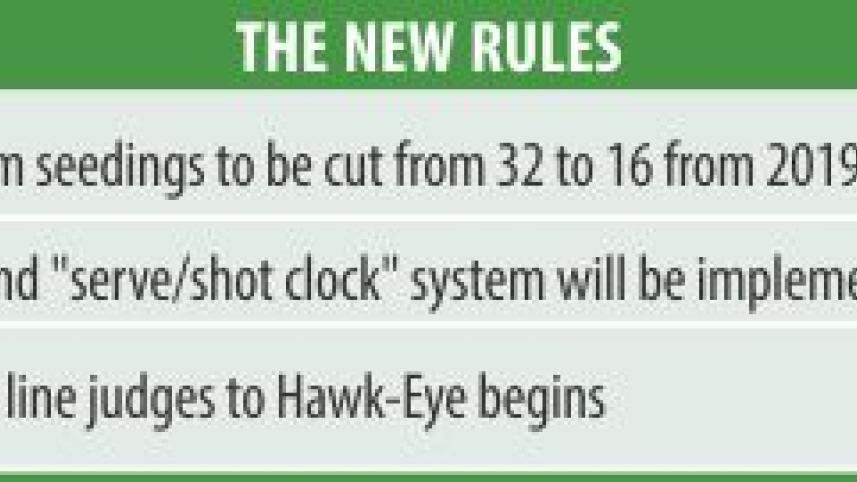
From 2019, Wimbledon and the Australian, French and US Opens will have only 16 seeded players in the men's and women's draws.

Halving the number of seeds is an attempt to make the early rounds of the majors more interesting as it will open the possibility of higher-ranked players facing off before the last 16.
There were 16 seeds at Grand Slams until after Wimbledon in 2001, when the US Open asked for 32 in the hope that stars would still be in contention in the closing rounds.
The Grand Slam Board meeting in London also approved the Australian Open's request to implement a 25-second "serve/shot clock" system in line with the scheme trialled at the 2017 US Open to speed up play.
The board has also moved to tackle the problem of players withdrawing from or purposefully lacking effort in first-round matches and still getting their full prize money.
Grand Slams will now give the injured who pull out on site before their opening match 50 per cent of the first-round prize money, with the other 50 per cent going to the "lucky loser" who replaces them.
HAWK-EYE REPLACING LINE JUDGES IN ADELAIDE
Adelaide's World Tennis Challenge will be the first professional tennis event to totally rely on Hawk-Eye Live camera technology -- bumping line umpires from the court.
It means the players' right of challenging line calls will be scrapped and all computer ball tracking decisions will stand.
The technology was trialled at the Next Gen ATP Finals in Milan earlier this month — where the eight best young players of 2017 competed — and the chair umpire was left as the sole official on the court.
Hawk-Eye Live will be used on all lines throughout every point at the WTC and when triggered it will generate an automated “Out” call.
 For all latest news, follow The Daily Star's Google News channel.
Comments