


Element of surprise helps babies learn

Researchers at John Hopkins University found that infants have inborn knowledge about the world and when their expectations are defied, they learn best.
In a paper published on April 3 in the journal Science, cognitive psychologists Aimee E Stahl and Lisa Feigenson demonstrate for the first time that babies learn new things by leveraging the core information they are born with. When something surprises a baby, like an object not behaving the way a baby expects it to, the baby not only focuses on that object, but ultimately learns more about it than from a similar yet predictable object.
"For young learners, the world is an incredibly complex place filled with dynamic stimuli. How do learners know what to focus on and learn more about, and what to ignore? Our research suggests that infants use what they already know about the world to form predictions. When these predictions are shown to be wrong, infants use this as a special opportunity for learning," said Feigenson, a professor of psychological and brain sciences in the university's Krieger School of Arts and Sciences. She also adds, "When babies are surprised, they learn much better, as though they are taking the occasion to try to figure something out about their world.
source: sciencedaily.com

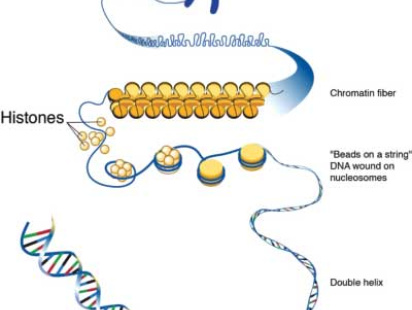
DNA Can't Explain All Inherited Biological Traits
New research shows that characteristics passed between generations are not solely decided by DNA, but can also be brought by other material in cells.
Scientists studied proteins found in cells, known as histones, which are not part of the genetic code, but acts as spools around DNA's which are wounded. Histones are known to control whether or not genes are switched on.
Researchers found that naturally occurring changes to these proteins, which affect how they control genes, can be sustained from one generation to the next and so influence which traits are passed on.
The finding demonstrates for the first time that DNA is not solely responsible for how characteristics are inherited. It paves the way for research into how and when this method of inheritance occurs in nature, and if it is linked to particular traits or health conditions.
It may also inform research into whether changes to the histone proteins that are caused by environmental conditions – such as stress or diet – can influence the function of genes passed on to offspring.
source: sciencedaily.com
 For all latest news, follow The Daily Star's Google News channel.
Comments