


Quirky Science

Robot Helps to Study
When early terrestrial animals began moving about on mud and sand 360 million years ago, the powerful tails they used as fish may have been more important than scientists previously realised. That's one conclusion from a new study of African mudskipper fish and a robot modeled on the animal.

Animals analogous to the mudskipper would have used modified fins to move around on flat surfaces, but for climbing sandy slopes, the animals could have benefitted from using their tails to propel themselves forward, the researchers found. Results of the study, reported this week in the journal Science, could help designers create amphibious robots able to move across granular surfaces more efficiently – and with less likelihood of getting stuck in the mud.
Sponsored by the National Science Foundation, the Army Research Office and the Army Research Laboratory, the project involved a multidisciplinary team of physicists, biologists and roboticists from the Georgia Institute of Technology, Clemson University and Carnegie Mellon University. In addition to a detailed study of the mudskipper and development of a robot model that used the animal's locomotion techniques, the study also examined flow and drag conditions in representative granular materials, and applied a mathematical model incorporating new physics based on the drag research.
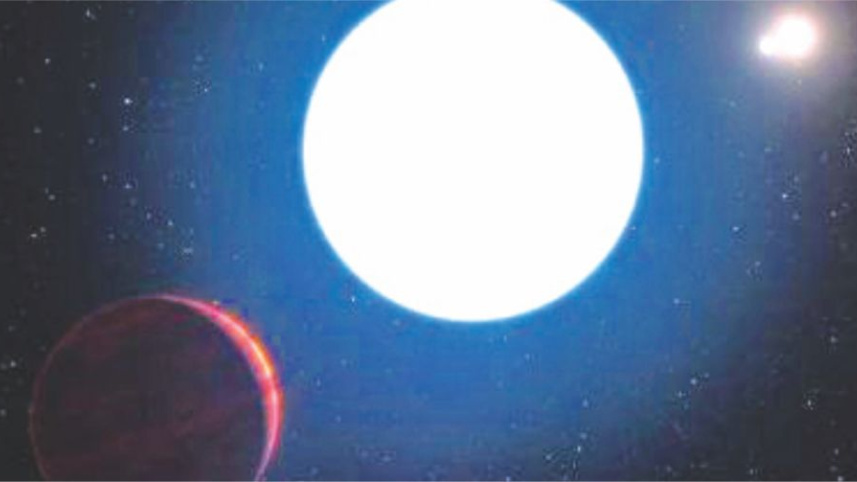
Surprising planet with three suns
A team of astronomers have used the SPHERE instrument on ESO's Very Large Telescope to image the first planet ever found in a wide orbit inside a triple-star system. The orbit of such a planet had been expected to be unstable, probably resulting in the planet being quickly ejected from the system. But somehow this one survives. This unexpected observation suggests that such systems may actually be more common than previously thought. The results will be published online in the journal Science on 7 July 2016.
Luke Skywalker's home planet, Tatooine, in the Star Wars saga, was a strange world with two suns in the sky, but astronomers have now found a planet in an even more exotic system, where an observer would either experience constant daylight or enjoy triple sunrises and sunsets each day, depending on the seasons, which last longer than human lifetimes.
This world has been discovered by a team of astronomers led by the University of Arizona, USA, using direct imaging at ESO's Very Large Telescope (VLT) in Chile. The planet, HD 131399Ab, is unlike any other known world – its orbit around the brightest of the three stars is by far the widest known within a multi-star system. Such orbits are often unstable, because of the complex and changing gravitational attraction from the other two stars in the system, and planets in stable orbits were thought to be very unlikely.
Located about 320 light-years from Earth in the constellation of Centaurus (The Centaur), HD 131399Ab is about 16 million years old, making it also one of the youngest exoplanets discovered to date, and one of very few directly imaged planets. With a temperature of around 580 degrees Celsius and an estimated mass of four Jupiter masses, it is also one of the coldest and least massive directly-imaged exoplanets.
 For all latest news, follow The Daily Star's Google News channel.
Comments