


QUIRKY SCIENCE
Vacuum Fluctuations
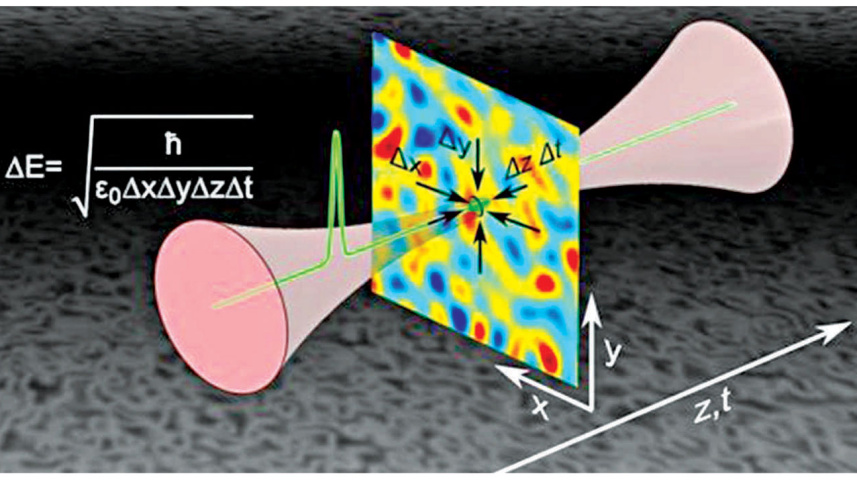
What are the properties of the vacuum, the absolute nothingness? So far, physicists have assumed that it is impossible to directly access the characteristics of the ground state of empty space. Now, a team of physicists led by Prof. Alfred Leitenstorfer at the University of Konstanz (Germany) has succeeded in doing just that. They demonstrated a first direct observation of the so-called vacuum fluctuations by using short light pulses while employing highly precise optical measurement techniques. The duration of their light pulses was ensured to be shorter than half a cycle of light in the spectral range investigated. According to quantum physics, these oscillations exist even in total darkness, when the intensity of light and radio waves completely disappears.

The existence of vacuum fluctuations is already known from theory as it follows from Heisenberg's uncertainty principle, one of the main pillars of quantum physics. This principle dictates that electric and magnetic fields can never vanish simultaneously. As a consequence, even total darkness is filled with finite fluctuations of the electromagnetic field, representing the quantum ground state of light and radio waves. However, until now direct experimental proof of this basic phenomenon has been considered impossible. Instead, it is usually assumed that vacuum fluctuations are manifested in nature only indirectly. From spontaneous emission of light by excited atoms e.g. in a fluorescent tube to influences on the structure of the universe during the Big Bang: these are just some of the instances that highlight the ubiquitous role the concept of vacuum fluctuations plays in the modern physical description of the world.

Approach to making a mini-brain
If you need a working miniature brain – say for drug testing, to test neural tissue transplants, or to experiment with how stem cells work – a new paper describes how to build one with what the Brown University authors say is relative ease and low expense. The little balls of brain aren't performing any cogitation, but they produce electrical signals and form their own neural connections – synapses – making them readily producible testbeds for neuroscience research, the authors said.
"We think of this as a way to have a better in vitro [lab] model that can maybe reduce animal use," said graduate student Molly Boutin, co-lead author of the new paper in the journal Tissue Engineering: Part C. "A lot of the work that's done right now is in two-dimensional culture, but this is an alternative that is much more relevant to the in vivo [living] scenario."
Just a small sample of living tissue from a single rodent can make thousands of mini-brains, the researchers said. The recipe involves isolating and concentrating the desired cells with some centrifuge steps and using that refined sample to seed the cell culture in medium in an agarose spherical mold.
Source: Sciencedaily.com
 For all latest news, follow The Daily Star's Google News channel.
Comments