


QUIRKY SCIENCE
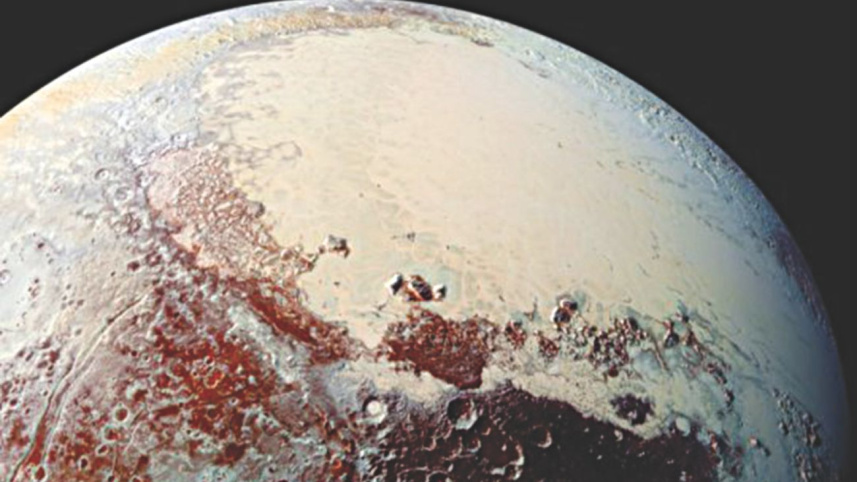
Three Months After Flyby
The New Horizons team described a wide range of findings about the Pluto system in its first research paper, published today. "The Pluto System: Initial Results from its Exploration by New Horizons" appears in and on the cover of the Oct. 16 issue of the journal Science; the publication comes just three months after NASA's historic first exploration of the Pluto system in mid-July.

The authors include more than 150 New Horizons project and NASA personnel; Principal Investigator Alan Stern of Southwest Research Institute (SwRI) is first author.
From the variety in Pluto's geological landforms, to Pluto's atmosphere, to its intriguing moons, New Horizons has revealed a degree of diversity and complexity on Pluto and its moons that few expected in the frigid outer reaches of the solar system.
"The New Horizons mission completes our initial reconnaissance of the solar system, giving humanity our first look at this fascinating world and its system of moons," said Jim Green, director of planetary science at NASA Headquarters in Washington. "New Horizons is not only writing the textbook on the Pluto system, it's serving to inspire current and future generations to keep exploring – to keep searching for what's beyond the next hill."
Crystal Captures Carbon
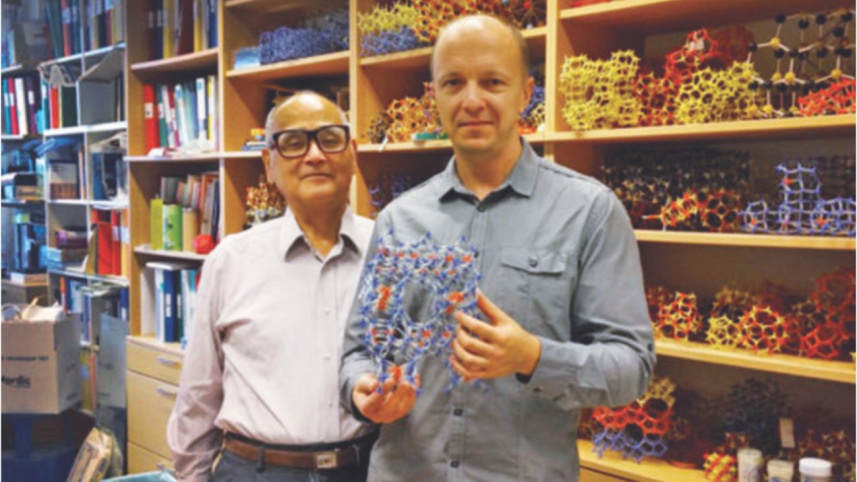
A new material with micropores might be a way to fight climate change. Scientists have created crystals that capture carbon dioxide much more efficiently than previously known materials, even in the presence of water. The research was recently published in a report in the scientific journal Science.
One way to mitigate climate change could be to capture carbon dioxide (CO2) from the air. So far this has been difficult, since the presence of water prevents the adsorption of CO2. Complete dehydration is a costly process. Scientists have now created a stable and recyclable material, where the micropores within the crystal have different adsorption sites for carbon dioxide and water.
"As far as I know this is the first material that captures CO2 in an efficient way in the presence of humidity. In other cases there is competition between water and carbon dioxide and water usually wins. This material adsorbs both, but the CO2 uptake is enormous," says Osamu Terasaki, Professor at the Department of Materials and Environmental Chemistry at Stockholm University.
The new material is called SGU-29, named after Sogang University in Korea, and is the result of international cooperation. It is a copper silicate crystal. The material could be used for capturing carbon dioxide from the atmosphere, and especially to clean emissions.
 For all latest news, follow The Daily Star's Google News channel.
Comments