


Quirky Science

A warmer world will be a hazier one
Aerosols, tiny solid and liquid particles suspended in the atmosphere, impact the environment by affecting air quality and alter the Earth's radioactive balance by either scattering or absorbing sunlight to varying degrees. What impact does climate change, induced by greenhouse gases (GHGs), have on the aerosol "burden" – the total mass of aerosols in a vertical column of air?

Past research done on climate models has found inconsistent results: Depending on the model, climate change was associated with an increase or decrease in aerosol burden. But a new study using the newest and state-of-the-art computer models, published today in Nature Climate Change, shows that under climate change associated with GHG-induced warming most aerosol species will register a robust increase, with implications for future air quality.
"Our work on the models shows that nearly all aerosol species will increase under GHG-induced climate change," said climatologist Robert J. Allen, an assistant professor in the Department of Earth Sciences at the University of California, Riverside and the lead author of the research paper. "This includes natural aerosols, like dust and sea salt, and also anthropogenic aerosols, like sulphate, black carbon and primary organic matter. Stricter reductions in aerosol emissions will be necessary for attaining a desired level of air quality through the 21st century."
Allen explained that an increase in GHGs will not only warm the planet, but also affect climate in many different ways. For example, GHGs will lead to changes in the hydrological cycle and large-scale atmospheric circulation. These changes, in turn, will affect air quality and the distribution of aerosols--irrespective of changes in aerosol emissions.
Complex skeletons
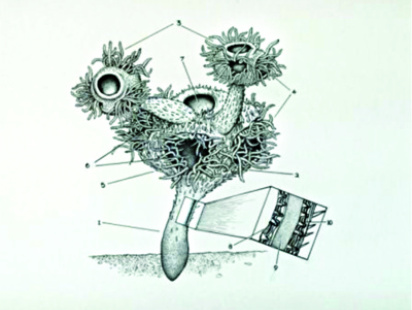
The first animals to have complex skeletons existed about 550 million years ago, fossils of a tiny marine creature unearthed in Namibia suggest.
The find is the first to suggest the earliest complex animals on Earth – which may be related to many of today's animal species – lived millions of years earlier than was previously known.
Until now, the oldest evidence of complex animals – which succeeded more primitive creatures that often resembled sponges or coral – came from the Cambrian Period, which began around 541 million years ago. Scientists had long suspected that complex animals had existed before then but, until now, they had no proof.
Genetic family tree data suggested that complex animals – known as bilaterians – evolved prior to the Cambrian Period. The finding suggests that bilaterians may have lived as early as 550 million years ago, during the late Ediacaran Period.
The study suggests that complex animals existed long before a period in the planet's history – known as the Cambrian explosion – during which most major animal groups evolved.
The team studied fossils of an extinct marine animal – known as Namacalathus hermanastes – which was widespread during the Ediacaran Period. The fossils are remarkably well preserved and reveal that the species possessed a rigid skeleton made of calcium carbonate – a hard material from which the shells of marine animals are made. The complex skeletal structures are similar to those of living creatures that dwell at the bottom of the sea, the team says.
Source: Sciencedaily.com
 For all latest news, follow The Daily Star's Google News channel.
Comments