


Quirky Science
PLANET IN MAKING
There are 450 light-years between Earth and LkCa15, a young star with a transition disk around it, a cosmic whirling dervish, a birthplace for planets.
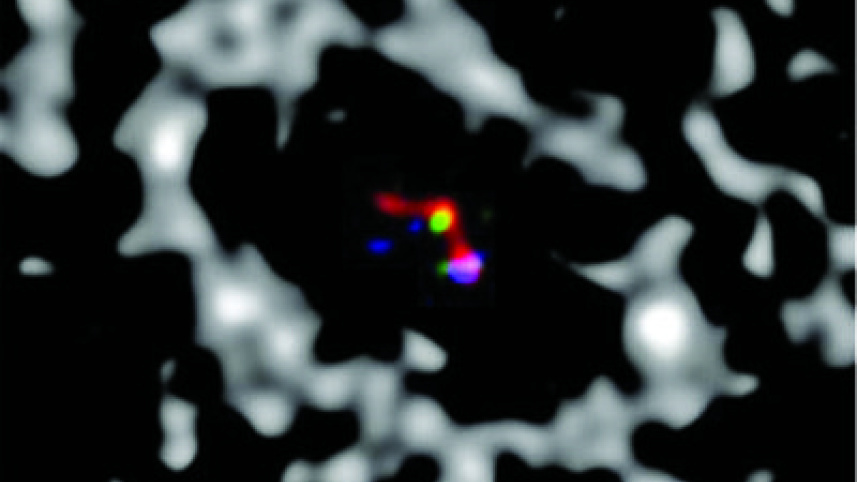
Despite the disk's considerable distance from Earth and its gaseous, dusty atmosphere, University of Arizona researchers captured the first photo of a planet in the making, a planet residing in a gap in LkCa15's disk.
Of the roughly 2,000 known exoplanets – planets that orbit a star other than our sun – only about 10 have been imaged, and that was long after they had formed, not when they were in the making.
"This is the first time that we've imaged a planet that we can say is still forming," says Steph Sallum, a UA graduate student, who with Kate Follette, a former UA graduate student now doing postdoctoral work at Stanford University, led the research.
The researchers' results were published in the Nov. 19 issue of Nature.
Only months ago, Sallum and Follette were working independently, each on her own Ph.D. project. But serendipitously they had set their sights on the same star. Both were observing LkCa15, which is surrounded by a special kind of protoplanetary disk that contains an inner clearing, or gap.
Protoplanetary disks form around young stars using the debris left over from the star's formation. It is suspected that planets then form inside the disk, sweeping up dust and debris as the material falls onto the planets instead of staying in the disk or falling onto the star. A gap is then cleared in which planets can reside.

OUR CLOSEST WORM COUSIN
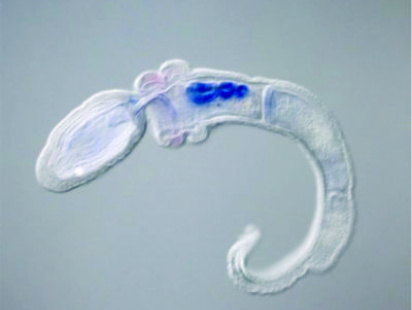
A team from the Okinawa Institute of Science and Technology Graduate University (OIST) and its collaborators has sequenced the genomes of two species of small water creatures called acorn worms and showed that we share more genes with them than we do with many other animals, establishing them as our distant cousins.
The study found that 8,600 families of genes are shared across deuterostomes, a large animal grouping that includes a variety of organisms, ranging from acorn worms to star fishes, from frogs to dogs, to humans. This means that approximately 70% of our genes trace their ancestry back to the original deuterostome. By comparing the genomes of acorn worms to other animals, OIST scientists inferred the presence of these genes in the common ancestor of all deuterostomes, an extinct animal that lived half a billion years ago. This research shows that the pharyngeal gene cluster is unique to the deuterostomes and it could be linked to the development of the pharynx, the region that links the mouth and nose to the esophagus in humans. These findings were published in Nature, summarizing an international collaboration between OIST researchers and teams from the US, UK, Japan, Taiwan and Canada.
Around 550 million years ago, a great variety of animals burst onto the world in an event known as the Cambrian explosion. This evolutionary radiation revealed several new animal body plans, and changed life on Earth forever, as complex animals with specialised guts and behavioural features emerged. Thanks to the genome sequencing of multiple contemporary animals of the deuterostome group, we can go back in time to unveil aspects of the long-lost ancestor of this diverse group of animals.
Source: Sciencedaily.com
 For all latest news, follow The Daily Star's Google News channel.
Comments