


QUIRKY SCIENCE
MARS TO LOSE ITS LARGEST MOON
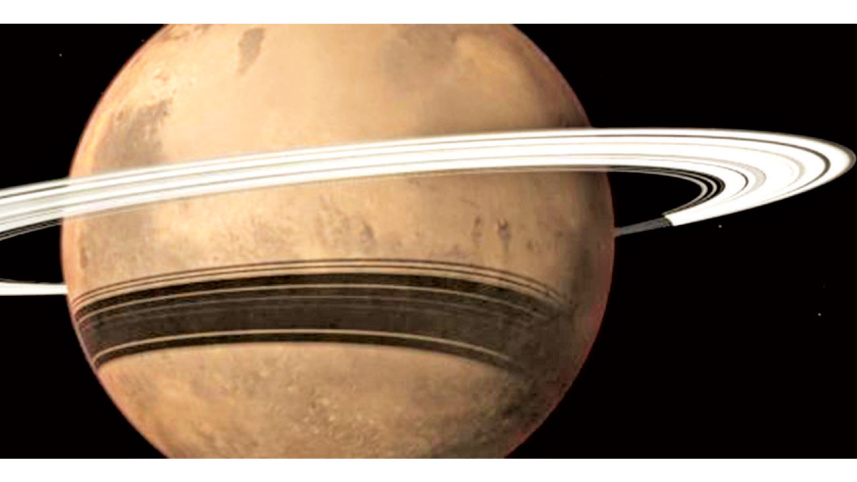
Mars' largest moon, Phobos, is slowly falling toward the planet, but rather than smash into the surface, it likely will be shredded and the pieces strewn about the planet in a ring like the rings encircling Saturn, Jupiter, Uranus and Neptune.

Though inevitable, the demise of Phobos is not imminent. It will probably happen in 20 to 40 million years, leaving a ring that will persist for anywhere from one million to 100 million years, according to two young earth scientists at the University of California, Berkeley.
In a paper appearing online this week in Nature Geoscience, UC Berkeley postdoctoral fellow Benjamin Black and graduate student Tushar Mittal estimate the cohesiveness of Phobos and conclude that it is insufficient to resist the tidal forces that will pull it apart when it gets closer to Mars.
Just as earth's moon pulls on our planet in different directions, raising tides in the oceans, for example, so too Mars tugs differently on different parts of Phobos. As Phobos gets closer to the planet, the tugs are enough to actually pull the moon apart, the scientists say. This is because Phobos is highly fractured, with lots of pores and rubble. Dismembering it is analogous to pulling apart a granola bar, Black said, scattering crumbs and chunks everywhere.
FARMING CHANGED THE HUMAN GENOME
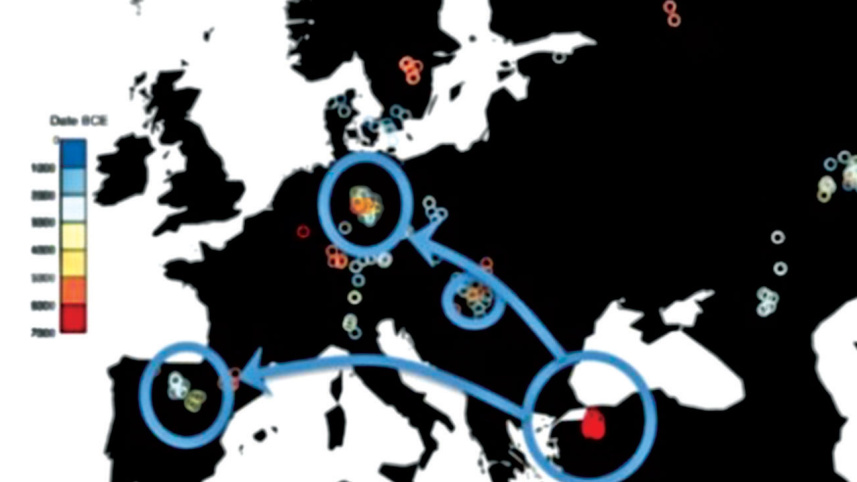
The introduction of agriculture into Europe about 8,500 years ago changed the way people lived right down to their DNA.
Until recently, scientists could try to understand the way humans adapted genetically to changes that occurred thousands of years ago only by looking at DNA variation in today's populations. But our modern genomes contain mere echoes of the past that can't be connected to specific events.
Now, an international team reports in Nature that researchers can see how natural selection happened by analyzing ancient human DNA.
"It allows us to put a time and date on selection and to directly associate selection with specific environmental changes, in this case the development of agriculture and the expansion of the first farmers into Europe," said Iain Mathieson, a research fellow in genetics at Harvard Medical School and first author of the study.
By taking advantage of better DNA extraction techniques and amassing what is to date the largest collection of genome-wide datasets from ancient human remains, the team was able to identify specific genes that changed during and after the transition from hunting and gathering to farming.
Many of the variants occurred on or near genes that have been associated with height, the ability to digest lactose in adulthood, fatty acid metabolism, vitamin D levels, light skin pigmentation and blue eye color. Two variants appear on genes that have been linked to higher risk of celiac disease but that may have been important in adapting to an early agricultural diet.
Source: Sciencedaily.com
 For all latest news, follow The Daily Star's Google News channel.
Comments