


Where have all women of July gone?

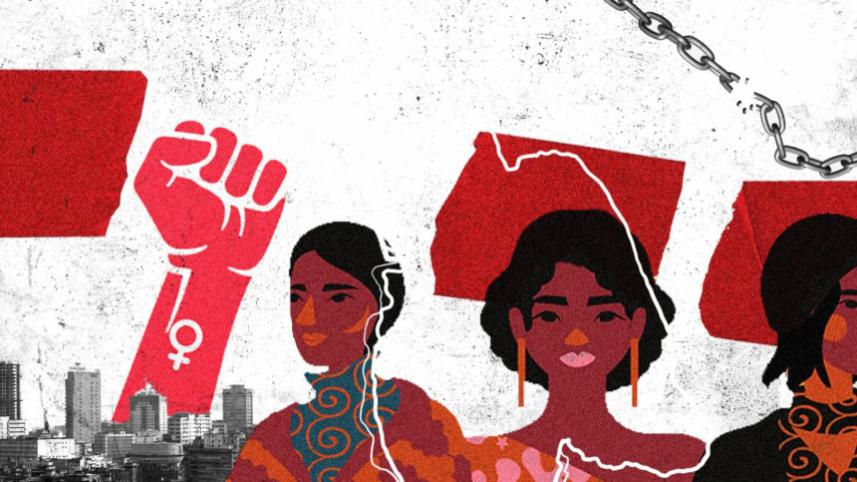
During the July uprising, women were among the most visible and effective forces on Bangladesh’s streets.
Their participation grew rapidly after female students broke open the gates of Ruqayyah Hall on July 14, 2024, says Shireen Pervin Huq, who later headed the Women’s Reform Commission formed by the interim government.

Nusrat Tabassum, a reserved seat NCP MP, also recalls women acting as “shields” during police attacks at Dhaka University, being on the frontlines protecting fellow protesters.
Women soon became a prominent presence across university campuses. They led slogans, blocked prison vans, rescued the injured, provided medical care, and arranged food.
Nafsin Mehanaz Azireen, a former coordinator for private universities, said women’s participation also encouraged families to join, giving the movement wider social acceptance.
Women were not merely participants; in many cases, they helped make decisions and shape the movement’s course.
But after the fall of the regime, that visibility rapidly faded from the country’s political and state structures.
So, where did the women of July go?
Female leaders and activists point to structural, political, and social barriers that continue to keep women away from positions of power.
When the interim government formed six reform commissions in September 2024 and five more in December, women remained grossly underrepresented.
Excluding the Women’s Reform Commission, which had 10 members with Shireen as its head, the other 10 commissions had 97 members, of whom only 15 were women -- and none led a commission.
Shireen said women were marginalised from the outset. Her commission was excluded from the initial batch and later faced resistance from the Constitution Reform Commission and the Consensus Commission.
“On the day we submitted our report, many in the advisory council were excited. But days later, a faction held a rally, professed to annul our report, and hurled abuses at us. The entire advisory council remained silent,” she said.
Political parties have also failed to turn commitments into meaningful representation.
Under the July Charter, parties were expected to nominate women for at least 5 percent of the 300 parliamentary seats in the national election. None complied.
Umama Fatema, former spokesperson of the Students Against Discrimination, said capable women are too often confined to reserved seats rather than encouraged to contest directly.
She believes politics remains a struggle for control, requiring networks, money, and political backing that most women lack.
Economic and structural inequalities further restrict women’s political participation.
Nusrat said many women lack financial autonomy despite earning an income, while institutional biases also create long-term hurdles.
She pointed to Dhaka University’s provision of far fewer residential halls for women as one example of how unequal access to resources can affect women’s participation.
 For all latest news, follow The Daily Star's Google News channel.
 Online abuse poses another barrier.
A Daily Star analysis of 139 posts targeting 15 prominent women from the July movement found that 63 percent contained sexually suggestive slurs, derogatory language or character assassination, alongside widespread body-shaming.
“When there is a disagreement with a male politician, it is countered through logic. For women, it quickly turns into attacks on clothing, personal life, and family,” Nafsin Azireen said.
The activists say quotas alone will not solve the problem.
Umama proposed amending the Representation of the People Order, 1972 to make female candidacy mandatory, with penalties for non-compliance, alongside direct voting for reserved seats.
Nusrat Tabassum called for a safe political environment, equal opportunities and a change in social attitudes.
For Nafsin, the deeper question is whether society sees women only as crisis-time assets or as equal partners in state-building.
“Female leadership cannot depend solely on individual courage; it is the responsibility of the state and society to ensure it.”
Shireen said her commission has prioritised 51 actionable recommendations from its 420 proposals for discussion with the elected government.
“The courage, leadership and organisation women displayed during July have secured them a place in Bangladesh’s history,” she said.
“But if that strength is not integrated into state structures, a major lesson of this uprising will remain unfulfilled,” she concluded.
Comments