


How Sheikh Hasina's iron grip unravelled

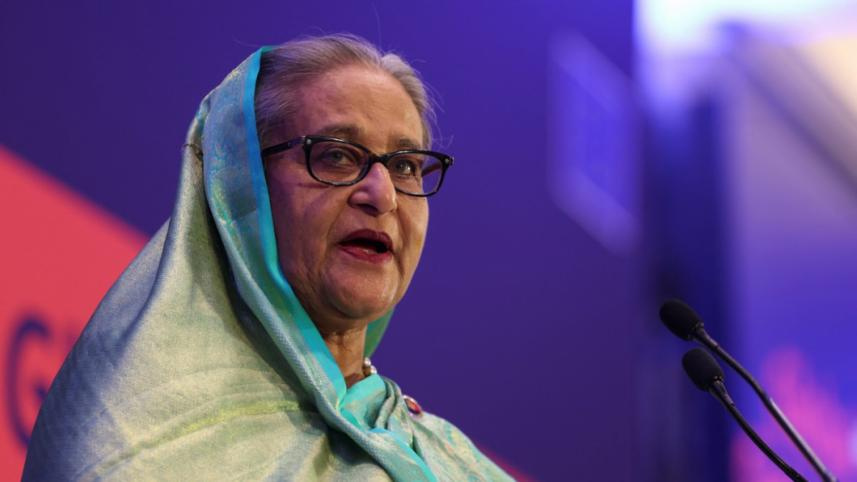
After returning to power in a landslide victory in 2009, she won three consecutive terms, becoming Bangladesh's longest-serving prime minister. To her supporters, she was the architect of economic growth, political stability and ambitious infrastructure development. Her critics, however, argued that she had steadily dismantled the democratic institutions that once limited executive power.
By the beginning of 2024, few imagined that Hasina could be seriously challenged, let alone be removed by a movement led largely by university students.

Yet, on the afternoon of August 5, 2024, that is exactly what happened.
As hundreds of thousands of protesters flooded the streets, Hasina fled the country, bringing an end to a political era that had increasingly become authoritarian, with an iron grip on the levers of state power. The student-led uprising did more than remove a government. It exposed how years of democratic erosion had gradually weakened the government's moral legitimacy.
The collapse had been building for years, beginning with the engineering of elections -- the very mechanism through which democratic governments are expected to gain and renew their legitimacy.
The January 5, 2014 parliamentary election fundamentally changed Bangladesh's political trajectory. The BNP and most opposition parties boycotted the polls, insisting on a neutral caretaker government to oversee the election. The caretaker system itself had been abolished in 2011 after the Awami League used its two-thirds parliamentary majority to amend the constitution.
The consequences were unprecedented. Awami League candidates won 153 of the 300 parliamentary seats uncontested, before a single vote was cast. In effect, the party had secured victory without going to the ballot boxes. This undermined the basic democratic principle that political power should be determined through genuine public contest.
Although the BNP decided to participate in the 2018 election, the playing field was widely seen as uneven. Opposition leaders and activists reported widespread arrests and intimidation, while the Election Commission faced criticism over alleged favouritism.
The election was overshadowed by allegations that ballot boxes had been stuffed on the eve of polling day, one of the defining controversies of the vote. Once again, it appeared that Hasina had secured victory before the election itself.
By the time the 2024 general election approached, the opposition again stayed away, arguing that a meaningful electoral contest was impossible. But elections were only one part of a broader transformation.
Over the years, Sheikh Hasina steadily centralised political and executive authority. She stood at the centre of decision-making, with power becoming concentrated in her office in what many viewed as a personalised autocracy.
Major policy decisions -- from landmark infrastructure projects such as the Padma Bridge and Dhaka Metro Rail to administrative appointments and economic planning -- were widely perceived to depend on the prime minister's personal approval. Cabinet ministers, lawmakers and even senior bureaucrats often appeared to exercise limited authority. Former civil servants became more prominent in influential positions traditionally held by politicians, reinforcing executive control over the state.
At the same time, institutions designed to provide checks and balances appeared to weaken as many constitutional bodies gradually became extensions of executive authority.
Parliament ceased to function as a forum for debate and accountability. The Election Commission faced persistent questions over its independence. Civil society organisations spoke of a shrinking democratic space, while journalists, activists and opposition figures reported mounting restrictions on freedom of expression.
Political repression further deepened public frustration.
Allegations of enforced disappearances, extrajudicial killings and politically motivated criminal cases became recurring features of Bangladesh's political landscape. Human rights organisations repeatedly documented cases involving opposition activists, while critics accused the government of using law enforcement agencies and the judiciary to suppress dissent.
Former prime minister and BNP chairperson Khaleda Zia was confined to her residence under heavy police restrictions and imprisoned in corruption cases that her supporters described as politically motivated. Whether viewed as legitimate legal proceedings or political prosecution, the cases reinforced the perception that opposition and dissent were being systematically suppressed.
The government's economic record, however, told a different story.
Bangladesh recorded impressive growth, expanded exports, built landmark infrastructure and transformed its transport network. The Padma Bridge, Dhaka Metro Rail, elevated expressways and numerous development projects became symbols of a rapidly modernising country.
Yet many argued that infrastructure received far greater attention than education and healthcare. They pointed to the politicisation of educational institutions, appointments based on political allegiance, the influence of student wings on university campuses and recurring questions over transparency in public-sector recruitment.
Economic achievements alone could not fully offset growing concerns about governance.
Large infrastructure projects were frequently accompanied by allegations of grand corruption. Critics argued that politically connected business groups benefited disproportionately from state patronage, while reports of capital flight and illicit financial outflows strengthened claims that the benefits of economic growth were unevenly shared.
For many ordinary citizens, particularly young people, rising living costs, unemployment and limited opportunities overshadowed impressive macroeconomic indicators.
Many educated graduates came to feel excluded from the country's economic progress. Employment failed to keep pace with growing expectations. Against this backdrop, the reinstatement of quotas in government recruitment became, for many students, a symbol of favouritism and the erosion of meritocracy.
Sheikh Hasina's government placed growing emphasis on the legacy of her father, Bangabandhu Sheikh Mujibur Rahman, presenting him as the singular architect of the Language Movement and the Liberation War. Critics argued that this narrative overlooked the contributions of many others and, over time, alienated not only sections of the younger generation but also some long-time admirers of Bangabandhu.
 For all latest news, follow The Daily Star's Google News channel.
 With each disputed election, every weakened institution, every allegation of extrajudicial killing, every enforced disappearance, every act of repression, every abuse of power and every narrowing of democratic space, Hasina's government lost its moral right to govern.
Little by little, the Awami League government weakened the institutions of the state. In doing so, it also gradually lost the legitimacy to govern, illustrating once again that no government remains in power indefinitely.
Comments